Ebook Info
- Published: 2017
- Number of pages: 336 pages
- Format: PDF
- File Size: 5.19 MB
- Authors: Dennis C. Rasmussen
Description
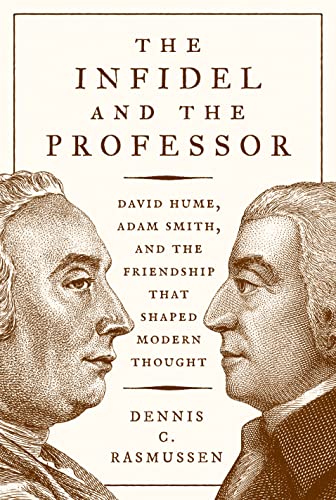
The story of the greatest of all philosophical friendships―and how it influenced modern thoughtDavid Hume is widely regarded as the most important philosopher ever to write in English, but during his lifetime he was attacked as “the Great Infidel” for his skeptical religious views and deemed unfit to teach the young. In contrast, Adam Smith was a revered professor of moral philosophy, and is now often hailed as the founding father of capitalism. Remarkably, the two were best friends for most of their adult lives, sharing what Dennis Rasmussen calls the greatest of all philosophical friendships. The Infidel and the Professor is the first book to tell the fascinating story of the friendship of these towering Enlightenment thinkers―and how it influenced their world-changing ideas.The book follows Hume and Smith’s relationship from their first meeting in 1749 until Hume’s death in 1776. It describes how they commented on each other’s writings, supported each other’s careers and literary ambitions, and advised each other on personal matters, most notably after Hume’s quarrel with Jean-Jacques Rousseau. Members of a vibrant intellectual scene in Enlightenment Scotland, Hume and Smith made many of the same friends (and enemies), joined the same clubs, and were interested in many of the same subjects well beyond philosophy and economics―from psychology and history to politics and Britain’s conflict with the American colonies. The book reveals that Smith’s private religious views were considerably closer to Hume’s public ones than is usually believed. It also shows that Hume contributed more to economics―and Smith contributed more to philosophy―than is generally recognized.Vividly written, The Infidel and the Professor is a compelling account of a great friendship that had great consequences for modern thought.
User’s Reviews
Editorial Reviews: Review “One of The Australian Review’s 2017 Books of the Year””One of The Guardian’s Best Books of 2017″”Selected for Bloomberg View’s “Must-Reads of 2017: From Space to Chinese Noir”””One of Project Syndicate’s Best Reads in 2017 (chosen by Kaushik Basu)””Shortlisted for the 2018 Ralph Waldo Emerson Award, Phi Beta Kappa Society””A wonderfully written book about a beautiful friendship.”—Tyler Cowen, Bloomberg View”Dennis Rasmussen . . . tells the story of Smith and Hume’s bond, arguing convincingly and engagingly that there is ‘no higher example of a philosophical friendship in the entire Western tradition.’”—Ruth Scurr, Wall Street Journal”Rasmussen tells an engaging and sometimes moving story of how the friendship between Smith and David Hume shaped, and was shaped by, their attempt to comprehend the rapid development of the social and political order under which we still live.”—Alexander Douglas, Times Literary Supplement”Lively and accessible–of broad interest to readers in philosophy, economics, political science, and other disciplines.” ― Kirkus”Masterly. . . . Easy to digest and smart. Recommended.”—Mark Spencer, Library Journal”In The Infidel and the Professor: David Hume, Adam Smith, and the Friendship that Shaped Modern Thought, Dennis Rasmussen . . . tells the story of their friendship well. Fourteen nicely-judged chapters take the reader through the overlapping lives of the two men, including such incidents as Hume’s notorious falling-out with Rousseau, through to the natural climax of their friendship at Hume’s death, and Smith’s own demise 14 years later. . . . A short and lively book that sustains the interest not merely of the general reader but the specialist to the end. That is a considerable achievement.”—Jesse Norman, Prospect”[Rasmussen] deftly examines not only Hume and Smith’s personal relationship, but also the indispensable part that they played in shaping the Scottish Enlightenment. The result is a valuable study of the rise of the liberal tradition.”—Jacob Heilbrunn, National Interest”The Infidel and the Professor is a lean, easy to digest read that is rich in interesting detail. It is anchored in weighty scholarship but not burdened by excessive demonstrations of it. . . . [Rasmussen] makes the distinctive qualities of each more evident. Pick up his book and you might find yourself agreeing with Hume that ‘reading and sauntering and lownging and dozing, which I call thinking, is my supreme Happiness’.”—Julian Baggini, Literary Review”What his book does offer . . . is a clearer, more exhaustive picture of the common ground that existed between the two thinkers, a map of the intersections, echoes and mirroring perspectives that connect their works. The Infidel and the Professor is written in a style that makes it accessible to non-specialists, who can discover through it the story of two exceptional and very engaging personalities. But it is also of interest for those who are already familiar with Hume’s and Smith’s lives and works, as it allows us to see them as part of a collective intellectual project. Above all, it reminds us of what the social sciences were originally meant to be: a broad critical reflection on the condition of human beings exposed to the bewildering transformations that modernity brought to their lives.”—Biancamaria Fontana, Times Higher Education”As a total Hume fan, I enjoyed reading it, and it’s a well-written book. You don’t need to be an expert on either [Hume or Smith] to enjoy it, and get some flavour of the milieu of the Scottish Enlightenment.”—Diane Coyle, Enlightened Economist”In addition to painting a vivid portrait of the intellectual life of 18th-century Scotland, Professor Rasmussen provides a road map of the development of Smith’s ideas based on his personal history and the broader political, social, theological and academic environments. [His] greatest contribution, however, is to shed new light on the surprising depth and nature of the intellectual and personal influence of the radical skeptic philosopher David Hume on Smith. Touching and illuminating.”—Jonathan A. Knee, New York Times”The best authoritative scholarly book on David Hume and Adam Smith published in the last 5 years. It is destined to be the classic book of those times.”—Gavin Kennedy, Adam Smith’s Lost Legacy”The Infidel and the Professor shone a deserved spotlight on David Hume and Adam Smith.”—Julian Baggini, The Guardian”This is a well-written and well-researched history. It rewards a careful reading. . . . I recommend this book highly.”—John Mullen, Metapsychology”The Infidel and the Professor, [Rasmussen’s] account of a ‘friendship that changed modern thought’, is a charming work. Our politicians would benefit from reading it and so, frankly, would you.”—Alex Massie, The Times”Rasmussen has written an excellent book which offers a clear account of the ideas of Smith and Hume, and celebrates the importance of philosophical friendship.”—Robin Downie, Philosophy”Wonderful. . . . [This] book should prove to be an indispensable starting point for future inquiries into Hume and Smith’s personal and philosophical relationship.”—Erik W. Matson, Review of Austrian Economics”Rasmussen’s story about this strong and stable friendship will be engaging for those who are unfamiliar with Hume’s entertaining letters or Smith’s personal quirks, and it is a valuable contribution for scholars working on the philosophical views of each.”—Lauren Kopajtic, Journal of the History of Philosophy”A sympathetic account of the closeness of two of the world’s greatest thinkers and the warmth of the affection that he evokes is a fine testament to their friendship and his writing.”—Craig Smith, Perspectives on Politics”Rasmussen is at his interpretive best here, and his reading of how these events affected the friendship between Hume and Smith is both novel and persuasive.”—John Rick, Reading Religion”[N]ot a few times did I mark in the margins a thread of inquiry I should like to pull on in the future, using The Infidel and the Professoras a starting point. I do not doubt but it will be likewise stimulating for you.”—Edward Austin Middleton, EH.net”This original, elegantly written, compelling essay, which combines textual analysis with a contextual approach, is likely to have a momentous impact on the historiography of the Scottish Enlightenment and of the Age of Enlightenment as a whole.”—Diego Lucci, Journal of Ecclesiastical History”Compelling . . . gripping.”—James R. Otteson, History of Political Economy”Rasmussen’s beautifully written book is the kind of work that any serious David Hume and Adam Smith scholars might have once or twice dreamed of writing.”—Tatsuya Sakamoto, Journal of the History of Economic Thought”An excellent introduction for those coming to Hume and Smith for the first time.”—Ralph McLean, Journal of the Edinburgh Bibliograpical Society”Rasmussen succeeds not only in uncovering the uniquely intimate friendship between Hume and Smith among the group of like-minded literati who produced the Scottish Enlightenment, but a kind of inter-generational ‘passing of the baton’ from Hume (eleven years older) to his younger colleague.”—Patrick Madigan, Heythrop Journal”Admirable. . . . Rasmussen’s book is to be highly recommended for the legion of readers of Hume . . . and Smith.”—Peter Loptson, European Legacy Review “This engagingly written book tells the story of a remarkable friendship between two giants of eighteenth-century thought and heroes of the Scottish Enlightenment. Rasmussen is a historically and philosophically astute guide to the lives and ideas of Hume and Smith―as well as those of a large cast of supporting characters. His highly readable narrative offers great insights into an influential intellectual and social world.”―Steven Nadler, author of A Book Forged in Hell: Spinoza’s Scandalous Treatise and the Birth of the Secular Age”After Hobbes, David Hume and Adam Smith are the two most important philosophers and social scientists in the English-speaking world. This cleverly constructed, learned yet eminently readable account uses their friendship to illuminate the ways in which their ideas converged and diverged. An appealing introduction for the novice, with plenty of added value for the well versed.”―Jerry Z. Muller, author of Adam Smith in His Time and Ours: Designing the Decent Society”In this impressive account of the close relationship between the two giants of the Scottish Enlightenment, Dennis Rasmussen brings out the full significance of the warm lifelong friendship and intellectual dialogue between David Hume and Adam Smith.”―Leo Damrosch, author of Jean-Jacques Rousseau: Restless Genius”A remarkable combination of page-turner and serious intellectual history, The Infidel and the Professor is enormously enlightening and impossible to put down.”―William Easterly, author of The Elusive Quest for Growth”Adam Smith and David Hume were two of the world’s greatest thinkers. The joy of their friendship infuses every page of this marvelous book, which will make you love them both, as thinkers and people. If only one could have been at one of Hume’s dinner parties!”―Angus Deaton, Nobel Prize-winning economist”The Infidel and the Professor is the first book on the fascinating subject of the friendship between David Hume and Adam Smith. Masterfully weaving together the historical evidence, Dennis Rasmussen does justice to both the ideas of these two men and their larger social and intellectual context. The resulting account is erudite, absorbing, witty, and smoothly narrated.”―Andrew Sabl, author of Hume’s Politics”This account of the friendship between two of the most important and famous thinkers of the eighteenth century―David Hume and Adam Smith―also provides an accessible introduction to their thought and writings.”―John T. Scott, coauthor of The Philosophers’ Quarrel From the Back Cover “This engagingly written book tells the story of a remarkable friendship between two giants of eighteenth-century thought and heroes of the Scottish Enlightenment. Rasmussen is a historically and philosophically astute guide to the lives and ideas of Hume and Smith–as well as those of a large cast of supporting characters. His highly readable narrative offers great insights into an influential intellectual and social world.”–Steven Nadler, author of A Book Forged in Hell: Spinoza’s Scandalous Treatise and the Birth of the Secular Age”After Hobbes, David Hume and Adam Smith are the two most important philosophers and social scientists in the English-speaking world. This cleverly constructed, learned yet eminently readable account uses their friendship to illuminate the ways in which their ideas converged and diverged. An appealing introduction for the novice, with plenty of added value for the well versed.”–Jerry Z. Muller, author of Adam Smith in His Time and Ours: Designing the Decent Society”In this impressive account of the close relationship between the two giants of the Scottish Enlightenment, Dennis Rasmussen brings out the full significance of the warm lifelong friendship and intellectual dialogue between David Hume and Adam Smith.”–Leo Damrosch, author of Jean-Jacques Rousseau: Restless Genius”A remarkable combination of page-turner and serious intellectual history, The Infidel and the Professor is enormously enlightening and impossible to put down.”–William Easterly, author of The Elusive Quest for Growth”Adam Smith and David Hume were two of the world’s greatest thinkers. The joy of their friendship infuses every page of this marvelous book, which will make you love them both, as thinkers and people. If only one could have been at one of Hume’s dinner parties!”–Angus Deaton, Nobel Prize-winning economist”The Infidel and the Professor is the first book on the fascinating subject of the friendship between David Hume and Adam Smith. Masterfully weaving together the historical evidence, Dennis Rasmussen does justice to both the ideas of these two men and their larger social and intellectual context. The resulting account is erudite, absorbing, witty, and smoothly narrated.”–Andrew Sabl, author of Hume’s Politics”This account of the friendship between two of the most important and famous thinkers of the eighteenth century–David Hume and Adam Smith–also provides an accessible introduction to their thought and writings.”–John T. Scott, coauthor of The Philosophers’ Quarrel About the Author Dennis C. Rasmussen is associate professor of political science at Tufts University. His books include The Pragmatic Enlightenment. He lives in Charlestown, Massachusetts. Read more
Reviews from Amazon users which were colected at the time this book was published on the website:
⭐David Hume and Adam Smith seem like a couple of decent guys. It would be interesting to talk with them, both for the profoundness of their ideas and for their easy-going personalities. Ben Franklin was part of their intellectual set, as was Edmund Burke and Samuel Johnson, although Johnson was not fond of Hume. That was rare. Evidently almost everybody liked Hume, even if a majority disliked many of his iconoclastic ideas.Hume was not an atheist. He called himself a skeptic, just not concerned with metaphysics, since he said that there is nothing in this world from which we can infer anything beyond. When faced with the argument for God that the world was made with such perfection, he pointed out the that given the nature of how things work on this earth, one would question the perfection of the workmanship. It is not hard to see why this made his ideas unpopular with the devout.The book I just finished, “The Infidel and the Professor,” is chocked full of interesting observations and funny stories that illustrate the lives and friendship of Smith and Hume. Adam Smith today is the better known of the pair, but this was the opposite during their lifetimes. Their ideas overlap. Since, Hume was twelve years older than Smith, was an earlier established author and that they were clearly in regular contact, we might postulate that Smith copied from Hume. But we also find some ideas first in Smith. When we think about their intellectual society, however, we may conclude that many of the ideas were widely discussed and that maybe each refined his ideas in that sort of community of knowledge. You recognize similar ideas in Franklin and Burke. Is it really possible for any individual to originate an idea?From our modern vantage point, it is hard for us to appreciate that what Hume & Smith were advocating was iconoclastic. Good to recall the general truth that all the great thinkers we respect today were breaking with the traditions and people around them. That is why we remember them. What Smith and Hume were saying was not intuitive to people back then.Smith and Hume postulated that it was the capacity of people to create wealth was the true wealth of a country, not the gold and silver that governments could hoard. Beyond that, they said that it is good to have prosperous and rich neighbors and that everybody gets better off from exchange. This opposed common wisdom of the time, that held that people and individuals got rich by taking from others.Another idea odd for the time is what we would today call the principle of emergence, that a balanced system (or economy) could emerge from the decisions of many people w/o formal coordination or planning from somebody above. This extended into metaphysical belief systems, hence Hume’s infidel problem, but it also impacted morality.Both Hume and Smith though commerce could be a positive good. Again, this is something most of us accept today, but the idea was anathema for most of human history. Religion and philosophy tended to disparage and even condemn commerce. Certainly, the higher life involved more selfless pursuits, according to previous religion and philosophy (except maybe Epicurus). Hume said outright that the values of monks and religious asceticism, things like mortification of the flesh, were wasteful and negative. There was nothing intrinsically noble about poverty. You might have to endure it, but you should not impose it on yourself or others just to be good. (I am with Hume on this. I believe strongly that we should be willing to sacrifice and suffer to attain a goal we consider worthy, and comfort alone is not a high-level goal, but I just as strongly believe that suffering for the sake of suffering is pathological. I recall the story of one Simeon Stylites, whose claim to sainthood was that he went out into the desert and sat on top of a pillar for 37 years. While I respect his determination, it is virtue wasted and not to be admired.)Hume was a skeptic about more than religion. He was also a skeptic about the power of reason. He wrote that we can use reason as a tool to achieve our values, but that our values are based on something other than our reason. This is a good formulation. There are limits to both. G.K. Chesterton, like Hume more famous in his own time than now, wrote “A madman is not someone who has lost his reason but someone who has lost everything but his reason.”An interesting note on Smith. He is famous for “Wealth of Nations,” and so thought of a father of capitalism. But a strictly hands-off system is not what he advocates. He wrote that a strong and efficient government was necessary for prosperity. Government needed to provide security, protect that rule of law, promulgate reasonable regulation and help provide for those who could not provide for themselves. He simply points out through argument and example that governments are simply unable to make detailed plans for the economy or society. Government creates conditions by which people themselves can make decisions for their own prosperity.Another interesting point is that Smith’s more famous work, and the one he edited until his death, was “Theory of Moral Sentiments.” It is a little hard to read the book today because of changes in language and style in the recent centuries, but this is a real advice book on living a good life. It is reasonable and useful. I would recommend this book, maybe in a modernized and abridged form. I also recommend “The Infidel and the Professor.” It is worth the time.
⭐This is a very nice depiction of the relationship between David Hume and Adam Smith. Since they were two of the principal figures in the so-called Scottish Enlightenment (Edinburgh then being called the Athens of the North), the book provides a view of an intellectual ethos as well as a study of the relationship between two individuals.We also receive a summary of each man’s life and, to a somewhat modest degree, each man’s work. The author is at pains to stress the personal interactions between Hume and Smith, so we see much more of the manner in which their thought overlapped (basically how Hume had influenced Smith, since his major works preceded Smith’s) rather than how their thought fit into a larger context. We do not, e.g., see Hume in relation to Kant, which is more consequential, in the wider scheme of things than his relation to his contemporaries. That is not a criticism, for this is more of a biographical work than a study of the history of ideas and it succeeds very nicely in that regard, particularly in its attention to the details of life-as-lived. We learn, e.g., that the 46 miles or so between Edinburgh and Glasgow required 12 hours of travel time at the outset of Hume’s and Smith’s relationship. We are also reminded, e.g., that there was no bridge across the Firth of Forth at this time, so that the journey between Edinburgh and Smith’s Kircaldy resulted in serious seasickness for Hume.The twelve chapters, introduction and epilogue, focus on the two men’s experience, thought and their friendship but there are individual chapters devoted to Hume’s ‘quarrel’ with Rousseau and the details of Hume’s illness and death (probably the result of colon cancer and/or ulcerative colitis). A principal theme in the book is the nature of Hume’s view of religion (variously estimated on a sliding scale from atheism to agnosticism) and the degree to which it coincided with Smith’s, the latter being far less associated with ‘infidelity’ than the former. Gibbon is added as a third example and the traditional point is reinforced that the British Enlightenment was far more traditional and reverent in its treatment of religion than the French, both Hume and Gibbon being shocked by the overt atheism they encountered in French intellectual and cultural circles. This is a matter of significant social and cultural import. The author very wisely discusses Hume’s view of a state religion and the manner in which it can contribute to the social order (in part by neutralizing the attempts of hot gospellers to disrupt that peace). Hume’s reverence, such as it is, is also an indicator of his ‘conservatism’ in his history of England and the nature of the good spirits, friendliness and cheerfulness which he characteristically exhibited. The French called him le Bon David and Smith argued that he approached, ‘as nearly to the idea of a perfectly wise and virtuous man’ as the nature of human frailty would permit.The author gives more attention to Smith’s Theory of Moral Sentiments than to his Wealth of Nations, but this is appropriate given the fact that the former had a greater impact on its times than the latter. While the stereotype of Hume as infidel and Smith more as company man persists (The Infidel and the ‘Professor’), the author points out that Smith did drop the curtain from time to time and reveal his own tilts toward the Humean, particularly in the letter to William Strahan on the occasion of Hume’s death. This letter was intended for publication and it is reprinted here as an appendix along with Hume’s brief ‘My Own Life’.Bottom line: this is a lovely introduction to an important subject that will be fully accessible to layreaders. Scholars will have their quibbles. The thought of Thomas Reid, e.g., which is increasingly seen to be of considerable importance, is given short shrift, but it remains an important duty to bring the experience of these two titans of the Enlightenment to the consciousness of contemporary readers. To add a personal note: when we were in Berwick, looking for a driver to take us to visit the Hume familial estate, Ninewells, none of the locals had any idea who David Hume was. When we were on a bus tour driving past Auchinleck there was talk of a coal mine nearby but no mention of James Boswell. Memories are fleeting. Books such as this help restore and solidify them.The Princeton Press did an excellent job in producing the book. The materials are of high quality and the illustrations (including, e.g., pictures of Hume’s and Smith’s graves) are very helpful.Highly recommended. For those beginning to study the Enlightenment I still recommend Peter Gay’s two-volume history.
⭐An interesting account of the friendship between the two giants of the Scottish enlightenment, David Hume and Adam Smith. In spite of differences in temperament and intellectual priorities, their friendship was based on real affection and mutual respect. They did not agree about all the issues but supported each other even when they held opposing opinions. Adam Smith was more of a moralist than an Economist. By contrast David Hume made his reputation as an accomplished Historian rather than a philosopher. Smith accepted that religion was not a foundation of morality but rather a buttress that helped to preserve social cohesion and the adherence of people to moral norms, whereas David Hume was sceptical about the morality offered by revealed religion and questioned its rational claims, as he believed morality was derived from sentiments.There are interesting biographical vignettes revealing of the intellectual atmosphere in Scotland, the second most important centre of the European Enlightenment after 18th Century France. The text outlines the importance of Aristocratic patronage as a crucial factor for the material survival of intellectuals, particularly if devoid of Academic tenure as in Hume’s case. It describes the compromises with the Authorities and the Church that the likes of Hume had occasionally to accept. The breakup of Hume’s friendship with the paranoid Rousseau showed the Scotsman’s generosity of spirit. His protracted painful death from cancer demonstrated extraordinary fortitude and stoicism.It is an entertaining but serious text that focuses on some of the controversies of the time. For instance Smith believed that pluralism in the realm of religion encouraged competition between different religions/ sects and minimised intolerance and fanaticism, resulting in the same benefits as the free market in the realm of commerce. Hume in spite of his aversion to religion disagreed, contending that an established religion with a salaried clergy in the service of the State, would lead to their indolence and lack of enthusiasm for evangelical pursuits , thus curbing the tendency for religious zeal. An enjoyable read with a vivid portrayal of a lively intellectual friendship, perhaps a bit unusual in our own days.
⭐David Hume , blethering garrulous Scots agnostic philosopher , and his canny shy friend , the father of economics , Adam Smith, were close friends only separated by the fifty miles separating Glasgow from Edinburgh? After reading , and listening to the “Audible” version of this book , I am beginning to doubt how close they really were.The author seems intent on covering the differences in thought , experience and emotion between Hume and Smith. Hume’s support for slavery, an unbridled mercantile market, support for the horrific behaviour of the East India Company during the great Famine of 1770 contrasts with the far more sceptical outlook of Adam Smith.I agree with the author that, it is ironic, that Adam Smith is lauded as the prophet of unbridled mercantile excess, when the true father of this , ironically , was David Hume.The Book seems to gloss over Hume’s racism as a mere “bottom of page addendum”, whilst not commenting on Adam Smith’s doubts about the horrors of slavery on ethical, human, and practical economic grounds.The Audible version of this book is excellent.
⭐A good well-written & engaging introduction to the life and work of Smith and Hume. Highly readable but perhaps a little superficial. I would have liked bit more about the influence of Hutcheson and Mandeville on both Smith and Hume. But I am getting to be an old hand at this, having taught Hume for thirty years, so my reservations are probably irrelevant to a beginner who would be likely to find this book both entertaining and instructive.
⭐A lovely account of the two 18th century Scottish philosophers; their lives, their works and their friendship. Extremely touching and readable and a celebration of atheism.
⭐Deepening my knowledge and understanding. about Hume and Smith
Keywords
Free Download The Infidel and the Professor: David Hume, Adam Smith, and the Friendship That Shaped Modern Thought in PDF format
The Infidel and the Professor: David Hume, Adam Smith, and the Friendship That Shaped Modern Thought PDF Free Download
Download The Infidel and the Professor: David Hume, Adam Smith, and the Friendship That Shaped Modern Thought 2017 PDF Free
The Infidel and the Professor: David Hume, Adam Smith, and the Friendship That Shaped Modern Thought 2017 PDF Free Download
Download The Infidel and the Professor: David Hume, Adam Smith, and the Friendship That Shaped Modern Thought PDF
Free Download Ebook The Infidel and the Professor: David Hume, Adam Smith, and the Friendship That Shaped Modern Thought