

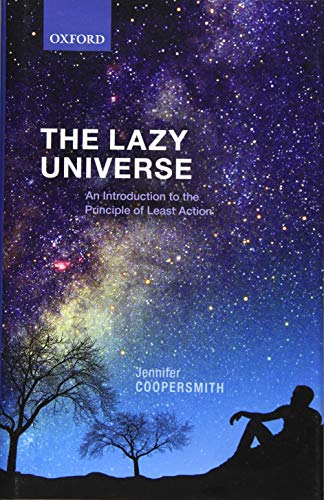
Ebook Info
- Published: 2017
- Number of pages: 272 pages
- Format: PDF
- File Size: 4.70 MB
- Authors: Jennifer Coopersmith
Description
This is a rare book on a rare topic: it is about ‘action’ and the Principle of Least Action. A surprisingly well-kept secret, these ideas are at the heart of physical science and engineering. Physics is well known as being concerned with grand conservatory principles (e.g. the conservation of energy) but equally important is the optimization principle (such as getting somewhere in the shortest time or with the least resistance). The book explains: why an optimization principle underlies physics, what action is, what `the Hamiltonian’ is, and how new insights into energy, space, and time arise. It assumes some background in the physical sciences, at the level of undergraduate science, but it is not a textbook. The requisite derivations and worked examples are given but may be skim-read if desired. The author draws from Cornelius Lanczos’s book “The Variational Principles of Mechanics” (1949 and 1970). Lanczos was a brilliant mathematician and educator, but his book was for a postgraduate audience. The present book is no mere copy with the difficult bits left out – it is original, and a popularization. It aims to explain ideas rather than achieve technical competence, and to show how Least Action leads into the whole of physics.
User’s Reviews
Editorial Reviews: Review “Jennifer Coopersmith has written a most welcome book, the first historically and philosophically motivated full study since two classics written nearly a half-century ago… [She] has attempted and succeeded admirably I believe in her aim to write a modern book on the history and philosophy of the action principles, as well as to give the technical details.” — American Journal of Physics”Any careful reader of this book will seek out the monograph without fail and benefit from its perusal… I have no hesitations in recommending this book to any physical scientist or engineer who wants to understand variational principles better.” — Contemporary Physics”Recommended.” — CHOICE”[C]ontagious enthusiasm and a sense of humour unusual in this kind of literature … The first part is excellent reading for anybody with an interest in the history and philosophy of science. I also recommend the book to students in physics and mathematics who are willing to dig deeper into this subject after taking classes in analytical mechanics, and I believe that it is accessible to any student in STEM disciplines. Practitioners in physics from any sub-discipline will enjoy a refresh and a different point of view that puts their tools of the trade in a broader context.” — CERN Courier”Inspired by the monumental work of Lanczos, Jennifer Coopersmith has constructed a beautiful exposition of the philosophical basis underlying classical mechanics. It has enough technical meat to be interesting to an expert, while remaining accessible to a novice.” — Gerald Jay Sussman, Panasonic Professor of Electrical Engineering, Massachusetts Institute of Technology”This is a well written and comprehensible presentation of some of the most fascinating and fundamental principles which theoretical physics has uncovered. The author has done a great job in making accessible ‘as if-laws’ to a broader audience.” –Helmut Pulte, Ruhr University Bochum, Germany”This book has a general audience: every practicing physicist — and a specific audience: every physics textbook writer. Envision and teach physics powerfully and directly with energy, action, and the Principle of Least Action.” — Edwin F. Taylor, Senior Research Scientist Emeritus, Massachusetts Institute of Technology About the Author Jennifer Coopersmith, Honorary Research Associate, La Trobe University, AustraliaJennifer Coopersmith took her PhD in nuclear physics from the University of London, and was later a research fellow at TRIUMF, University of British Columbia. She was for many years an associate lecturer for the Open University (London and Oxford), and was then a tutor on astrophysics courses at Swinburne University of Technology in Melbourne while based at La Trobe University in Bendigo, Victoria. She now lives in France.
Reviews from Amazon users which were colected at the time this book was published on the website:
⭐This is a very interesting book that I would suggest to anyone interested in physics. It has some very intuitive aspects and several more mathematical details. It seems in part to be geared toward a non-technical audience, but then several discussions and key passages require a decent familiarity with differential calculus. I found several fantastic gems in this book and for this reason, I would give it a full five stars, but I did not like too much the extensive use of appendixes. Some appendixes are fine where they are, but others really need to be read while reading the rest of the material within the book, and to have to switch back and forth between main text and appendixes is a bit disruptive in my mind. I also found the book easier to follow up to chapter 6, but, as the author admits, the maybe excessive use of handwaving, makes the rest of the book more obscure and difficult to grasp some physical insight from. However, even if one can go through only the first 5-6 chapters, I think the book provides a fantastic overview of these fascinating topics, and I really applaud the author for being able to convey some intuitive understanding of otherwise difficult and abstract concepts. Very well done.
⭐This book is very well written in terms of enabling one to more deeply understand Lagrangian and Hamiltonian theory. It offers the history of the thoughts, the physics, and mathematical details, of these wide ranging and fundamental concepts. It would definitely complement a standard physics approach to these ideas and help with understanding why they work at all and how widely they can be applied in our attempts to better understand Nature, from the QM scales to GR. Jennifer is quite detailed in her approach and it is fascinating to see how in many ways that differential geometry is abstractly applied to these ideas of least action on many scales, (not just in GR). You cannot hardly attend any advanced physics or cosmological lecture and not meet with Lagrangian and Hamiltonian theory, so that by better understanding these ideas from a ground up and abstract level one can see how they are used in so many areas of science. To me this is how we should begin in physics class and “work” our way down to Newton.
⭐This book is one every beginning physics student will enjoy and reread. The principle of least action permeates every aspect of the universe, and in this sense bonds the macro with the micro and bight be the core of a “Theory of Everything” if one is ever composed.
⭐A great book. Solid physics, solid math, and very well written. I appreciate that the author respects readers who want to see and understand the equations. My only complaint is the appearance of math symbols in the Kindle edition. In-line math symbols are fuzzy and of various size. Equations in figures are microscopic. PDF, ArXiv, and everybody else in the world can produce clean equations. Why can’t Kindle? (I have the same complaint for most of the other Kindle math books I’ve seen . . . )
⭐Excellent treatment. Coopersmith’s unique and most valuable contribution is to raise questions about the idealizations showing that both the Lagrange and Hamilton approaches are of only limited applicability. The value of the infinitesimal approach is that it reveals insights about the physical reality. However, as Coopersmith points out – albeit in a footnote (#36 Ch5) – both micro and macro reality are non-commutative (viz. path dependent). As modern thermodynamics is dominated by the presupposition that all thermodynamic change is path independent, she appropriately hopes that ‘someone’ will ‘pick up the baton’ and lead us to a more general thermodynamics. Coopersmith earlier book: Energy, The Subtle Concept, primarily for the same reason: she asks important, insightful penetrating questions about tacit presuppositions of the current orthodoxies.
⭐It is agood bokk extensive in explanatios and very consistent. The principle of least action is simple and means that nature always prefer yhe way to spand the minimum energy possible or even to gain some extra energy (ex a car down hill). It is a version of physiscs of the Occan’s razor: why complicate if can be simpler?? Intuitive!Paulo Fernando Veiga do Amaral – Rio Brasil
⭐Not for the dilettante. This is a serious book intended for the serious reader. The strength of this book lies in its clear exposition of the physics with carefully selected mathematical detail. The point of which is to expand and revise a generally pedestrian understanding of the material world to a more contemporary view. If you find your college physics a bit fuzzy then this book will bring things into a better focus.
⭐it’s a great book for physics people……,
⭐Jennifer Coopersmith’s good-to-excellent book discusses the principle of least action, Lagrangians, the calculus of variations and so on in the style of the best tutor you ever wanted to have. You really do have to know multivariate calculus (partial differential equations), vector calculus and have some exposure to the calculus of variations however. Coopersmith doesn’t shy away from the equations.There is a wealth of historical motivation here for why the whole counter-intuitive Lagrangian-Hamiltonian project got off the ground (incredibly useful!) and the author attempts to make concepts like (T-V), action and least-action plausible. The extent to which she is successful is the extent to which these abstractions are intuitive at all. That they work is the minimal answer. I was glad I worked through Coopersmith’s book, although it’s hardly a page-turner. I was motivated by the fact that you cannot engage with QFT or the particle physics underlying the standard model without travelling the Lagrangian path.
⭐I really like the way Jennifer Coopersmith covers this subject, difficult to explain why, but I think it has to do with the way she answers the sort of questions that are troubling but seem so trivial one is embarrassed to ask. What is all the fuss about? So it is a different way of solving mechanical problems around the conservation of energy so what? Coopersmith addresses these types of question by emphasisng how much more universal and fundamental the Principle of Least Action is and this gave me one of those beautiful but rare epiphany moments when I actually think I see some great and significant truth. I am not sure I fully grasp the full significance but it is exciting and while I have not yet completely finished the Lazy Universe has given me much to think about.
⭐I picked it up – my immediate response was “This slim volume” – and downgraded my assessment.Then I opened it and saw why the volume is so slim! The font size selected for the text is really small, otherwise this would have been one of those 10kg behemoths I might have expected!I haven’t read very far into it, but the writing style is appealing and engaging.As to the content, it looks like it will indeed fulfil my expectations, although that means it may well take several readings and much contemplation to understand it fully.
⭐Lucent and very original introduction to the Principle of Least Action and D’Alembert’s Principle, providing both depth (‘formulas’) and width (‘history’). Most definitely: read this first before you read Goldstein’s Classical Mechanics. You will instantly understand the why instead of just accepting the murky stuff about Lagrangians and Hamiltonians. It will make sense!
⭐Jennifer Coopersmith hat in Physik promoviert, an verschieden Universitäten in Kanada, USA, Großbritannien und Australien gelehrt und verschiedene allgemein verständliche Werke verfasst, darunter “Energy, the Subtle Concept“.Das vorliegenden Werk ist durch “The Variational Principles of Mechanics“ von Cornelius Lanczos inspiriert, das die Autorin als eines der besten Bücher erachtet, das physikalischen Prinzipien im Detail erörtert. Ihre eigene Darstellung ist als ein kompakter Abriss des Themas des Prinzip der kleinsten Wirkung (least action principle) abgelegt; große Teile des Textes sind dabei auf für Laien verständlich gehalten. Das gilt insbesondere für die Kapitel über die historischen Wurzeln und die Bedeutung des Prinzips in den verschiedensten Gebieten der Theoretischen Physik. Ihr Entwurf ist aber sehr wohl originär.Einer der Anlässe die Newtonsche Mechanik umzuformulieren, sind Fragestellungen mit Restriktionen, resp. Zwangsbedingungen. Johann Bernoulli fand, dass sich Gleichgewichtsbedingungen der Statik einfacher mittels des Prinzips der Virtuellen Arbeit (priciple of virtual work) behandeln lassen als mittels des Newtonschen Ansatzes von Zwangskräften. Jean d‘ Alembert erweiterte dieses Prinzip, durch Einführung von Trägheitskräften, auch auf dynamische Probleme.Joseph-Louis Lagrange fand schließlich, dass sich d‘ Alemberts Prinzip auch als Bedingung der kleinsten Wirkung ausdrücken lässt. In dieser Form ist die Mechanik besonders elegant und flexible darstellbar, letzteres vor allem, da die Lagrangesche Form auch bei Einführung verallgemeinerter Koordinaten erhalten bleibt.Jennifer Coopersmith ist bemüht die Hauptzusammenhänge herauszuarbeiten, um den Umfang schlank und übersichtlich zu halten, verzichtet sie ausdrücklich auf ‘Spezialfälle‘, wie sie im Vorwort herausstellt. Dabei wird besonderer Wert auf Herausarbeitung der physikalischen Bedeutungen der behandelten Prinzipien gelegt. So geht die Autorin auf die Hintergründe für die Form T-V des Langrangians ein, oder auf die Berechtigung der Namensgebung Prinzip der ‘kleinsten‘ Wirkung‘ statt der ‘stationären‘ Wirkung.Die weitreichenden Erkenntnisse, die Lagrange in seiner “Mecanique analytique“ formuliert hat, sind aber durchaus noch nicht das Ende der Entdeckungen zur Formulierung der Mechanik. W.R. Hamiltion blieb es vorbehalten, die ‘natürlichen‘ Variablen zu finden, mit denen sich ein mechanisches Problem umformulieren lässt. Genauer wird die Zahl der Variablen verdoppelt – ein Standardverfahren, um Differentialgleichung zweiter Ordnung als System von Gleichungen erster Ordnung zu reformulieren –, aber durch die geschickte Wahl der Impuls- variablen, erhalten die Euler- Lagrangeschen Gleichungen eine besonders einfache Struktur, der ‘kinetische Term‘ bekommt die kanonische Form pq^{.} und die Gesamtenergie wird zum ‘Potential Term‘.Einige technische Ergänzungen, die auf einen etwas fortgeschritteneren mathematischen Niveau und kompakter verfasst sind, sind den Anhängen vorbehalten, die finden sich auch durchgerechneten Beispiele, sowie Porträts der Protagonisten dieses Buches. Abgeschlossen wird dieser Abschnitt durch eine kurze Bibliographie und Hinweisen zur weiteren Lektüre.Der Autorin ist mit ihrem Buch ein schöne Einführung in die Analytische Mechanik gelungen, die zwar keine Standard Lehrbuch ersetzen kann, und auch gar nicht will – sie ist aber sicher für alle geeignet, die sich nicht mit unreflektierten ‘axiomatischen‘ Darlegungen zufrieden geben möchten, sondern sich für die Gründe interessieren, warum gerade das Prinzip der kleinsten Wirkung eine so zentrale Rolle in der Theoretischen Physik spielt. Die Auseinandersetzung mit dem Kontext einer Kontext einer wissenschaftlichen Theorie bedeutet aber notwendig ein Beschäftigung mit ihrem historischen Werdegang – und gerade die Synthese ist in diesem Buch gut gelungen, ohne dabei im Umfang auszuufern.
⭐
Keywords
Free Download The Lazy Universe: An Introduction to the Principle of Least Action 1st Edition in PDF format
The Lazy Universe: An Introduction to the Principle of Least Action 1st Edition PDF Free Download
Download The Lazy Universe: An Introduction to the Principle of Least Action 1st Edition 2017 PDF Free
The Lazy Universe: An Introduction to the Principle of Least Action 1st Edition 2017 PDF Free Download
Download The Lazy Universe: An Introduction to the Principle of Least Action 1st Edition PDF
Free Download Ebook The Lazy Universe: An Introduction to the Principle of Least Action 1st Edition