Ebook Info
- Published: 1993
- Number of pages: 536 pages
- Format: PDF
- File Size: 13.98 MB
- Authors: Benjamin Isaac
Description
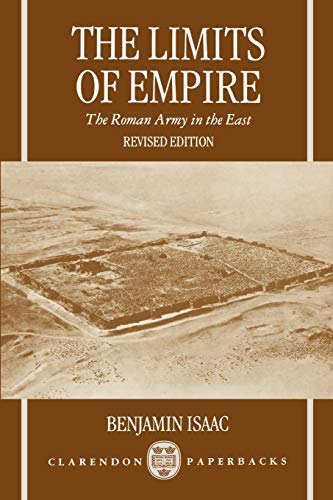
For more than seven centuries most of the Near East was part of the Roman empire. Yet no work exists which explores the means by which an ancient power originating in the western Mediterranean could control such a vast and distant region. What was the impact of the army presence on the population of the provinces? How did Rome respond to the challenge posed by the desert and its nomadic population? Isaac here offers answers to these questions in the first comprehensive treatment of the Roman military presence in the Near East. Using both well-known and neglected sources, he reassesses the means by which Rome achieved and maintained its control over the region. His study, now revised and updated to reflect recent research findings, casts new light on an important issue which has far-reaching implications for the understanding of ancient and modern imperialism.
User’s Reviews
Editorial Reviews: Review Praise for the first edition: “His book is where to start looking for information and bibliography about individual sites and their relation to other sites.”–Classical World”A readable and stimulating synthesis.”–International History Review”Has original ideas which no student of the Roman Empire can neglect.”–Classical Review”Immensely impressive.”–Bryn Mawr Classical ReviewPraise for the first edition: “Magnificent….Students ignore it at their peril.”–Times Literary Supplement About the Author Benjamin Isaac is at University of Tel Aviv.
Reviews from Amazon users which were colected at the time this book was published on the website:
⭐This is an excellent book. It is largely written to counteract the view of certain military historians (specifically Edward Luttwak and his
⭐) who view the emperors as following a planned strategy for expansion and defense. Isaac views the entire policy of expansion as being completely ad hoc as various emperors invaded different regions for an often indecipherable mix of ambitions and pride. His way of refuting this is to go back to the original sources and sites and see whether the evidence supports the conclusions or not. As should be expected given the vastly overreaching thesis of Luttwak the evidence simply doesn’t support (and in many case completely contradicts) his conclusions. Essentially he tears down Luttwak’s ideas and leaves it to others to explain them.Which isn’t to say that he completely avoids building any new ideas. He views the purpose of army fortresses as being primarily for controlling the populations rather than defending the borders. Most of the data comes from Israel, where the author lives, with a substantial amount of data from the neighboring provinces, where the author was unable to visit due to his Israeli heritage. Coming from the province in the empire with the greatest amount of internal strife (and therefore the greatest use of soldiers for police actions) it isn’t necessarily surprising that he should come to this conclusion. It is in fact very similar to the way the Israeli army sets up bases in occupied Palestine in order to monitor and control the population. Whether that gives him a unique insight into the situation or colors his conclusions is for the reader to decide. For my part I like the way that his explanation of these forts explains why so many forces were needed on even quiet frontiers and why the size of the army grew during the later empire despite its lessened effectiveness.There is a lot of information here. Possibly too much. The biggest problem with this book is that it has two different foci that often don’t work together. His first goal is to analyze the eastern provinces (mainly Judea, Arabia, Syria, and Mesopotamia) and the way in which they are different from the other ones. His second one is to analyze the development and purpose of the defenses and army in frontier zones in general. As you can tell the second goal is much wider than the first one. By limiting the study to the eastern provinces he severely limits his opportunities to explore this issue. By focusing on the wider issue he loses the opportunity to deal with the differences between the eastern and western provinces. In short he can’t completely satisfy either goal. This isn’t to say that he doesn’t offer a great deal of useful analysis but it does mean that his conclusions are sadly limited. It is still a great book but it feels like he could have achieved much more by picking a single topic to focus on.I’m not always sure that I buy his conclusions but it is always possible to follow how he reached them. I do think that he overreaches himself at times and that some of his conclusions are not as strongly supported as he makes out. In some areas he is strongly hampered by his restriction to the eastern provinces. Any discussion of the purpose of frontier defenses that only mentions Hadrian’s Wall once is simply incomplete. Overall this is a book that reexamines the evidence for the military on the eastern frontier and does it very well. If it sometimes tries to cover more than it is able this is still better than covering too little.If you’re interested in the Roman frontier then you might want to check out
⭐. It is less concerned with the military but it covers all the frontiers instead of just one.
⭐This is a heavy-duty study that took ten years to write and sets out to challenge the notion of a physical Roman frontier in a way we would understand it today. In particular, the author takes aim at Edward Luttwak’s “The Grand Strategy of the Roman Empire” written during the Cold War as a tool for modern strategists and planners to understand the challenges of imperial Roman frontier defence and apply it to late 20th century security challenges faced by the US and the West in its struggle against the Soviet Union. As such, Isaac believes Luttwak’s book – based mostly on secondary sources – is fundamentally flawed in seeing Roman military planning, defence and security organization through late-20th century eyes and not looking closely enough at the evidence from the time. Isaac sets out to disprove the very idea of a physical frontier by focusing mainly on the defence of the Roman East by going back to the archaeological, geographical and documentary evidence of the time, which is itself uneven and at times barely visible.Isaac takes us through a meticulous examination of the available archaeological and documentary evidence of the time of writing (1980-90) that includes many biblical references to show there is little evidence of a frontier system at the time of the high Principate let alone during the Republic. Roman military deployments, its forts and other installations actually served a variety of purposes from maintaining internal order, to raising taxes and customs duties, to acting as auxiliary engineers and builders, as well maintaining roads and other infrastructure and even forming their own settlements. None of this points to a strategic policy of frontier defence as Luttwak argues, but rather a more pragmatic and localised use of military forces in an auxiliary as well as a military capacity that also reflected the need to maintain and support large bodies of troops during peacetime – a huge logistical and financial challenge that created its own imperatives.Isaac’s main beef seems to be that Luttwak has taken 20th century concepts of the nation state, frontiers, border and defence and security doctrines and transferred them to the ancient world when there is in fact little evidence to support this either in contemporary or near contemporary Roman sources, even those written by reputably objective witnesses like Josephus. Roman reasons for waging war were varied and often quite opportunist and by our standards morally suspect. Simply the fact of having to support a large standing army made it difficult to resist opportunities to use it and allow the ordinary legionaries to acquire booty and for the emperor and his generals to raise cash from loot and claim glorious victories and success which were seen as prerequisites to maintain prestige and power. Few Romans at the time would have questioned the need or the reasons for going to war and a pretext could readily be found even if quite trivial, e.g. a perceived insult or snub or alleged breach of a treaty, which were anyway always drafted to leave plenty of ambiguity for either side to interpret as they wished. This was especially true in relations between Rome and Persia during the 700 years of their coexistence.Isaac concludes that the Romans had no clearly defined concept of a frontier system and that many of the structures we identify as classic symbols of a Roman frontier security like the Limes in Germany and Hadrian’s Wall actually served multiple functions from transport to trade and customs posts, as well as internal security rather than merely frontier defence. Apart from anything else, the Romans lacked accurate maps and knew little of the territories beyond their control and therefore any attempt to define its own borders in relation to its neighbours would have been fairly pointless and ultimately meaningless.Just to add that the book is a demanding read requiring concentration and probably deserves to be reread to get the maximum value out of it. I would actually recommend starting with the final chapter “Frontier policy – Grand Strategy?” in which Isaac presents his conclusions and retreads much of the evidence presented in the earlier chapters. After that the reader can decide how much of the rest of the book s/he would like to read. I only gave it four stars because the last edition was published in 1990 and reprinted in 2000. A lot of work has been done on Roman frontiers and a lot of new finds have emerged since then for instance vast frontier structures in North Africa that have been highlighted through satellite and advanced imaging technology – and it would be interesting to learn to what extent these support or undermine the thesis of this excellent and unique book which can serve as a reference on the subject. I also agree with the other reviewer that the book could deserve with being less narrowly focused and take in other parts of the Roman frontier to give a fuller picture as in each theater the Romans faced quite different challenges as the author himself acknowledges.I would also recommend it to any aspiring classical historian or archaeologist as a prime example of how to construct a well-founded argument based on often sketchy and limited documentary and physical evidence and how much work and research is required to do it. It also reminds us of the importance of going back to original sources and not relying on others’ interpretations of historical evidence which can be distorted by their own political, religious or contemporary prejudices and assumptions.
⭐Good study, and the author obviously knows their stuff. It certainly opened up the Eastern half of the empire in a tremendous amount of ways, particularly the border region and frontier around Syria and Judea. I’d thoroughly recommend this book to any student or anyone seriously interested in the topic.
Keywords
Free Download The Limits of Empire: The Roman Army in the East (Clarendon Paperbacks) in PDF format
The Limits of Empire: The Roman Army in the East (Clarendon Paperbacks) PDF Free Download
Download The Limits of Empire: The Roman Army in the East (Clarendon Paperbacks) 1993 PDF Free
The Limits of Empire: The Roman Army in the East (Clarendon Paperbacks) 1993 PDF Free Download
Download The Limits of Empire: The Roman Army in the East (Clarendon Paperbacks) PDF
Free Download Ebook The Limits of Empire: The Roman Army in the East (Clarendon Paperbacks)