

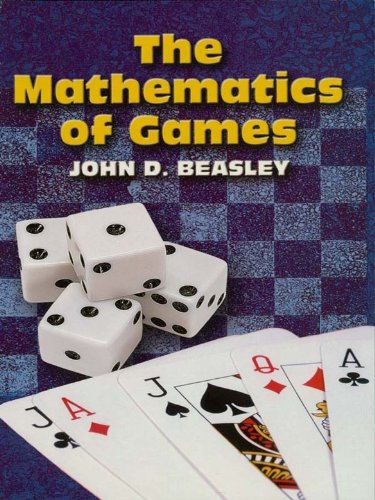
Ebook Info
- Published: 2013
- Number of pages: 176 pages
- Format: PDF
- File Size: 2.90 MB
- Authors: John D. Beasley
Description
Mind-exercising and thought-provoking.—New ScientistIf playing games is natural for humans, analyzing games is equally natural for mathematicians. Even the simplest of games involves the fundamentals of mathematics, such as figuring out the best move or the odds of a certain chance event. This entertaining and wide-ranging guide demonstrates how simple mathematical analysis can throw unexpected light on games of every type—games of chance, games of skill, games of chance and skill, and automatic games.Just how random is a card shuffle or a throw of the dice? Is bluffing a valid poker strategy? How can you tell if a puzzle is unsolvable? How large a role does luck play in games like golf and soccer? This book examines each of these issues and many others, along with the general principles behind such classic puzzles as peg solitaire and Rubik’s cube. Lucid, instructive, and full of surprises, it will fascinate mathematicians and gamesters alike.
User’s Reviews
Reviews from Amazon users which were colected at the time this book was published on the website:
⭐I learned a new family game from John D. Beasley’s “The Mathematics of Games.” The game is called driving-the-old-women-to-bed. It brings a lot of fun to my family. My family even derives “new” games from the original game by changing the rules. One rule we change is the amount of cards a trick can win. The other rule is that we play two stacks of card together, which is 52(2) + 4 (jokers) = 108 cards, instead of 52 + 2 (jokers) = 54 cards. The jokers require the next player either to play 5 plain cards or to play a court card. Driving-the-old-women-to-bed is “… an automatic game with no opportunity for skills … which is why… so suitable for family play.” Zachary, my son, would jump up onto the table if the game excited him. There are interesting ideas for mathematicians as well:(a) How long is a game likely to last?(b) Can a game get into an infinite loop?(c) If it cannot, can we hope to prove this? The first two questions are solved by the statistics generated by the computer simulation. For the third question, the author provides merely a hint, which is “…a process cannot repeat indefinitely is to show that some property is irreversibly changes by it.” The statistics also brings out an interesting characteristic of the game: half-life. About 50% of the games terminate within a further 20 tricks. The book is about the analysis of games. Generally speaking, there are four classes of games: (1) games of pure chance (card and dice games), (2) games of mixed chance and skill (ball games such as golf and soccer), (3) games of pure skill (puzzle such as Rubik’s cube), and (4) automatics games. Following are the most interesting overviews, analysis of the games, and mathematical ideas I found on the book:(a) The definition of hard game: “…the amount of computation needed to analyze a specific `instance’ of it … increases with the amount of numerical information needed to define this instance. If the increase is merely linear, the game is relatively easy; if it follows some…polynomial of low degree, the game may not be…bad; if it is exponential, the game is…difficult; and if it is worse than exponential, the game is hard…”(b) Once a game of pure skill has been fully analyzed, it is competitively dead. It is only the ignorance of players that keeps games such as chess alive at championship level.(c) “Turing game…features a line of coins…with a robot which runs up and down turning them over…The robot is extremely simple; in each state, it can only examine the current coin, turn it over if required, and move one step to the left or right…The outcome of the game is completely determined by the actions of the robot in each state and by the initially orientations of the coins…”(d) “…the line initially contains two rows of heads, separated by a single tail…the robot starts within the right hand row…the overall effect is to form a new row whose length is the sum of the lengths of the original rows…”(e) “…each of the fundamental operations of computing (addition, subtraction, multiplication, and division) can be performed by suitably programmed Turing robot…if a number can be computed at all then it can be computed by supplying a Turing robot with a suitably program…”(f) “…the playing of an automatic game is logically equivalent to the performance of a computation, so every automatic game can be simulated by a Turing robot…every automatic game is equivalent to a Turing game…”(g) “A formal logical system is based on axioms and rules of construction, and a proposition is said to be `provable’ if it can be derived from the axioms by following the rules of construction.”(h) The hole at the heart of mathematics: “…Gödel…assign a number to every symbol in a formal logical argument in such a way that the logical proposition `The string of symbols S constitutes a proof of the proposition P’ became equivalent to an arithmetical proposition about the numbers representing S and P. The proposition ‘There is no string of symbols which constitutes a proof of proposition P’ accordingly became equivalent to an arithmetical proposition about the number representing P; but, being itself a proposition, it was represented by a number, and when it was applied to the number representing itself, either a proof or a disproof was seen to lead to a contradiction. So this proposition was neither provable nor disprovable.”(i) “…the consistency of arithmetic…is formally improvable…”(j) “…a program can be represented by a number is now obvious…a logical argument can be represented by a number is now…just as obvious, but it was no means obvious in 1930.” Points (c), (d), and (e) suggests that an machinery without intelligent but programmable (an Turing robot) is able to perform an arithmetic operation by simply following the instructions which merely involve checking the state of the machine, checking the coins, flipping the coins if required, and moving to the left or right.
⭐Great study of statistics applied to games. WELL written and clear.
⭐This is a wonderful book for all the reasons given by the reviewer Man Kam Tam. There are some additional sections, like an analysis of Nim and an introduction to combinatorial game theory. There is also analysis of some classic recreational math puzzles. In particular, Beasley gives an approach to the solution of the 12 coin problem and its generalization to other numbers of coins that I have not seen anywhere else. He provides a recursive method starting with just 3 coins that makes it very easy.
Keywords
Free Download The Mathematics of Games (Dover Books on Mathematics) in PDF format
The Mathematics of Games (Dover Books on Mathematics) PDF Free Download
Download The Mathematics of Games (Dover Books on Mathematics) 2013 PDF Free
The Mathematics of Games (Dover Books on Mathematics) 2013 PDF Free Download
Download The Mathematics of Games (Dover Books on Mathematics) PDF
Free Download Ebook The Mathematics of Games (Dover Books on Mathematics)