Ebook Info
- Published: 2044
- Number of pages: 358 pages
- Format: PDF
- File Size: 11.89 MB
- Authors: Theodore G. Faticoni
Description
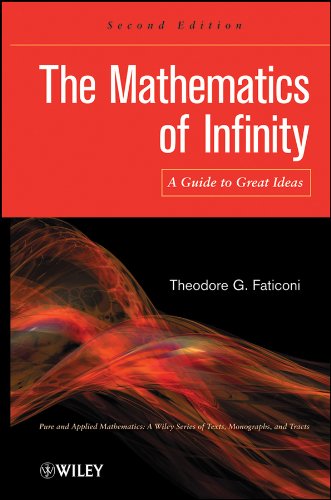
Praise for the First Edition “. . . an enchanting book for those people in computer science or mathematics who are fascinated by the concept of infinity.”—Computing Reviews”. . . a very well written introduction to set theory . . . easy to read and well suited for self-study . . . highly recommended.”—ChoiceThe concept of infinity has fascinated and confused mankind for centuries with theories and ideas that cause even seasoned mathematicians to wonder. The Mathematics of Infinity: A Guide to Great Ideas, Second Edition uniquely explores how we can manipulate these ideas when our common sense rebels at the conclusions we are drawing.Continuing to draw from his extensive work on the subject, the author provides a user-friendly presentation that avoids unnecessary, in-depth mathematical rigor. This Second Edition provides important coverage of logic and sets, elements and predicates, cardinals as ordinals, and mathematical physics. Classic arguments and illustrative examples are provided throughout the book and are accompanied by a gradual progression of sophisticated notions designed to stun readers’ intuitive view of the world.With an accessible and balanced treatment of both concepts and theory, the book focuses on the following topics:Logic, sets, and functionsPrime numbersCounting infinite setsWell ordered setsInfinite cardinalsLogic and meta-mathematicsInductions and numbersPresenting an intriguing account of the notions of infinity, The Mathematics of Infinity: A Guide to Great Ideas, Second Edition is an insightful supplement for mathematics courses on set theory at the undergraduate level. The book also serves as a fascinating reference for mathematically inclined individuals who are interested in learning about the world of counterintuitive mathematics.
User’s Reviews
Editorial Reviews: From the Inside Flap Praise for the First Edition “. . . an enchanting book for those people in computer science or mathematics who are fascinated by the concept of infinity.”—Computing Reviews”. . . a very well written introduction to set theory . . . easy to read and well suited for self-study . . . highly recommended.”—ChoiceThe concept of infinity has fascinated and confused mankind for centuries with theories and ideas that cause even seasoned mathematicians to wonder. The Mathematics of Infinity: A Guide to Great Ideas, Second Edition uniquely explores how we can manipulate these ideas when our common sense rebels at the conclusions we are drawing.Continuing to draw from his extensive work on the subject, the author provides a user-friendly presentation that avoids unnecessary, in-depth mathematical rigor. This Second Edition provides important coverage of logic and sets, elements and predicates, cardinals as ordinals, and mathematical physics. Classic arguments and illustrative examples are provided throughout the book and are accompanied by a gradual progression of sophisticated notions designed to stun readers’ intuitive view of the world.With an accessible and balanced treatment of both concepts and theory, the book focuses on the following topics:Logic, sets, and functionsPrime numbersCounting infinite setsWell ordered setsInfinite cardinalsLogic and meta-mathematicsInductions and numbersPresenting an intriguing account of the notions of infinity, The Mathematics of Infinity: A Guide to Great Ideas, Second Edition is an insightful supplement for mathematics courses on set theory at the undergraduate level. The book also serves as a fascinating reference for mathematically inclined individuals who are interested in learning about the world of counterintuitive mathematics. From the Back Cover Praise for the First Edition “. . . an enchanting book for those people in computer science or mathematics who are fascinated by the concept of infinity.”—Computing Reviews”. . . a very well written introduction to set theory . . . easy to read and well suited for self-study . . . highly recommended.”—ChoiceThe concept of infinity has fascinated and confused mankind for centuries with theories and ideas that cause even seasoned mathematicians to wonder. The Mathematics of Infinity: A Guide to Great Ideas, Second Edition uniquely explores how we can manipulate these ideas when our common sense rebels at the conclusions we are drawing.Continuing to draw from his extensive work on the subject, the author provides a user-friendly presentation that avoids unnecessary, in-depth mathematical rigor. This Second Edition provides important coverage of logic and sets, elements and predicates, cardinals as ordinals, and mathematical physics. Classic arguments and illustrative examples are provided throughout the book and are accompanied by a gradual progression of sophisticated notions designed to stun readers’ intuitive view of the world.With an accessible and balanced treatment of both concepts and theory, the book focuses on the following topics:Logic, sets, and functionsPrime numbersCounting infinite setsWell ordered setsInfinite cardinalsLogic and meta-mathematicsInductions and numbersPresenting an intriguing account of the notions of infinity, The Mathematics of Infinity: A Guide to Great Ideas, Second Edition is an insightful supplement for mathematics courses on set theory at the undergraduate level. The book also serves as a fascinating reference for mathematically inclined individuals who are interested in learning about the world of counterintuitive mathematics. About the Author THEODORE G. FATICONI, PhD, is a Professor in the Department of Mathematics at Fordham University. His professional experience includes forty research papers in peer-reviewed journals and forty lectures on his research to his colleagues. Read more
Reviews from Amazon users which were colected at the time this book was published on the website:
⭐I’m rather surprised at the fairly glowing reviews on amazon.com (and other sites) for the first edition of this book, because there are some serious mathematical errors, many of which have not been corrected in the second edition. On the whole, the book covers good material that should be of interest to bright high school and college students interested in foundational issues in mathematics, and the exposition at times is pretty good. But the glaring mathematical mistakes make it hard to recommend that anyone buy this book. See the last paragraph of this review for more thoughts along these lines. Let me get very specific about the errors by citing several examples (this list is by no means exhaustive).The definition of well-ordered set (an idea central to the subject matter of this book) given on page 207 (all page numbers refer to the second edition) states that the property that each nonempty subset of a set A contains a unique least element (the correct definition) is equivalent to the statement that each element of A has a unique successor (which would make the integers well-ordered and any finite set not well-ordered). On page 228 we are told that the F in ZFC stands for Franklin (rather than Fraenkel) and on page 227 that Paul Cohen, rather than Kurt Godel, proved that the negation of the continuum hypothesis is independent of the ZFC axioms. The proof that any two line segments have the same cardinality on page 153 is flawed (and this is not the only flawed proof in the book — see, for example, the nonsense on pages 268-269) in that it leaves out the case in which the lines joining the respective endpoints do not intersect. On page 288 we read that 2^495 times (2^496 – 1) is a perfect number, which of course it is not because 496 is not prime. (Is this an improvement over the first edition, when we were told that the odd number 521 is perfect?) On page 297 we read that 1024 divided by 10 ln 2 is 160 (it’s actually about 147.7) and that 3^20 divided by 20 is equal to 1.5 times 3^18, which is off by a factor 3 1/3). There is some more nonsense on pages 223-224 about how the first uncountable ordinal is given by any well-ordering of the real numbers. On page 238 the author states that under the generalized continuum hypothesis every successor cardinal number is a power of 2 (what power of 2 is the successor of 10?); at least this is an improvement over the first edition, in which it was stated that every cardinal number other than aleph_0 is a power of two (what power of 2 is aleph_omega?). On page 55 we read that the domain of the tangent function is all real numbers. On pages 31 and 33, the definitions of the set of natural numbers and the set of positive rational numbers imply that 0 is to be considered a positive number, contrary both to common usage and the author’s intent (pages 33-34). Finally (and this list has hit just a few high points), we are told on page 293 that “it would take a desktop computer some time to find the first million primes” using the Sieve of Eratosthenes; it took my computer, using Maple, 6 minutes. (At least this is not quite as outrageous as the claim in the first edition that it would take “more than a week” to find all the (78,498) primes less than 1,000,000, a task that my Mac accomplished in 17 seconds.)In short, there are many places in this book where it seems that the author has no idea of what he is talking about (in addition to being very careless). Professor Faticoni is a university mathematician, and he has published many books and research papers, mostly in other branches of mathematics; his substantial record gives no cause to doubt his competence in these fields. Perhaps here he just ventured too far from his areas of expertise. His book on combinatorics is scheduled to be published by Wiley later this year. Like logic and set theory, combinatorics is an area in which he has little or no research experience (see his publication list in MathSciNet), so one wonders whether it might suffer some of the same problems that the book under discussion does.What is particularly galling is that most of these errors were pointed out in a review of the first edition published in Mathematical Reviews (MathSciNet, the official reviewing publication of the American Mathematical Society), which apparently the author and publisher didn’t take the time to read. Why would they not want to correct these mistakes in the second edition? I understand that the editor in charge was informed about the serious problems with this book around the time the first edition was reviewed in 2007.The book has problems besides its mathematical misconceptions. The author sometimes has difficulty writing coherently and respecting his audience. For example, on page 105 he writes, “I ask you to devote a fraction of [the] energy [you devote to video games] into [sic] the topics that we will cover in the next few chapters.” On page 283 we read, “You have known [that there are infinitely many prime numbers] since birth.” Well, I suppose some babies are a bit precocious. It would have been easy enough to fix these lapses in exposition, which also were pointed out five years ago. The lack of proof-reading and good copy-editing shows in the numerous typographical errors and other slips of language and notation, as well. The sloppiness even extends to the fact that the index for this second edition seems to be the un-updated index from the first edition, which of course has all the wrong page numbers!All this being said, on the whole the writing is not bad, and the book does have some nice features (such as the discussion of “Hilbert’s Infinite Hotel”). I can see a cleaned-up version of this book being a useful addition to the literature for a lay audience. It is a shame that the publisher did not care enough to get a mathematician knowledgeable in this branch of mathematics to vet the contents. Because the author is a very competent research mathematician and has written several other books (which I have not read and so cannot vouch for the quality of), it is not as if one should have expected this dismal result. I would think that Professor Faticoni would be greatly embarrassed by all this. For me the bottom line is that it is really irresponsible of Wiley — and an insult to the mathematical community — to put out a second edition of this flawed book and do almost nothing to correct the errors in the first edition that were pointed out to the editors.
⭐I really wasn’t sure what to expect when I ordered this book. Would it be an advanced modern mathematics text? A history of the mathematics of infinity? Or a philosophical discussion? Happily, while this book focuses on the mathematics, it includes elements of all of these in a very readable and accessible format. However, there are also some serious short-comings that prevent me from recommending this book without reservations. There are a couple of other books that I would recommend over this one.I was struck by how enjoyable reading this book was. It isn’t dry and boring or full of cryptic symbols and terminology. The writing is clear to someone who isn’t a PhD in math and the writing style makes math fun. This is not a particularly advanced math book; rather, it is a good, solid introduction to the mathematics of infinity.An advanced high school math student may be able to read this book, but some college math would help a great deal. Some of the notation is college level, but Dr. Faticoni introduces advanced concepts in a clear, gradual manner. If you already have some college mathematics, you should be able to jump into any part of the book. If not, read the book in order.When I started reading the first chapters, I thought, “This isn’t about infinity!” But then I realized he is building a foundation for the later discussions. He starts with logic, sets, and functions before discussing countable infinite sets (including a fun section on Hilbert’s Infinite Hotel), cardinality and well-ordered sets (including a discussion of Georg Cantor’s Continuum Hypothesis). Then he goes on to induction, prime numbers, and finally closes with some advanced topics in logic and cardinality such as “Godel’s Incompleteness Theorem”. Most of the topics relate in some way to infinity, although some of the discussion has more to do with other areas (such as logic), but are certainly interesting.As I mentioned previously, there are also some problems with The Mathematics of Infinity. The first thing I noticed was the page numbers in the index were wrong. After looking at the previous edition on amazon, I realized that the index in this second edition was copied exactly from the first edition – someone forgot to update it. This was very disappointing, as I rely a great deal on the index to find material in my math books.I also noticed several apparent errors and omissions in the book (though not as a many as a previous reviewer). One that stood out to me was the conclusion on page 113 that it would take 100 googol grains of sand to equal the earth, when it is generally accepted that there are fewer than a googol atoms in the entire universe. (A googol is the number represented by 1 followed by 100 zeros.) His root error is the assertion that the mass of the Earth is about 10^100 grams, when it is actually about 6×10^27 grams – a VAST difference.He also claims to have a solution to the oft-discussed Paradox of the Surprise Examination/Termination/etc, which goes like this. A teacher tells her students that there will be a surprise test one weekday next week. The students realize that it can’t be Friday, since then it wouldn’t be a surprise. Therefore, it couldn’t be Thursday either, and so on, until they conclude it can’t be any weekday next week. They are all surprised when the teacher gives out the test on Wednesday, fulfilling her promise. Although much has been written on this paradox, there has never really been a generally accepted solution. Dr. Faticoni basically states that in ruling out Friday, one assumes the test wasn’t given through Thursday, which is what is being set out to prove – that the test won’t be given. I believe this objection is incorrect, as one is only assuming that IF the test isn’t given by Thursday, then it can’t be given Friday either. If the answer were this simple, there wouldn’t be dozens (hundreds?) of articles that try to resolve it!There are also some things that I wish he had taken a little further. For example, he talks about the necessity of using a “radius of convergence” when working with infinite sums, but doesn’t say how to determine it. He doesn’t go into algebraic and transcendental numbers. But perhaps I am getting too picky – he does cover enough of the important topics for an introductory book on infinity.If you are looking for a more historical exposition, an excellent book that I would recommend on the history of discoveries regarding infinity is
⭐by Amir D. Aczel. While it includes mathematical discussion, it focuses more on the people and discoveries throughout the ages, from the ancient Greeks including Pythagoras and Euclid, and ancient Jewish mysticism, through Galileo and especially Georg Cantor up through Bertrand Russell and Godel.I also recommend the more general classic
⭐by Ian Stewart, which includes a 16-page chapter “Counting: Finite and Infinite” which discusses cardinality, and includes Cantor’s cool proof that trancendental numbers must exist. Like Faticoni, he also includes chapers on sets, functions, and axiomatics, and discusses infinite series. But this is a much broader book than Faticoni’s, including topics such as geometric transformations, Abstract Algebra, Topology, Linear Algebra and Probability.To conclude, I would recommend this book to anyone with a general interest in mathematics and a solid background in high school math (at least pre-calculus). It is a fun read – just be aware of the caveats.
⭐I truly hope that they go back and make a third edition of this, and clean up everything that they can. If that happens, I’d love to get my hands on a copy to check out and to give it a really glowing review.On one hand, I really like the fact that the author clearly truly wants to make mathematics accessible. He tries to warn readers that you might fail, fail, and fail again, but if you even make it a little farther into understanding something each time that’s progress and it’ll pay off. That’s a good message to include, considering that mathematics tends to be a field where people tend to assume that if they don’t understand instantly, they’re not math people and they should go do something else.The problem is that the math he puts in isn’t always right, and that’s kind of important in a math book.I think the book still has some value, because it has some interesting stuff. I think it might be more useful as it stands as an overview of topics, where you’re not digging into all the details where you might really run up against an error. I just really hope that they do go back, clean it all up, and give us a properly polished version. It has the potential to be a gem.
⭐accessible à toute personne ayant des bases en mathématiques niveau terminale S, ce livre nous permet d’entrevoirdes idées profondes . Quelques fautes de frappe, c’est dommage.
⭐
Keywords
Free Download The Mathematics of Infinity: A Guide to Great Ideas 2nd Edition in PDF format
The Mathematics of Infinity: A Guide to Great Ideas 2nd Edition PDF Free Download
Download The Mathematics of Infinity: A Guide to Great Ideas 2nd Edition 2044 PDF Free
The Mathematics of Infinity: A Guide to Great Ideas 2nd Edition 2044 PDF Free Download
Download The Mathematics of Infinity: A Guide to Great Ideas 2nd Edition PDF
Free Download Ebook The Mathematics of Infinity: A Guide to Great Ideas 2nd Edition