

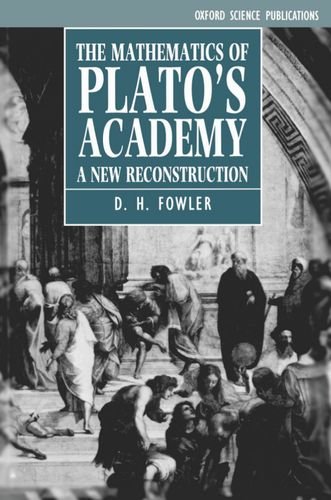
Ebook Info
- Published: 1987
- Number of pages: 401 pages
- Format: PDF
- File Size: 49.74 MB
- Authors: D. H. Fowler
Description
This book presents a reinterpretation of early Greek mathematics, one of the most tantalizing intellectual subjects of the last 2,000 years. The first part offers several new interpretations of the idea of ratio in early Greek mathematics and illustrates them in detailed discussion of several texts. Part Two discusses the historical context of the subject–what we know of Plato’s academy during his lifetime, the origin of our text of Euclid’s Elements, and what we know of early Greek numerical practice. The book finishes with an account of the theory of continued fractions and its history since the 17th century.
User’s Reviews
Reviews from Amazon users which were colected at the time this book was published on the website:
⭐Two things are certain if you really want to know what mathematics was done in Plato’s Academy, and before Euclid: Your heart will break at the lack of evidence, and you will have to read this book.Fowler details how thin the surviving evidence is, even for such basics as when Euclid’s ELEMENTS were written. Drawing on other careful classicists he demolishes now traditional stories about the Pythagoreans and the irrational, Plato’s Academy, even Euclid’s own style in the Elements. He shows them coming from heavy interpretations of extremely vague (and often late) sources. Plates in the book show how desperately scanty are the physical remains of any mathematical writing within centuries of Plato’s death. Even the first and second century AD leave us only a few scraps of Euclid.On the positive side, Fowler gives a persuasive account of a method of reciprocal subtraction which he calls “anthyphairesis”. It lay within the grasp of Athenian geometers, and suits some remarks Plato makes on mathematics, and suits traditions on geometers Plato knew, and goes far to unify and explain much of Euclid. It was apparently cited by Aristotle (under the name “antanairesis”). Probably, it really was used in the period. It also makes some very pretty geometry. Regular pentagons make a lot of sense anthyphairetically. Anyone trying to read the later books of Euclid, especially books X and XIII, will get tremendous help from this book. Conversely, you can hardly read much of this book without reading Euclid.The book is not well organized. It spends many pages at a time on mathematical reconstructions that could not possibly have been used by the Greeks, so as to show beyond question that they could not have been. And it probably pushes its point too far. That is what classicists do. They push a point for all it is worth and perhaps more. These flaws are inevitable when you work on such important questions on so little evidence. Fowler assembles enormous amounts of classical textual evidence and later scholarship. He gives some nice mathematics including an appendix on the later arithmetized incarnation of anthyphairetic methods as continued fractions.If you are determined to ask what math Plato knew and promoted, and what existed before Euclid–and so you are determined to break your heart–then you must read this book.
⭐Often when describing mathematics we add historical information to motivate what we are explaining or to situate it with respect to what was known at the time. One of the first things that many people learn to prove is that the square root of 2 is irrational, and they are often told stories about the discovery of this fact. But this often seems to be used as a fable, without treating it as a historical event that can be seriously studied and understood.There seems to be a story that is fuzzily held by a noticeable number of mathematicians that the person who discovered that the square root of 2 is irrational was killed by the Pythagoreans for ruining their idea that everything could be expressed using integers. This could be a mashing together of different stories told by Iamblichus, who himself is not reliable. Or it may have come from a passage in Pappus’s Commentary on Book X of Euclid’s Elements, in which Pappus relates as a parable the story that the first person who revealed incommensurables to non-Pythagoreans died by drowning. Here let me mention that neither of these tales is about the discoverer of irrationals but about the one who revealed irrationals to non-Pythagoreans. I don’t suggest that the people who tell this story have read works that cite Iamblichus or Pappus, but that the story has gone through many steps of broken telephone, and that they don’t care enough about historical accuracy for it even to occur to them to investigate the story they tell students.It was worth mulling over this story because Fowler disagrees with its implication that irrational numbers caused a foundational crisis in early Greek mathematics. My original reason for turning to Fowler’s book was his presentation of continued fractions in Chapter 9, which is an excellent self-contained sketch of the history of continued fractions. On page 33 of the book, in Chapter 2, Fowler presents (although not in this language) the continued fraction for the square root of 2. Rather than being inexpressible (or only being expressible in some haphazard way through decimals as we would obtain by taking the square root of 2 on a calculator), the ratio of the diagonal of a side to its side can naturally be expressed as a continued fraction. And anyone who teaches the Euclidean algorithm should think about using it to get the continued fraction expansion of a fraction a/b.Fowler has done a great job pulling together many different classical sources, digesting the material and doing mathematics. But this theory could be presented better. Other books about this material are Knorr,
⭐, and Szabo,
⭐.
Keywords
Free Download The Mathematics of Plato’s Academy: A New Reconstruction in PDF format
The Mathematics of Plato’s Academy: A New Reconstruction PDF Free Download
Download The Mathematics of Plato’s Academy: A New Reconstruction 1987 PDF Free
The Mathematics of Plato’s Academy: A New Reconstruction 1987 PDF Free Download
Download The Mathematics of Plato’s Academy: A New Reconstruction PDF
Free Download Ebook The Mathematics of Plato’s Academy: A New Reconstruction