Ebook Info
- Published: 1977
- Number of pages: 192 pages
- Format: PDF
- File Size: 1.49 MB
- Authors: Gilbert Harman
Description
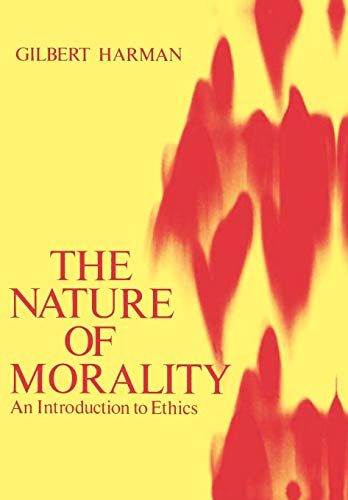
Contains an overall account of morality in its philosophical format particularly with regard to problems of observation, evidence, and truth.
User’s Reviews
Editorial Reviews: Review “A good book for undergraduates….Allows students to think about ethics conceptually and to consider different perspectives.”―Rachel M. McCleary, Georgetown University”A refreshing and thought-provoking book which will benefit serious students, both sophisticated beginners and more advanced graduate students.”―Ethics”Harman deserves to be highly commended….A good introductory ethics text which…significantly advances contemporary discussion of the nature of morality.―International Philosophical Quarterly From the Back Cover This book is a philosophical introduction to ethics. It differs from existing texts by focusing on a basic philosophical problem about morality, its apparent immunity from observational testing. Other texts either ignore this issue altogether, in order to concentrate on interesting but largely nonphilosophical discussions of moral problems, or treat the issue as only one of several highly technical questions in something called ‘meta-ethics.’ About the Author Gilbert Harman is at Princeton University. Read more
Reviews from Amazon users which were colected at the time this book was published on the website:
⭐First, a point of clarification: this is basically a book about meta-ethics, not normative ethics. (Indeed, judging by his statements in the Preface, Harman thinks the properly philosophical part of thought about morality is exhausted by meta-ethics.) What is meta-ethics? The study of the metaphysics, semantics, epistemology, and psychology of morality.This isn’t a textbook on ethics; it’s an original work of philosophy written in such a way that it is accessible to those without a substantial philosophical background. Still, Harman does a pretty good job of introducing readers to many of the issues in meta-ethics while developing his own naturalistic account of morality, an account that ends up being a form of moral relativism. Harman does discuss positions other than those he favors, but they are discussed only insofar as they have some role to play in the progress in his own argument. And he does refer to historically important thinkers (e.g., Hume, Kant, Moore, and Hare), primarily using their work as a foil to his own or as a source of insights he can use in formulating his own theory.So this isn’t a book for someone looking for comprehensive coverage of the positions in meta-ethics or an introduction to historical work on this subject. (If you’re looking for a textbook on meta-ethics, you might try Stephen Darwall’s Philosophical Ethics or Alexander Miller’s recent An Introduction to Contemporary Meta-Ethics. Both of those works present and criticize most of the important positions in contemporary meta-ethics.)The book begins with a seminal, albeit frustrating, argument that Harman thinks poses a problem for the objectivity of ethics. Harman argues that a fundamental problem with putative moral facts, whose existence would be necessary for morality to be objective, is that it appears they cannot be tested against observation. He then presents an account of the nature of observation according to which this problem boils down to the fact that it appears moral facts cannot be fit into the explanatory framework provided by our scientific conception of the world. In particular, it seems we cannot understand how moral facts could causally interact with anything in the world in such a way that could ultimately cause our having experiences of them. Consequently, we cannot have observational evidence for or against claims about putative moral facts.The rest of the book can be understood as Harman’s response to the worry presented in this chapter. First, Harman considers whether this argument ought to lead us directly to moral nihilism, the doctrine that there are no moral facts. He thinks not. In chapters 2-4 he scrutinizes some possible responses to this worry, including reductive naturalism, emotivism, and the ideal observer theory. This is followed by the long central section of the book in which he develops his own response to the worries about moral facts formulated in the first chapter. Harman ends up arguing that there may be moral facts, and that, if there are, these facts can be fit into a naturalistic worldview. However, he claims that these moral facts are relative ones. That is, he argues for a form of moral relativism.He begins with analysis of what it means to claim that someone morally ought to do something, and here he argues for a form of reasons internalism. More specifically, he argues that if it is true that person P ought to do action A, then P has reason to A. He then argues for a relativistic theory of reasons. According to Harman, a person has a reason to A only if there is some process of reasoning that would lead the person to do A (or at least to be motivated to do A). How do we determine what reasoning might lead a person to do? Harman suggests that we can find a clue to answering this question if we focus on the social nature of morality. He presents a view according to which morality has developed through certain social conventions accepted within groups. Moral reasons ultimately depend on these conventions; they apply only to those who have, at least implicitly, accepted the conventions of a group. So a person’s moral reasons are supplied by her commitment to the conventional rules of that group.Importantly, persons outside the relevant group, i.e. persons not committed to the relevant conventions, do not have such reasons. And since Harman has argued that one ought not to act a certain way only if one has reasons not to do so, it is not true that those outside the relevant conventions ought not to act as they do. Even if those people act in a way that violates the conventions of our group, we cannot truly say that they ought not to have acted that way. This is perhaps most clear if we consider an example Harman himself uses. Hitler, he tells us, was clearly outside our moral conventions, conventions that rule out slaughtering millions for our political goals. So, while it is true that we who are committed to such conventions (and thus have reason not to act in this way) ought not to do such thing, Hitler had no such reasons and so it was not true that he ought not to have done what he did. Given his psychology and his lack of commitment to any such conventions, there was no reason for him not to have ordered and overseen the Holocaust. And since he ought not to do have done so only if he had such reasons, it’s not the case that he ought not to have ordered the Holocaust. We cannot apply our standards to Hitler, who is outside our group, and truly judge that he ought not to have done what he did. Harman thinks that a sort of criticism of Hitler is possible, however–but it isn’t possible to correctly claim that he ought not to have done what he did. Harman claims this view is consistent with our normal usage of ‘ought’ and our intuitions about how it ought to be applied in such cases. We think that we cannot apply our moral standards to a person like Hitler, that he is “beyond the pale.”So, on Harman’s account of morality, there do end up being moral facts; they are psychological facts about the reasons people have to behave in certain ways. Nevertheless, these facts are relative and not universal.
⭐This is an introductory book on ethics which provides a marked advance of discussion of the nature of morality.The book is unique in its focus on the basic philosophical problem about morality and its apparent immunity from observational testing. The author considers a number of possible responses to the apparent fact that ethics is cut off from observational testing in a way that science is not.The author divides the book into five parts. Part I discusses the problem with ethics; Part II is on Emotivism; Part III is on Moral Law; Part IV on Reasons and Conventions whilst Part V is on Oneself and Others.This is recommended reading for those embarking on the study of moral philosophy.
⭐Harman’s early chapters give a good summary of primary issues in modern meta-ethics. His own form of ethical naturalism developed later in the work is flawed. There are interesting reviews of many theories in ethics, including the difficulties of utilitarianism. Not a first choice, except for those especially interested in the role of explanation in morality.
Keywords
Free Download The Nature of Morality: An Introduction to Ethics in PDF format
The Nature of Morality: An Introduction to Ethics PDF Free Download
Download The Nature of Morality: An Introduction to Ethics 1977 PDF Free
The Nature of Morality: An Introduction to Ethics 1977 PDF Free Download
Download The Nature of Morality: An Introduction to Ethics PDF
Free Download Ebook The Nature of Morality: An Introduction to Ethics