Ebook Info
- Published: 2011
- Number of pages: 274 pages
- Format: PDF
- File Size: 2.49 MB
- Authors: George Friedman
Description
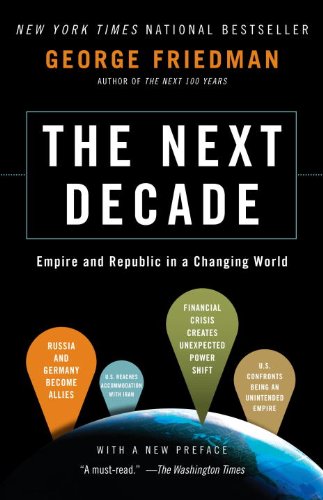
The author of the acclaimed New York Times bestseller The Next 100 Years now focuses his geopolitical forecasting acumen on the next decade and the imminent events and challenges that will test America and the world, specifically addressing the skills that will be required by the decade’s leaders. In the long view, history is seen as a series of events—but the course of those events is determined by individuals and their actions. During the next ten years, individual leaders will face significant transitions for their nations: the United States’ relationships with Iran and Israel will be undergoing changes, China will likely confront a major crisis, and the wars in the Islamic world will subside. Unexpected energy and technology developments will emerge, and labor shortages will begin to matter more than financial crises. Distinguished geopolitical forecaster George Friedmananalyzes these events from the perspectives of the men and women leading these global changes, focusing in particular onthe American president, who will require extraordinary skills to shepherd the United States through this transitional period. The Next Decade is a provocative and fascinating look at the conflicts and opportunities that lie ahead.
User’s Reviews
Reviews from Amazon users which were colected at the time this book was published on the website:
⭐This book was published in 2011, and now it is 2017. Even with the majority of this decade completed, this is still a comprehensive, daunting, and somewhat too Americanist book to work through. A clear example of the comprehensive nature of the book is the background material for Israel and Palestine. There is so much material astutely summarized it could facilitate a dozen episodes of Days of our Lives. And that is part of his point in this book, that a decade is much more intimate than a century and thus much more susceptible to the decision-making of the Presidency. And that is the primary institution on which he focuses, becauses it is so oriented to the wider world, with the ability to share foreign policy and deploy military force, while being comparatively hemmed in domestically. The author of this book seeks to fuse the idealistic and the realistic in what he refers to as the ‘Machiavellian Presidency’ and the reader is well advised to pay close attention to the section on Abraham Lincoln; among other things, the so-called Great Emancipator refused to emancipate slaves in areas where he could directly emancipate slaves so as to maintain a convincing war effort against the Confederacy. Roosevelt and Reagan are two other presidents that are central to the book’s analysis.This book can seem cold and detached to some readers. For example, the so-called Great Recession is referred to with reasonable thoroughness, yet the discussion may seem rather aloof for a downturn that witnessed a net loss of jobs in one month of over 700,000 and of unemployment benefits extended into the range of eighteen months. Yet that is a large part of what the author is aiming at: to apply a dispassionate way of understanding so as to gain the greatest accuracy of this nation’s current situation and likely trajectory over the next several years. Mr. Friedman clarifies that such fiscal crises are actually semi-regular occurences, and reminds the reader of the Municipal bond crisis of the 70s, the Third World debt crisis of the 80s, and the S and L crisis of the early 90s. And he also clarifies that the GDP contraction of the Great Recession, 4%, was far milder than what occurred with the Great Depression (50%), and that the economic turbulence of the late 70s/early 80s was characterized by double-digit inflation, unemployment, and mortgage rates. What this leaves out, though, are the longer-term structural changes in the work force (longevity of employment decreasing to 5-8 years from 20+ years, defined benefit retirement plans being replaced with defined contribution plans, increased indebtedness related to consumer credit and university financing, and sharply reduced purchasing power) that are not directly reflected in the unemployment numbers or core ‘consumer price index’ inflation.And this book also dwells on the strategic mis-step of drilling down on one tactic – terrorism – at the price of more enduring principles (maintenance of regional balance of powers, identifying and using proxies to engage in conflict in the place of the US, and using ‘main force’ only as a last resort). Mr. Friedman uses the analogy of Pearl Harbor, which lead to a similar number of casualties and did not lead to a Global War on Naval Aviation. And there were drastic efforts made to re-assure the native US populace of their safety (given their assumption of security in their North American homeland) with the creation of the Transportation Security Agency and the Department of Homeland Security. While not simply public relations efforts, the results of these new security measures was not robust, and a determined commando could still bypass the perimeter. And there was also the awkward after-effect of having up to 200,000 service members for several years. The initial agenda had been to decapitate the Iraqi government and replace it with a more pro-western, democratic government. The Bush administration had not counted on the wholesale collapse of the Iraqi government, military, and infrastructure.And this invited the option of actually negotiating with Iran to become the new central power of the Middle East, as neither Turkey nor Saudi Arabia had sufficient force projection capacity to maintain order. There has been great tension between the US and Iran going back to the 70s and even earlier. The occupations of Iraq and Afghanistan found the US with hundreds of thousands of troops on either side of Iran and with no sound strategy for regime change in Iran. The nation is geographically a fortress, direct invasion would be far too resource-intensive, and the Iranian military has the clear-cut option to effectively shut down the Straits of Hormuz (through which 45% of the world’s oil is shipped). Therefore this presents the US with the option of entente with Iran as a way to avoid permanently garrisoning the region.Mr. Friedman brings this book to a close by summarizing that this decade will be one of recovery and transition. Recovery from the relative devastation of the Great Recession (with housing values returning to historic norms) and from the eight years of combat operations in Iraq and Afghanistan. And there will be relatively little in the way of innovation: ‘The next decade will be a period in which technology lags behind needs. In some cases, existing technologies will reach the limits of how far they can be stretched, yet replacement technologies will not be in the pipeline. Which isn’t to say that there won’t be ample technological change; electric cars and new generations of cell phones will abound… the next generation of notable technological breakthroughs won’t emerge until the 2020s.’The major difference this time around is that relatively little has come from this extensive military activity, with the large volume of activity in the two Muslim nations having been primarily light infantry affairs that facilitated better up-armored transportation (like the Mine-Resistant Ambush Protected vehicles) but none of the major breakthroughs that previous engagements facilitated. Technologies that may well come online in future decades, like robotics and space-based solar, are not yet available (although a lot of initial-stage research has been taking place). The genuine exception, in the category of technological innovation, is that of hydraulic fracturing, which will experience much broader implementation in this decade.Issue by issue, and region by region, this book provides some very good analysis. And the overall framework, that of the Machiavellian Presidency, is quite productive as well. For the most part, I read this book in one day off from work. The exception I primarily take is the notion of the United States as an imperial power. Again, I am not disagreeing with the specific examples he gives (such as changes in American consumer preferences can have rather drastic impacts in other nations’ economic activities). I just find it less than convincing that the U.S. is an imperial power simply due to the fact that the Soviet Union collapsed in the early 90s. As percentage of global economic activity, I would imagine the U.S. has declined sharply over the last fifty years. China and India were not active participants in the world economy then, and twenty years before that the other major world powers, like Russia, Britain, Germany, France, and Japan were all in ruins. The reality is that the U.S. faces much more competition globally than it did one or two generations ago. And this goes along with the structural changes in the economy summarized above. Therefore, I find this to be an excellent ‘gazeteer’ of ongoing global developments and how the U.S. interfaces with those trends and at the same time dwells somewhat too heavily on the notionally imperial power of the U.S. when it evidently has been more powerful and more prosperous in previous decades after World War Two.
⭐In the 1950’s John Von Neumann was acknowledged as the greatest mathematician of the 20th century. A man so smart that the United States military said that when you asked Von Neumann a question, if he answered you, there was no need to think about it any longer. He was that far ahead of everyone else in the room. Author George Friedman is an extraordinary thinker, and he is paid to think, which makes for an interesting profession. Born in Hungary, and educated at the City College of New York, he has a Ph.D. in government from Cornell. He then teaches for 20 years at Dickinson College.His real deal however is that for years he would brief senior commanders in the armed services, and you can’t blow smoke when you do this. People simply get onto you, and they do not suffer fools gladly. For years now, he has run Stratfor which is a think tank specializing in intelligence matters. They also have a paid subscription service for those who are interested in current, cutting edge information on geo-political matters. He has authored more than a half dozen books, all of which have been profoundly interesting and what I call page-turners.In this book, The Next Decade, Friedman only goes out ten years in time compared to his previous work when he went out 100 years. It is the author’s contention that with the demise of the Soviet Union, the United States has become pre-eminent in the world militarily, politically, economically, and no one is even close. We have become an EMPIRE like it or not. Now we may be an Empire that doesn’t like being an Empire similar to ancient Rome or Great Britain in the 19th century, but it doesn’t change facts, and the facts are we are what we are.The second theme of this book is that since we are an Empire, we must learn to manage the Empire, and at this, it does not seem that we have given it much thought. The author does a thorough job of going through three Presidents, Lincoln, FDR and Reagan, all of whom were great influences in the creation of our Empire. As Great Britain was the pivot point of the world up until WWI, the United States is now the pivot point or fulcrum of the world and that is not going to change. His feelings on China are darn right fascinating. He believes the so-called Chinese miracle will come to an end fairly soon, and China’s growth rate will slow down to that of a mature economic power. This may well be. It is also Friedman’s opinion that in another five years if China’s growth continues, they will still have a billion people living in abject poverty. You don’t read this kind of thinking anywhere else.Is An EMPIRE Worth the Price of a Republic?Friedman very clearly brings forth a concept that the very creation of an empire means a loss of liberty to some extent for its citizens. The question becomes how great a loss, but it is obvious that the author worries about this loss of liberty. Do we want our government to install sufficient numbers of computers at the National Security Agency to monitor one billion phone calls? What does this mean for democracy in America, and the loss of personal freedom associated with it? This is really the big question for the author, and it needs to be thought about and answered.On the foreign policy side, the author believes that terrorism cannot be eradicated from the earth, but sufficiently damaged as to bring it under control. Al Qaeda has sought to create chaos in the Muslim world, and reconstitute an Islamic Caliphate, which was a theocracy established by Mohammad in the 7th century. Clearly, this is not going to happen. At the same time, the United States invades Iraq, and then re-invades Afghanistan recently, a process Friedman refers to as slamming into the Muslim world. These are really spoiling attacks, and they cost us dearly in terms of treasure, and energy.We have put a trillion dollars into Iraq and we don’t even know the amount for Afghanistan, although we do know that one American solider costs us one million dollars per year to send overseas. That amounts to a billion dollars per 1,000 soldiers, a number that is not even comprehendible under normal thinking. Friedman’s answer seems to be that the United States should encourage regional balances of power. If we continue to build up Japan, South Korea and Indonesia, than we do not have to worry about China. This is because China will be concerned with their newly powerful neighbors.He feels that we have not created a proper working relationship with Russia, and we have driven the Russians into a working relationship with the Germans of all people. At first it does not make sense, but then when you follow his logic and this author always has impeccable logic, it does make sense. The Germans do not want any more immigration. They have massive problems with the people coming into the country now including the Arabs. At the same time, the Germans have massive technological expertise, on a par with America. The Russians have massive manpower and not technology. You can combine the two and both Germany and Russia will benefit. It makes sense, and this is why you read Friedman. So what is the answer for America in the event this alliance becomes stronger? The answer is we re-invigorate Poland, to offset the power created by Germany and its new friend Russia.CONCLUSIONI have always looked forward to George Friedman’s next new book. His thinking is refreshing, it’s original, it’s provocative, but most of all, it is always brilliant and cutting edge. Every time I read Friedman, I feel like I am the President of the United States getting a briefing on a topic. It is that good. When he talks about the United States being a DEEP POWER, and Europe being a WEAK POWER, it all becomes clear. It hits it right on the head when he says that we Americans don’t like being an Empire. We don’t want an Empire, but we like the BENEFITS OF ONE. We want all the growth potential of OPEN MARKETS but we don’t want the PAIN that comes from it. In politics we want and have enormous INFLUENCE in the world, but we don’t want other people’s RESENTMENT, and it goes hand in hand.Finally, we are a COMMERCIAL REPUBLIC. As a 200 year old country, we were built on TRADE. That is why we have the largest navy in history-to protect the sea lanes. As the dominant power on the earth we have to manage our power. We could choose not to, but if we choose to be oblivious to our power, than the author likens us to a rampaging elephant and that doesn’t seem helpful. Read the book and enlighten yourself. We are citizens of the most important country ever created. We owe it to ourselves to be individually responsible for our country’s acts. Buy the book today, and thank you for reading this review.Richard C. Stoyeck
⭐This is an outstanding book. Friedman starts from the viewpoint of the US and its need to maintain balances of power around the globe. It is now 7 years since the book was published and prospective readers might be excused for wondering why they should read it now. After all, we now know most of what has been happening during the decade! True, and on some of it, Friedman has been pretty spot on while on other areas he has not been so close. Where the book really excels is in its rapid summaries of the historical background to the different areas of the world. Bearing in mind that this is consciously a very US-based view of the world, you get a wonderful broad sweep of the histories, the strategies and the power plays going on in the world, most of which are still absolutely relevant even though the detail of how this is playing out may have changed in places. Friedman has also written another book called “The Next 100 Years”, which is probably even more thought-provoking. Read both!
⭐Good condition.
⭐The book was nice to have one.
⭐I liked the book. It actually doesn’t say much about the next decade, but talks a lot about history and how we got to where we are.
⭐I bought this book after reading ” the next 100 years ” and I was not disappointed .
Keywords
Free Download The Next Decade: Where We’ve Been . . . and Where We’re Going in PDF format
The Next Decade: Where We’ve Been . . . and Where We’re Going PDF Free Download
Download The Next Decade: Where We’ve Been . . . and Where We’re Going 2011 PDF Free
The Next Decade: Where We’ve Been . . . and Where We’re Going 2011 PDF Free Download
Download The Next Decade: Where We’ve Been . . . and Where We’re Going PDF
Free Download Ebook The Next Decade: Where We’ve Been . . . and Where We’re Going