

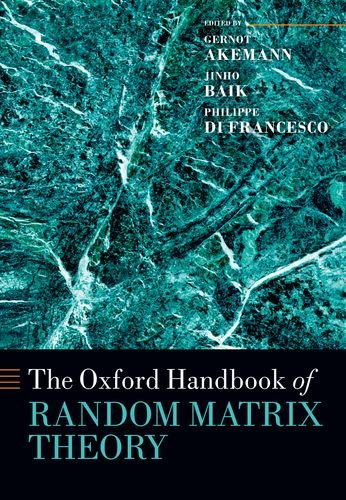
Ebook Info
- Published: 2011
- Number of pages: 960 pages
- Format: PDF
- File Size: 49.73 MB
- Authors: Gernot Akemann
Description
With a foreword by Freeman Dyson, the handbook brings together leading mathematicians and physicists to offer a comprehensive overview of random matrix theory, including a guide to new developments and the diverse range of applications of this approach.In part one, all modern and classical techniques of solving random matrix models are explored, including orthogonal polynomials, exact replicas or supersymmetry. Further, all main extensions of the classical Gaussian ensembles of Wigner and Dyson are introduced including sparse, heavy tailed, non-Hermitian or multi-matrix models. In the second and larger part, all major applications are covered, in disciplines ranging from physics and mathematics to biology and engineering. This includes standard fields such as number theory, quantum chaos or quantum chromodynamics, as well as recent developments such as partitions, growth models, knot theory, wireless communication or bio-polymer folding. The handbook is suitable both for introducing novices to this area of research and as a main source of reference for active researchers in mathematics, physics and engineering.
User’s Reviews
Editorial Reviews: About the Author Gernot Akemann gained his PhD in theoretical physics at Leibniz Universitat Hannover in 1996. He was an EU Marie-Curie Fellow from 1996 until 1998. He has worked at MPIK Heidelberg and later at CEA SPhT, where he held a Heisenberg fellowship. He is currently Professor for Mathematical Physics at the Faculty of Physics, Bielefeld University, Germany.Jinho Baik gained his PhD in mathematics at New York University in 1999. He has been the recipient of the AMS Centennial Fellowship, the Sloan Research Fellowship and he won the CMFT2005 Young Researcher Award. He is currently an associate professor in the Department of Mathematics, University of Michigan.Philippe Di Francesco gained his PhD in theoretical physics in 1989 at the Universite Pierre et Marie Curie (Paris 6). He completed his habilitation in mathematics in 2004 at the Universite Paris Diderot (Paris 7). He was a postdoctoral researcher in the Department of Mathematics, Princeton and a professor with the Department of Mathematics, University of North Carolina. He has been a research member of IPHT, CEA Saclay since 1989.
Reviews from Amazon users which were colected at the time this book was published on the website:
⭐In the 1950s the great Hungarian-American physicist Eugene Wigner introduced the concept of random matrix, a Hermitian matrix whose elements are random variables. The distribution of eigenvalues of such random matrices are useful models in studying the properties of nuclear spectra whereby the Hamiltonian that govern the interaction among nuclear energy levels is unknown. Random matrix theory (RMT) and energy level statistics were further developed in the 1960s when physicists were investigating nuclear spectra but only in the early 1970s it gained the interest of mathematicians who discovered a connection between RMT and the Riemann zeta function.This 900+ pages handbook is a multi-author volume containing 43 chapters: chapters 1-2 (Part I) are introductory, chapters 3-23 (Part II) discuss about the properties of random matrices while chapters 24-43 (Part III) are concerned with the applications (mainly in physics) of RMT. Among the chapters of Part III, interesting applications of RMT that go beyond physics are those concerned with RNA folding, information theory, and financial markets. It is hoped that in the near future RMT will find interesting applications in other fields of science, particularly chemistry and biology. The standard text on RMT is Mehta’s Random Matrices, now in its 3-rd edition (2004). An overview of energy level statistics and its application to the study of nuclear spectra can be found in Porter’s book Statistical Theories of Spectra: Fluctuations (1965).
⭐Will keep me busy for a decade
⭐This book is very difficult content which areas are both Mathematics and Physics..Even though the students who belong to the Tokyo Universality will have to spent their times to this book to understand this book content absolutely..I contend to read and use this’s book for calculate 3,000 lines 3 raw matrix for secret program.
⭐
Keywords
Free Download The Oxford Handbook of Random Matrix Theory (Oxford Handbooks) in PDF format
The Oxford Handbook of Random Matrix Theory (Oxford Handbooks) PDF Free Download
Download The Oxford Handbook of Random Matrix Theory (Oxford Handbooks) 2011 PDF Free
The Oxford Handbook of Random Matrix Theory (Oxford Handbooks) 2011 PDF Free Download
Download The Oxford Handbook of Random Matrix Theory (Oxford Handbooks) PDF
Free Download Ebook The Oxford Handbook of Random Matrix Theory (Oxford Handbooks)