Ebook Info
- Published: 2006
- Number of pages: 368 pages
- Format: PDF
- File Size: 5.46 MB
- Authors: Eric R. Scerri
Description
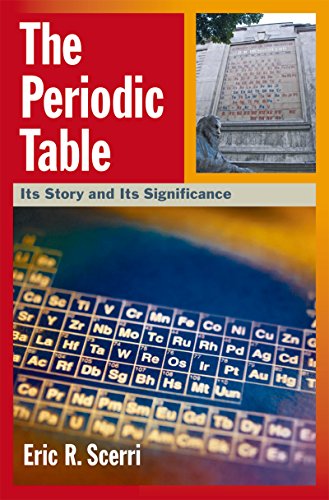
The periodic table is one of the most potent icons in science. It lies at the core of chemistry and embodies the most fundamental principles of the field. The one definitive text on the development of the periodic table by van Spronsen (1969), has been out of print for a considerable time. The present book provides a successor to van Spronsen, but goes further in giving an evaluation of the extent to which modern physics has, or has not, explained the periodic system. The book is written in a lively style to appeal to experts and interested lay-persons alike.The Periodic Table begins with an overview of the importance of the periodic table and of the elements and it examines the manner in which the term ‘element’ has been interpreted by chemists and philosophers. The book then turns to a systematic account of the early developments that led to the classification of the elements including the work of Lavoisier, Boyle and Dalton and Cannizzaro. The precursors to the periodic system, like Döbereiner and Gmelin, are discussed. In chapter 3 the discovery of the periodic system by six independent scientists is examined in detail.Two chapters are devoted to the discoveries of Mendeleev, the leading discoverer, including his predictions of new elements and his accommodation of already existing elements. Chapters 6 and 7 consider the impact of physics including the discoveries of radioactivity and isotopy and successive theories of the electron including Bohr’s quantum theoretical approach. Chapter 8 discusses the response to the new physical theories by chemists such as Lewis and Bury who were able to draw on detailed chemical knowledge to correct some of the early electronic configurations published by Bohr and others.Chapter 9 provides a critical analysis of the extent to which modern quantum mechanics is, or is not, able to explain the periodic system from first principles. Finally, chapter 10 considers the way that the elements evolved following the Big Bang and in the interior of stars. The book closes with an examination of further chemical aspects including lesser known trends within the periodic system such as the knight’s move relationship and secondary periodicity, as well at attempts to explain such trends.
User’s Reviews
Reviews from Amazon users which were colected at the time this book was published on the website:
⭐This is a fascinating exposition punctuated with a mixture of history, philosophy, physics and chemistry. Allow me to concentrate on one aspect of this book, quoting Scerri: “It is indeed something of a miracle that quantum mechanics explains the periodic table to the extent that it does at present.” (page 248).(1) Recently, I availed myself of McQuarrie’s Quantum Chemistry textbook. What impresses me anew is how awesome it is that presented with postulates of quantum theory and armed with some mathematical machinery, one is able to extract experimental numbers regarding atoms and molecular structure from so few theoretical inputs. As Scerri writes, it seems “a miracle.” Now, I wonder if what is really implied by the word “miracle'” is that earlier scientists (Mendeleev and others) were able to accomplish so much without benefit of a compass, a testable theory (experimental predictions despite absence of a working theory).(2) Scerri writes: Mendeleev’s “mature periodic system” first appeared in 1869 and that “Mendeleev had remained strongly opposed to any attempts to reduce, or explain, the periodic table in terms of atomic structure.” (page 183), but Scerri does not say why Mendeleev “remained strongly opposed.” Then, read: “…unlike physicists, chemists were working largely inductively with experimental data on the elements and not via theoretical arguments.” (in the first quarter of the twentieth century, page 205). And yet, the first-quarter of the twentieth century entails the timeframe of the “old quantum theory” (which is not a “theory”). We read “…most chemistry and physics textbook authors…imply that quantum mechanics does indeed provide a perfectly satisfactory deductive explanation of the periodic system…this fuels the general impression that chemistry is fully explained by quantum mechanics and has a negative effect on chemical education.” (page 232). Yet, quantum mechanics appears to “explain” things as well as they can be explained. As for being “satisfactory,” so long as the numbers from experiment coincide with numbers arrived at through quantum mechanics, what could be more satisfying ?(3) It is interesting to read of Niels Bohr: “Indeed, Bohr seems to have arrived at many configurations by appeal to chemical as well as other experimental data that he then dressed-up in quantum mechanical language through his characteristically obscure style of writing.” (page 224). Scerri presents the argument that Niels Bohr ruled the day (compared to contributions of chemist Charles Bury) due to “the prevailing reductionist climate.” But, keep in mind, we are still in the timeframe of the “old quantum mechanics.”(4) Later on, we arrive at what is now known as “quantum mechanics.” (chapter nine). Scerri uses the word “imperialistic” to describe how modern quantum mechanics “re-presents” the periodic system (page 248). I wondered if the use of the word “imperialistic” was meant to strike a negative tone ? Earlier on, reading: “the story of the early development of the periodic table demonstrates very effectively how scientific ideas can progress in spite of what appear to be mistakes.” (page 57).(5) Concluding my review: I enjoyed this book quite a bit. Resources are provided in 40 pages of endnotes, as there are no footnotes. The preface states the underlying theme for the entire book: “…examining the extent to which chemical models, or, indeed, the periodic system, can be explained by the most basic theory of physics, quantum mechanics.” (page xviii). Scerri has indeed provided much food for thought.
⭐This is a fantastically wonderful and eminently informative book about the development and adoption of the periodic table of elements. But it goes further, following the progress of those who first investigated the nature, structure and fundamental properties of the elements at the atomic level.Eric R Scerri is an accomplished chemist, educator, and he is an extraordinary writer capable of describing the technical in a way accessible to the general reader. I thoroughly enjoyed my trip through this narrative and discovered many people and ideas I had not encountered before.Of all those who contributed to our growing knowledge one of my favorites is Henry Moseley. The author, of course, does not leave him out and really impresses upon the reader his fantastically important contributions. I really think, had he not been killed at Gallipoli, he would have won a Nobel Prize.This book is for anyone curious about how the periodic table of the elements came to be and its significance. You will also be treated to an examination of the significance of quantum mechanics to chemistry and an illustration of how quantum mechanics does not, so far, provide a complete overview of the properties of the elements.
⭐Eric takes one through the trenches of how the periodic table has been developed and how it has evolved. It is a grind I appreciated when havingcompleted the book. I now know and appreciate the numerous issues involved in how the table is constructed. I just wish Eric would have devoteda section of this book to outlining the nature of all the types of relationships that do occur between the elements. We get it in bits and pieces.
⭐There are two versions of the periodic table’s history: The one you thought you knew, and the one Eric Scerri lays out in this delightful history. Do yourself a favor: Let him be your Virgil and reveal the much richer version of the story! Scerri — a chemist, historian, and philosopher all rolled into one — sleuths out what really happened in the creation and development of the table over more than a century of science history. He takes the static chart you remember on the wall in high school chemistry and shows how it was pieced together. (It certainly wasn’t just Dmitri Mendeleev…) Overall, Scerri provides a thorough scientific grounding in the table, and shows why its study is relevant to science today. Just as important, he balances the science with stories about the personalities behind it, revealing an eye for anecdote you won’t find in most other studies.Highly recommended for anyone who ever wondered how this scientific icon became an icon in the first place.-Sam Kean, author of The Disappearing Spoon
⭐While reading this book I realized how little I knew about the periodic table. You learn that in the chemistry lessons at school then at the university, but I think this book is a good complement for those seeking clearing some concepts. And lot of concepts and data flow in this book, explaining all the minds that in some way tried to get -and later obtained- the final and accepted periodic table.
⭐Not for the casual lay reader. I thought I was going to learn all about the elements, their discovery history and gain a deeper insight into the link between physics and chemistry. But if you don’t already know all the elements well, and have a pretty good foundation in physics, then much of what is stated is about abstruse arguments between physics and chemistry that can’t be of interest to a casual reader. While his scholarship is unquestioned, as other reviewers and the author himself has pointed out to me, his writing didn’t help this beginner to understand the Periodic Table.
⭐I really liked this indepth history of the periodic table. Easy to read style and well organized. College-level reading.
⭐Great book for learning all the key background to the periodic table
⭐Very good book if one is interested in the elements ,which I am , but be warned it can be a bit technical in places ,a moderate background in chemistry would be helpful in reading this book .
⭐This book is an extensive story about the discovery of the Periodic Table of the elements, very well written and told. I don’t give five stars because some historical facts are missing and some others seems to be there in order to demonstrate the thesis of the author, though without solid proofs. Moreover, I was expecting that the treatment of some topics would have had a more scientifically advanced and consistent base. Though, in general, this book is an excellent and almost complete introduction for further studies.
⭐research
⭐Consulta sobre las propiedades de algunos elementos su fecha de descubrimiento y sus principales propiedades.Me gustaría leer otro libro de este autor.
⭐
Keywords
Free Download The Periodic Table: Its Story and Its Significance 1st Edition in PDF format
The Periodic Table: Its Story and Its Significance 1st Edition PDF Free Download
Download The Periodic Table: Its Story and Its Significance 1st Edition 2006 PDF Free
The Periodic Table: Its Story and Its Significance 1st Edition 2006 PDF Free Download
Download The Periodic Table: Its Story and Its Significance 1st Edition PDF
Free Download Ebook The Periodic Table: Its Story and Its Significance 1st Edition