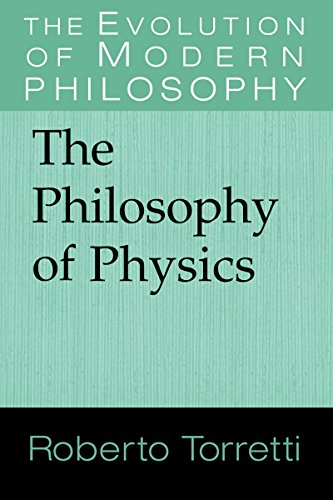
Ebook Info
- Published: 1999
- Number of pages: 532 pages
- Format: PDF
- File Size: 27.35 MB
- Authors: Roberto Torretti
Description
A magisterial study of the philosophy of physics that both introduces the subject to the non-specialist and contains many original and important contributions for professionals in the area. Modern physics was born as a part of philosophy and has retained to this day a properly philosophical concern for the clarity and coherence of ideas. Any introduction to the philosophy of physics must therefore focus on the conceptual development of physics itself. This book pursues that development from Galileo and Newton through Maxwell and Boltzmann to Einstein and the founders of quantum mechanics. There is also discussion of important philosophers of physics in the eighteenth and nineteenth centuries and of twentieth-century debates. In the interest of appealing to the broadest possible readership the author avoids technicalities and explains both the physics and philosophical terms.
User’s Reviews
Reviews from Amazon users which were colected at the time this book was published on the website:
⭐The basic problem with this book is that it does not deliver what the book promises. There is no original philosophical arguments in the book. It is mostly a compilation of basic physics and informal history of the field. Very disappointing for those looking for real philosophy of physics.
⭐This book, as much as I’ve read thus far, is easy to read and understand and gives the reader a “notion” of the origin of thoughts in Physics to glom onto.
⭐Torretti has done an excellent job of weaving the history and philosophy of physics into a rich ,flowing narrative that keeps the reader interested to the end of the book.Nor does the mathematical analysis get in the way.One can read this book and obtain great intellectual profit while simultaneously skipping most of the math.Torretti takes the reader on a journey that starts back in the 17th century with Galileo and Newton.He then moves on through the 18th and 19th centuries,covering the contributions of Kant and Boltzmann before arriving in the 20th century ,where he covers Mach,Einstein,Planck,Bohr,Heisenberg,and Schrodinger.All of the chapters are excellent.However,in my opinion,chapter 6 is the most interesting.It covers the famous 1926 meeting between Bohr,Heisenberg,and Schrodinger over how to deal with the apparent conflicts between Quantum Mechanics(microscopic particles )and General Relativity(macroscopic aggregates).The conflict between Einstein and Bohr over quantum mechanics and the famous exchanges between them centering on the concept of action at a distance, as presented by Einstein,Podolsky, and Rosen in their thought experiment concerning the mathematical spin properties of two particles and what interpretation makes sense(from Einstein’s realist position)about the results,is very well done,although Torretti appears to be too eager to accept the philosophical conclusions of Bohr’s argument(the purely mathematical points of debate ended in a draw,in my opinion.Bell’s 1964 proof established that if the EPR argument is accepted,then quantum mechanics is not only incomplete,but inconsistent).If one accepts Bohr’s argument,then a general field theory unifying the macro and micro analysis is not possible and you are left with distinct and separate fields of study forever.The reader might consider reading the same material as covered by Roger Penrose in his The Emperor’s New Mind(1989,pp.279-284).Penrose is neutral.He,however,demonstrates that Einstein and his coauthors raised a very important question.I have deducted one star from my rating due to the numerous errors presented on pp.437-438,441 by Torretti in his discussions of Logical theories of probability ,in general,and John Maynard Keynes’s logical theory of probability specifically.I will only correct a few of the errors present on those pages.First,Keynes’s and Wittgenstein’s theories are different.In fact,most probabilities for Keynes are interval(set)estimates and not precise,numerical probabilities as they are for Wittgenstein.Second,the Ramsey-De Finetti-Savage theory of subjective probability ,dealing with degrees of belief ,is a very special case of Keynes’s general theory of probability,which deals with rational degrees of belief.The subjectivist theory of probability requires that all probabilities be linear,unique,additive,precise,single number,fully weighted estimates of degrees of belief that require the holder of such an approach to bet on all propositions.Unfortunately,Ramsey’s reviews of Keynes’s logical approach to probability dealt generally with only one chapter in Keynes’s A Treatise on Probability(1921),chapter III.Keynes’s full theory was developed in chapters 5,10,12,15,17,20,22,and 26.Torretti fails to subject the Ramsey claims to the careful scrutiny that one would expect a philosopher to bring to bear.
⭐This is an outstanding book about the conceptual development of modern theoretical physics, from Newton to Quantum mechanics, and its philosophical implications. The general slant of the work is mainly historical and philosophical, but it also makes extensive use of mathematics (calculus and vector spaces). A summary of the contexts may be in order here.The first chapter provides some background to Newtonian physics. The second, discusses Newton’s concepts of mass, force, space, time and gravitation, and finishes with a technical section on Lagrange’s analytical formulation of mechanics. The next chapter is strictly philosophical and offers an assessment of Kant’s contribution to philosophy of nature in his Critique of Pure Reason. The chapter devoted to the 19th. Century deals successively with Non Euclidean geometries, field theories, and thermodynamics. It also reserves a long section for the work of the scientists-philosophers: Whewell, Peirce, Mach, and Duhem. The chapter on relativity stresses the geometrical approach, providing a detailed account of Minkoski’s spacetime. It follows a review of the philosophical problems of special relativity, such as conventionality of simultaneity or the twin’s paradox, and briefer sections on general relativity and relativistic cosmology. The chapter on quantum mechanics is quite technical and a bit tortuous. It begins with the older formalism of matrix and wave mechanics, and then it presents the standard Hilbert space formalism. There is a thorough analysis of philosophical problems, including the EPR argument, the measurement problem, hidden variables theories and quantum logic.The last chapter contains general philosophical reflections on the nature of physical theories. The author subscribes to the so called estructuralist view of theories, an approach associated, among others, with the names of P. Suppes and J. Sneed in the US, and W. Stegmuller and W. Balzer in Germany. According to this conception, a physical theory is not a system of statements that intend to be true -or approximately true- of the physical world. Physical theories are rather concepts or predicates, which are true or false of a family of, purported models. These models, in turn, are idealized representations of physical systems or aspects of the physical world.A final appendix provides the required definitions of higher mathematical concepts, such as vector spaces, Hilbert spaces, lattices, and topology. It is a very good refresher for the reader with enough mathematical background, but, on my view, it is too brief and compact for those who want to learn these topics from the scratch. The thirty three-page bibliography is rich and comprehensive, especially on original sources of modern physics in any language (nonetheless, there are some omissions of works quoted in abbreviated form in the footnotes). The scope of the book is really wide and almost complete, but I have missed a section on elementary particle physics.In conclusion, it is a long and demanding, but not less rewarding, work, in which the reader may learn history, physics, and philosophy at the same time. Although it is not highly technical, its rather abstract style makes it more suitable for graduate level studies in science and philosophy. Strongly recommended for lovers of mathematical physics with a philosophical slant.
Keywords
Free Download The Philosophy of Physics (The Evolution of Modern Philosophy) in PDF format
The Philosophy of Physics (The Evolution of Modern Philosophy) PDF Free Download
Download The Philosophy of Physics (The Evolution of Modern Philosophy) 1999 PDF Free
The Philosophy of Physics (The Evolution of Modern Philosophy) 1999 PDF Free Download
Download The Philosophy of Physics (The Evolution of Modern Philosophy) PDF
Free Download Ebook The Philosophy of Physics (The Evolution of Modern Philosophy)