Ebook Info
- Published: 2014
- Number of pages: 322 pages
- Format: PDF
- File Size: 6.17 MB
- Authors: Barry Parker
Description
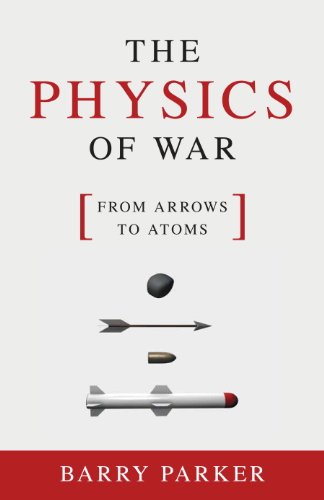
This fascinating blend of popular science and military history examines the science of war, demonstrating the close connection between the discovery of basic physical principles and the development of weaponry over the ages.Physics has played a critical role in warfare since the earliest times. Barry Parker highlights famous battles of the past as well as renowned scientists and inventors such as Leonardo, Galileo, Newton, Maxwell, and Einstein whose work had an impact on the technology of combat. Mechanics and the laws of motion led to improved shell trajectories; gas dynamics proved important to the interior ballistics of rifles and cannons; and space exploration resulted in intercontinental missiles, spy satellites, and drone aircraft.Parker emphasizes the special discoveries that had revolutionary effects on the art of warfare: the Chinese invention of gunpowder, the development of firearms, the impact of the Industrial Revolution, the deployment of the airplane in the First World War, and in our era the unleashing of the enormous power inherent in nuclear fission and fusion.
User’s Reviews
Reviews from Amazon users which were colected at the time this book was published on the website:
⭐The Physics of War: From Arrows to Atoms by Barry Parker”The Physics of War” is a fun and easy-to-read book that shows the close connection between physics and the development of weaponry over time. Professor emeritus at Idaho State University and author, Barry Parker provides the public with an accessible book that highlights famous battles and the most significant science behind them. This solid 322-page book includes the following eighteen chapters: 1. Introduction, 2. Early Wars and the Beginning of Physics, 3. Basic Physics of Early Weapons, 4. The Rise and Fall of the Roman Empire and the Early English-French Wars, 5. Gunpowder and Cannons, 6. Three Men Ahead of Their Time, 7. From Early Guns to Total Destruction and Discovery, 8. The Impact of the Industrial Revolution, 9. Napoleon’s Weapons and New Breakthroughs in Physics, 10. The American Civil War, 11. Where Does the Bullet Go?, 12. Hey, Look…It Flies!, 13. The Machine Gun War – War World I, 14. The Invisible Rays, 15. Sonar and the Submarine, 16. The Great War, 17. The Atomic Bomb, and 18. The Hydrogen Bomb, Intercontinental Missiles, Lasers, and the Future.Positives:1. A very accessible book intended for laypersons. It’s easy to read and Parker keeps the math to a very basic level.2. A fascinating topic. The important role that physics has played in the development of weapons, from chariots to drones.3. Parker has great command of the topic. He presents the war history, the “wonder weapon” and the technology and science behind it. “Known as the Hundred Years’ War, this period yielded one of the greatest advances in weaponry. It first appeared in the Battle of Crécy in 1346, and it was called the longbow.”4. Does a good job of explaining the basic physics. “The principle of conservation of momentum. It states that the total momentum of any isolated system remains constant. This means that the total momentum before the collision will be equal to the total momentum after it, assuming there are no outside influences.”5. Very good at introducing weaponry and establishing when they were first used and by whom. “The cannon was first used by the English in the Hundred Years’ War, which started in 1337 and ended in 1453. It was a long war that was fought off and on between the French and English.”6. The scientists behind the physics. Leonardo da Vinci’s military inventions. “Because Leonardo was employed so frequently as a military engineer, most of his inventions were war machines.”7. No book of physics would be worth reading without going through the contributions of Sir Isaac Newton. “Newton solved this mystery with his law of gravity. It is as follows: every particle in the universe attracts every other particle of matter with the force that is personal to the product of their masses and inversely proportional to the square of the distance between them. In mathematical terms this is F = m1m2/r2, where F is force, m1 and m2 are masses, and r is the distance between them.”8. The impact of the Industrial Revolution. “The revolution in England, which began about 1760, was fueled mostly by three technical advances: James Watt’s steam engine, John Wilkinson’s new techniques for iron production, and new techniques in the textile industry.”9. The contributions of Michael Faraday. “Within a few years Faraday’s work led to two very important inventions: the electrical generator and the transformer.”10. An interesting look at the American Civil War. “In addition, developments in physics and other sciences led to the wartime use of the electric telegraph, electric generators, surveillance balloons, better and larger ships, torpedoes, and significantly improved telescopes.”11. Ballistics. “To see why a spinning bullet was so revolutionary, we have to look at the physics of a spinning object. When an object of any type rotates, it rotates around an axis, and this axis of rotation acquires a special status. In the case of a bullet in flight (shot from a rifle) there are two motions we have to consider: its translational motion (that gives it its trajectory) and its rotational motion.”12. Where mass production meets history. “The Civil War was, in fact, one of the first truly industrialized wars. Mass-produced weapons, ironclad steamships, large factories producing various goods for the war, railroads, and so on all played important roles.”13. Fascinating historical tidbits. “In 1844 it was paraded out before President Tyler and a large audience in Washington, DC. Stockton, eager to show off its guns, ordered a demonstration. As the third shot was fired, the large gun exploded, spraying the attending crowd with fragments of iron. The secretary of state, the secretary of the navy, and several other officials were killed. It was a tremendous blow to both Stockton and Ericsson, who had helped in the design.”14. The science behind flight. “One of the most important people in the history of aeronautics, however, was the engineer George Cayley of England. He is usually considered to be the first person to understand most of the basic underlying principles and forces involved in flight, and because of this he has frequently been referred to as the father of aerodynamics.”15. The development of the machine gun. “The machine gun played such a central role in the war that World War I is now sometimes referred to as the machine-gun war.”16. Poisonous gases. “Then Haber came up with the most dreaded gas of the war–mustard gas. The Germans used it for the first time against the Russians in September 1917. Mustard gas was almost odorless, and it caused serious blisters both internally and externally.”17. Electromagnetic waves. “James Clerk Maxwell is regarded by many as one of the most important physicists ever born. His prediction of the existence of electromagnetic waves led to major advances in science and also to important changes in everyday life.”18. The physics of submarines. “And when it is floating its average density has to be less than that of water, but when it dives its average density has to be greater. So it obviously has to change its density, and it does this using ballast tanks that are on its outer surface. When these tanks are full of air the average density of the submarine is less than that of water, so the submarine floats. To submerge, the submarine releases the air through small vents and allows the tanks to fill with water. When they are full (or partially full), the average density of the submarine is sufficient for it to sink. To surface, air is pumped into the ballast tanks from a compressed air tank. It forces the water out.”19. The technology behind the Great War. “The British Spitfire was, without a doubt, one of the best. It was used very successfully against the Luftwaffe in the Battle of Britain. It had a maximum speed of approximately 350 miles per hour, and it performed well in climbs; furthermore, it was relatively easy to fly.”20. The atomic and hydrogen bombs. “The development of the atomic bomb is, without a doubt, one of the most impressive and awe-inspiring developments in history.”21. Links to notes and formal bibliography provided.Negatives:1. The book lacks depth. It is intended for laypersons. Engineers like me and scientists will find the book too basic.2. Tables, timelines, comparative charts, maps would have added value.3. The writing style though informative lacks panache.In summary, this was an easy book to pick up and read. Parker provides a good overview of the most significant battles of history and shows how physics in particular contributed to the technology of war. Laypersons looking for a synopsis of war history and science will enjoy this book. The writing style lacks panache and the science is basic but Parker succeeds in providing the general public with an accessible book the covers the science behind war. I recommend it!Further recommendations: “Engineers of Victory: The Problem Solvers who Turned the Tide in the Second World War” by Paul Kennedy, “The Science of War: Defense Budgeting, Military Technology, Logistics, and Combat Outcomes” by Michael E. O’Hanlon, “Corporate Warriors: The Rise of the Privatized Military Industry, Updated Edition (Cornell Studies in Security Affairs)” and “Wired for War: The Robotics Revolution and Conflict in the 21st Century” by P.W. Singer, “War Made New: Weapons, Warriors, and the Making of the Modern World” by Max Boot, “The Dawn of Innovation: The First American Industrial Revolution” by Charles R. Morris, “For the Love of Physics: From the End of the Rainbow to the Edge of Time – A Journey Through the Wonders of Physics” by Walter H.G. Lewin, “Science Matters: Achieving Scientific Literacy” by Robert M. Hazen “Fool Me Twice: Fighting the Assault on Science” by Shawn Lawrence, “Lies, Damned Lies, and Science” by Sherry Seethaler, and “Science Under Siege” by Kendrick Frazier.
⭐This is a very quick read indeed, which is a good thing. It is very skimmable. I learned a few intriguing nuggets, and refreshed my knowledge to the general sequence of scientific contributions to warfare. That was enough to make this a worthwhile read. Unfortunately it is written at a middle school level of language – my overwhelming impression was that this is a children’s book.It is very variable at connecting the nature of the challenge or opportunity and how physics made a contribution to overcome them. There is an explanation of the magnetron, which contains a diagram, but requires a sophisticated prior knowledge of electro-magnetism to even comprehend. Another appalling example is his discussion of the challenge of Longitude (the subject of Dava Sobel’s eponymous book). The solution appears as described in two inaccurate and trivial sentences: “In the end, the best solution was an accurate clock for the ship, and it came when the British clockmaker, John Harrison, realized that pendulums could not be used for clocks at sea. He devised a spring driven clock, and it worked beautifully.” I do not know where to start with this – everyone knew that pendulums didn’t work on ships, and it took Harrison most of a life time to come up with an accepted solution. No discussion of the nature of the physics of springs.So, skim away, but so disappointing.
⭐An easy read. Covers history from the Greek and Roman era to modern. Some errors in the history, full of formulas, Some not easy for the layman.Written as for the high school age.
⭐First few chapters on early warfare development are interesting, goes down hill from there with political background of WWI and II.
⭐Needed an editor with a heavy hand.
⭐I am glued to this book. If you are interested in the subject you must read this book. I will add to the review after the read.
⭐Not well written, thus not good at explaining physics, warfare or the relations between them. All of physics is covered in about 3 pages, meaning it is slapdash, hurrried and not comprehensive. All of the warfare just reads as dry facts, thus not exciting or captivating. Not recommended. Not finishable either. Repetitive, poorly edited, lacking descriptions of the interesting items (why was a caravel different?) with extensive repetition of the uninteresting items (yes, we have seen the dates of the 30 years war three times now).
⭐Quite a few parts of this book end rather abruptly which is both aggravating and frustrating. There is too little thought to the flow of the book and it reads like a series of short pieces stitched together.
Keywords
Free Download The Physics of War: From Arrows to Atoms in PDF format
The Physics of War: From Arrows to Atoms PDF Free Download
Download The Physics of War: From Arrows to Atoms 2014 PDF Free
The Physics of War: From Arrows to Atoms 2014 PDF Free Download
Download The Physics of War: From Arrows to Atoms PDF
Free Download Ebook The Physics of War: From Arrows to Atoms