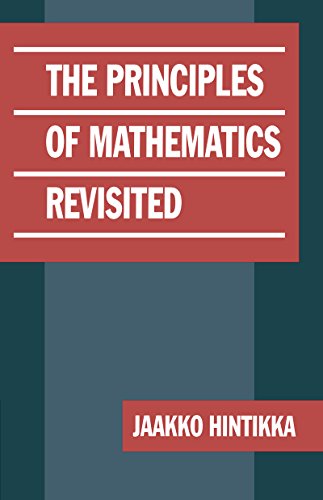
Ebook Info
- Published: 1998
- Number of pages: 304 pages
- Format: PDF
- File Size: 2.19 MB
- Authors: Jaakko Hintikka
Description
This book, written by one of philosophy’s pre-eminent logicians, argues that many of the basic assumptions common to logic, philosophy of mathematics and metaphysics are in need of change. It is therefore a book of critical importance to logical theory. Jaakko Hintikka proposes a new basic first-order logic and uses it to explore the foundations of mathematics. This new logic enables logicians to express on the first-order level such concepts as equicardinality, infinity, and truth in the same language. The famous impossibility results by Gödel and Tarski that have dominated the field for the last sixty years turn out to be much less significant than has been thought. All of ordinary mathematics can in principle be done on this first-order level, thus dispensing with the existence of sets and other higher-order entities.
User’s Reviews
Reviews from Amazon users which were colected at the time this book was published on the website:
⭐This book re-examines first-order logic as it has been applied to the foundations of mathematics. But it is much more than that. If you are interested in the human decisions behind why logics were built as they were, if you want to understand the impact of Godel’s Incompleteness Theorem, if you are interested in understanding philosophy of inferential systems in general, then you will find this book quite profound and useful.Requirements for reading this book are roughly: a general knowledge of syllogistic and first-order predicate logic, an idea of what Godel’s theorem is about and the concept of godel-numbering, some philosophy (e.g., ontology vs. epistemology), but mostly a keen interest at learning about logic and it’s foibles and potentials.Chapter 1 begins with the Hilbert program, and the attempt at axiomatization in general. Chapter 5 clears up alot of confusion about the Godel Incompleteness theorem and what it really means. He delineates between descriptive, semantic, deductive and Hilbertian completeness notions, and describes their inter-relatedness and Godel’s theorem’s role. These chapters alone are useful for gaining deeper understanding of the problems that arise in syntactic axiomatic deductive systems.Chapter 7 is on the Liar Paradox, and he offers a unique solution to that based not upon Austinian notions, but rather based upon Hintikka’s IF (“independence-friendly”) first-order logic which avoids resorting to infinities or relying on any semantic re-interpretation (Hintikka uses a simple formal statement “~T[d]” where d is the godel-number of that statement, as the basis of the discussion).He then goes on to discuss the presumed role of axiomatic set theory and chips away at it’s pretense as a secure foundational approach.But this merely scratches the surface. The book is primarily about the human decisions that were made, the reasoning behind them and why/where they failed. This is part of what makes it so readable and engaging. For Hintikka, logic and math seem to be very human activities, and there is no attempt to sanitize logic as being something pure or absolute.As an explication of human decision-making in logic, I think this book has important insights buried within and consequences for the inferential world of logic and mathematics, as well as reasoning in general. It will take several readings to grasp it’s profound implications.’IF logic’ itself (chapter 3) is a ridiculously simple and brilliant enhancement to first-order predicate logic, produced merely by lifting the mandatory left-to-right scoping restrictions Frege had placed on quantifiers in the syntax. And he extends (no pun intended) that notion by similarly lifting restrictions on mandatory scoping across operators as well. What arises looks very much like ordinary predicate logic, but the scoping independence opens up new vitality to the logic that makes it’s applicability broader, as well as philosophically more interesting.IF logic, in particular, is more amenable to being about imperfect information, and information independence (hence “independence-friendly logic”). Hintikka’s version of truth-definition is about a verification game (as in game theory), not a Tarskian retreat to a metalevel of formalism. Throughout, there are these kinds of comments and concepts on relating logic back to the world.IF logic is an intriguing example of how a subtle change in rules of syntax can have large consequences, and Hintikka is definitely pushing for it as -the- preferable first-order logic (actually, family of logics) over standard predicate logic. (And for game theoretical semantics and model theory as his preferred meta framework.) However, Hintikka’s salesmanship aside, the insights in the book are not dependant on IF as being -the- alternative, but as a demonstration of those insights.As a non-mathematician/non-logician, I had braced myself for a slog through a dry, tough read (particularly since there are nearly two decades of rust accumulated on my predicate logic skills) despite the positive reviews I had read on Amazon, but was pleasantly surprised at the lively writing style and also the modicum of formulae, with no tedious proofs to sweat over. Even the final chapter on “Epistemology of Mathematical Objects” is quite readable. And with some chapter headings like “Who’s Afraid of Alfred Tarski?” and “Axiomatic Set Theory: Fraenkelstein’s Monster?” you know the author enjoys his subject matter. 🙂
⭐I read this book last year and I found it both entertaining and interesting, but only recently I was struck by how profound it is. I find Mr. Hintikka’s insight into the dual use of logic (description vs. inference) and the conflict it caused in the development of logics (expressivity vs. axiomatic completeness) fascinating. He decisively resolves this conflict in favour of expressivity by introducing a brand of logic which is amazingly expressive yet non-axiomatizable. So, instead of proving propositions, we validate them through calculations in the semantic model.I don’t think this book will have the impact it should, only because the philosophical-logical establishment is already entrenched in certain ways of thinking that it can not abandon. And I think Mr. Hintikka is painfully aware of this. His tone is polemical, almost vitriolic at times, and it has a certain voice-of-reason-crying-in-the-wilderness streak to it. While entertaining, the style detracts from the importance of the book.I consider “The Principles of Mathematics Revisited” one of the most important books on logic ever. Its impact will not be immediate but it should eventually be momentous.
⭐I am a working mathematician with a PhD in Differential Geometry who has recently become interested in the foundations of Mathematics. I came to this book circuitously via a pdf by Jaakko called “A revolution in Logic”. Jaakko is on the offensive in this book, and he certainly can be polemic, to say the least. Having said that, the book is a tour de force: as a book on first order logic and IF, on the philosophy of mathematics, and the nature of mathematics and its objects and structures—it has gotten me thinking on many different levels. I would guess English is not his first language (due to easily corrected spelling, grammar, Etc), but despite this the writing style is quite smooth, with some interesting turns of phrases. I get the feeling this is one of the most brilliant books that I will ever have the pleasure of reading AGAIN and AGAIN! My 2cents David Thompson Assistant Professor of Mathematics and Computer Science Olivet College, Michigan
⭐Ce livre de Jaakko Hintikka (1929-2015) est l’un de ses ouvrages fondamentaux et la première version date de 1996, Les éditions successives datent de 1998 et 1999. Mieux vaut donc acheter les version corrigées de 1998 ou 1999. L’ouvrage reprend à nouveaux frais la question des fondements des mathématiques via l’outil mixte constitué de GTS et de la logique IF. C’est donc toute la philosophie et la logique de Hintikka qui converge ici vers une réinterprétation de la question qui avait occupé Russell dans The Principles of Mathematics au début du XXe siècle. On y retrouve la critique des approches compositionnelles du sens, les conceptions du langage et de la vérité exposées déjà dans Investigating Wittgenstein avec Merrill Hintikka, une tentative de définition de la vérité d’un langage dans ce langage même (contre Tarski) et de multiples autres analyses. L’ouvrage est donc essentiel à la compréhension du renouveau logiciste hintikkien, et n’a cessé de faire débat jusqu’à aujourd’hui, la question étant de savoir si Hintikka a vraiment réussi son pari.
⭐
Keywords
Free Download The Principles of Mathematics Revisited in PDF format
The Principles of Mathematics Revisited PDF Free Download
Download The Principles of Mathematics Revisited 1998 PDF Free
The Principles of Mathematics Revisited 1998 PDF Free Download
Download The Principles of Mathematics Revisited PDF
Free Download Ebook The Principles of Mathematics Revisited