

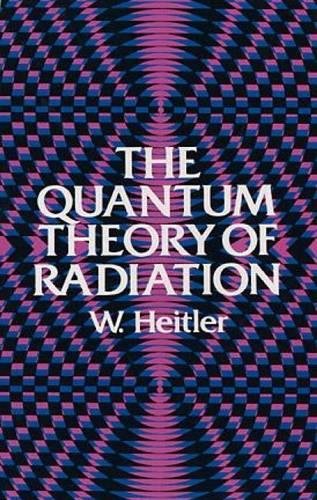
Ebook Info
- Published: 2010
- Number of pages: 464 pages
- Format: PDF
- File Size: 16.10 MB
- Authors: W. Heitler
Description
“It is difficult to imagine any more useful, or more instructive textbook than this.” — Transactions of the Faraday Society This book was the first comprehensive treatment of quantum physics to appear in any language. Originally published in 1936 as part of Oxford University Press’s famed International Series of Monographs on Physics, this book is a classic reference text. Although new particles have been discovered since the third edition was published in 1954, its presentation of quantum physics is still relevant because the basic theory remains unchanged. Moreover, its historical perspective is unique and its physical insight substantial; thus, it remains in demand among physics professors, students, and researchers. Beginning with Maxwell and Lorentz’s work, W. Heitler, in his lifetime a noted physics professor at the University of Zurich, covers seven major theoretical areas: • the classical theory of radiation• quantum theory of the pure radiation field• the electron field and its interaction with radiation• methods of solution• radiation processes in first approximation• radiative corrections and ambiguous features• the penetrating power of high-energy radiation Here is a unified and accurate guide to the application of radiative processes that explores the mathematics and physics of quantum theory. The author provides numerous examples to illustrate the conceptual material and deals with basic elements of the theory. Electrons, positrons, and radiation are all discussed as are the production, propagation, and detection of em radiation. Heitler’s thorough coverage of quantum physics has earned this landmark work an outstanding reputation among physicists and the book is highly recommended as both text and reference.
User’s Reviews
Editorial Reviews: From the Back Cover “It is difficult to imagine any more useful, or more instructive textbook than this.” — Transactions of the Faraday Society This book was the first comprehensive treatment of quantum physics to appear in any language. Originally published in 1936 as part of Oxford University Press’s famed International Series of Monographs on Physics, this book is a classic reference text. Although new particles have been discovered since the third edition was published in 1954, its presentation of quantum physics is still relevant because the basic theory remains unchanged. Moreover, its historical perspective is unique and its physical insight substantial; thus, it remains in demand among physics professors, students, and researchers. Beginning with Maxwell and Lorentz’s work, W. Heitler, in his lifetime a noted physics professor at the University of Zurich, covers seven major theoretical areas: • the classical theory of radiation• quantum theory of the pure radiation field• the electron field and its interaction with radiation• methods of solution• radiation processes in first approximation• radiative corrections and ambiguous features• the penetrating power of high-energy radiation Here is a unified and accurate guide to the application of radiative processes that explores the mathematics and physics of quantum theory. The author provides numerous examples to illustrate the conceptual material and deals with basic elements of the theory. Electrons, positrons, and radiation are all discussed as are the production, propagation, and detection of em radiation. Heitler’s thorough coverage of quantum physics has earned this landmark work an outstanding reputation among physicists and the book is highly recommended as both text and reference. About the Author Walter Heitler (1904–81) was a noted Professor of Physics at the University of Zurich who made contributions to quantum electrodynamics and quantum theory.
Reviews from Amazon users which were colected at the time this book was published on the website:
⭐Much of the original theory development for quantum mechanics (as we know it today) took place between 1900 and 1940, so references from that period take very little for granted in terms of the background that the reader needs. They also show how the original geniuses grappled with, and created the mathematical foundations of, the bizarre concepts in quantum theory. As with any textbook on the subject, having some background is definitely recommended as well as remembering three things: (1) there are many representations for the same thing, (2) very little of the math corresponds to anything we can measure or experience and (3) our understanding is still incomplete. That said, this book does a great job balancing derivations that demonstrate the formalism and conclusions that are general enough to be useful. In particular, I liked the handling of first vs. second quantization and radiation reaction. Get this book if you’re serious about learning quantum mechanics (QM). It was valuable even after 2 years of undergrad study and 4 years of graduate study in QM in my case.
⭐Classic reference for those working in plasma or atomic physics.
⭐To be honest, I am trying to learn formal QED, and this text is ‘feeding’ well. Heitler comes up with the goods..you feel you have actually covered some topic-(rather than some ‘lite’ or cryptic version). Having said that modern criticisms would be the usage of ‘old’ vector operations notation (minor taste criticism-you get used to the use of ‘[ , ]’ for vector products for example); and also omission of ‘Feynman diagrams’. However the additional material (to the 1934 edition) published in this reprinted 1954 edition gives reference to Feynman and Schwingers work prior to this date.For THE treatment of quantum bremsstrahlung theory (first approximation), here is the most oft quoted reference (with maybe an option on Kramers 1923 ‘Bohrian’ quantum paper)and arguably the most relevant. A must if only for this. Like most books written around this time in Dovers catalogue, it is well written, readable, and precise in the analysis- skipping math steps where truly reasonable. A gold mine for those of us trying to get to grips with the subject of the title.
⭐Heitler gives a clear, concise and accurate account of the interaction of charged particles and the electromagnetic field.This 3rd edition was published in 1953 but it is still one of the best accounts of the subject.
Keywords
Free Download The Quantum Theory of Radiation: Third Edition (Dover Books on Physics) in PDF format
The Quantum Theory of Radiation: Third Edition (Dover Books on Physics) PDF Free Download
Download The Quantum Theory of Radiation: Third Edition (Dover Books on Physics) 2010 PDF Free
The Quantum Theory of Radiation: Third Edition (Dover Books on Physics) 2010 PDF Free Download
Download The Quantum Theory of Radiation: Third Edition (Dover Books on Physics) PDF
Free Download Ebook The Quantum Theory of Radiation: Third Edition (Dover Books on Physics)