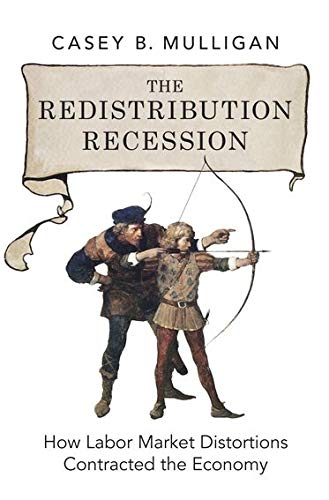
Ebook Info
- Published: 2012
- Number of pages: 368 pages
- Format: PDF
- File Size: 6.79 MB
- Authors: Casey B. Mulligan
Description
Redistribution, or subsidies and regulations intended to help the poor, unemployed, and financially distressed, have changed in many ways since the onset of the recent financial crisis. The unemployed, for instance, can collect benefits longer and can receive bonuses, health subsidies, and tax deductions, and millions more people have became eligible for food stamps.Economist Casey B. Mulligan argues that while many of these changes were intended to help people endure economic events and boost the economy, they had the unintended consequence of deepening-if not causing-the recession. By dulling incentives for people to maintain their own living standards, redistribution created employment losses according to age, skill, and family composition. Mulligan explains how elevated tax rates and binding minimum-wage laws reduced labor usage, consumption, and investment, and how they increased labor productivity. He points to entire industries that slashed payrolls while experiencing little or no decline in production or revenue, documenting the disconnect between employment and production that occurred during the recession. The book provides an authoritative, comprehensive economic analysis of the marginal tax rates implicit in public and private sector subsidy programs, and uses quantitative measures of incentives to work and their changes over timesince 2007 to illustrate production and employment patterns. It reveals the startling amount of work incentives eroded by the labyrinth of new and existing social safety net program rules, and, using prior results from labor economics and public finance, estimates that the labor market contracted two to three times more than it would have if redistribution policies had remained constant. In The Redistribution Recession, Casey B. Mulligan offers hard evidence to contradict the notion that work incentives suddenly stop mattering during a recession or when interest rates approach zero, and offers groundbreaking interpretations and precise explanations of the interplay between unemployment and financial markets.
User’s Reviews
Editorial Reviews: Review “Much of the policy reaction to the Great Recession emphasized Keynesian effects on aggregate demand and downplayed individual incentives to work, produce, and invest. In contrast, Casey Mulligan’s research focuses on how an expanded array of U.S. safety-net programs-food stamps, unemployment insurance, Medicaid, and housing/mortgage assistance programs-raised effective marginal income-tax rates especially for poor families. These diminished incentives to work help to explain the weakness of the U.S. economic recovery since the end of the recession in 2009 and also explain why Barack Obama is justifiably called the ‘Food-Stamp President.’ Hopefully, future government policymakers will deliver better results by learning from this important book.” –Robert J. Barro, Paul M. Warburg Professor of Economics, Harvard University “Professor Mulligan analyzes the question of why has labor supply remained low and unemployment remained high during the current recession. He finds that the expansion of government safety net programs along with their associated high marginal tax rates, decreases the economic incentives for labor supply. The question at issue is how much of the decrease in labor supply arises from these effects and their associated redistribution of income compared to the decreases in demand in sectors such as construction and manufacturing? He concludes that it is possible that nearly all or at least much of the decline in labor usage can be attributed to expansion of the social safety net. I highly recommend this sure to be controversial analysis of the effects of the Great Recession. Professor Mulligan has provided an innovative analysis of our current economic woes, which should cause most economists to rethink their views of what has gone wrong.” –Jerry Hausman, McDonald Professor of Economics,MIT “Casey Mulligan’s The Redistribution Recession presents a heterodox perspective on the Great Recession. The book argues that redistributive and other policies enacted to help cushion the blow of the financial and housing market collapses have reduced incentives to work, and thus had the unintended consequence of significantly lengthening and deepening the recession. The rich set of empirical analyses that Mulligan presents in support of this argument challenges the view that the problem of recovering from the Great Recession remains solely one of insufficient aggregate demand. Moreover, the analysis will likely provide a foundation for future research on the Great Recession and how policymakers responded to it.” –David Neumark, Chancellor’s Professor of Economics and Director, Center for Economics & Public Policy, University of California-Irvine “The endless campaign rhetoric on what to do about the recent recession left many wondering who or what was at fault. This book is an excellently researched attempt to provide an answer. Though the explanations and conclusions Mulligan presents are accessible to general readers, the methodology and econometric analysis require sophisticated training. This book provides a wealth of scholarly data and analysis…highly recommended.”–CHOICE “While by no means presenting the whole story (as Mulligan himself agrees), the book challenges many of the widely accepted views of the Great Recession… the book unquestionably presents serious economic analyses, thus taking the discussion to a more sophisticated level.” –Journal of Regional Science About the Author Professor of Economics, University of Chicago, author of Parental Priorities and Economic Inequality, weekly contributor to Economix blog for the New York Times
Reviews from Amazon users which were colected at the time this book was published on the website:
⭐You’ll need an Econ 101 background to fully appreciate Mulligan’s mathematical model, but the book contains a lot of important information accessible to the non-mathematically inclined. Mulligan looks carefully at the employment of different groups since 2009. It turns out that people who weren’t eligible for welfare worked about the same number of hours or even more since the Collapse of 2008. Americans who could get various kinds of welfare benefits, as long as they didn’t earn much, responded by working less or not working at all.One thing that distinguishes this book from more conventional literature is that Mulligan looks at means-tested debt relief, including mortgage relief. It turns out that the government set things up so that lower-income Americans with mortgages could save $1.31 for every $1 by which they cut their earnings from wages. I.e., people who worked less actually had more spending power.The book also provides a good survey of more standard economic research, e.g., the extent to which a higher minimum wage will cut employment and the extent to which people respond to extra welfare benefits by cutting their working hours. Very relevant right now to the political discussion around increasing minimum wages to $15/hour.
⭐Possibly the most important economics book of the decade but an incredibly difficult read. If you don’t have a graduate degree in economics, as I do, you’ll find it the toughest read of your life. Equation on top of equation, dense prose, obtuse diagrams, confusing tables; all the necessary ingredients to drive the average reader insane. But the content is wonderful! With vast detail and brilliant analysis, the author demonstrates how the government turned a bad recession into an unemployment nightmare. That’s on top of the Goldman Sachs Demopublicans bailing out Wall Street at the expense of Main Street. Furthermore, these results strongly support the growing fear that Obamacare will be another unemployment disaster. If you believe it’s an accident that Obamacare’s employer provisions have been suspended for the coming election year, I have a bridge to sell you.
⭐While the focus of most discussions following the crisis has (correctly, in my opinion) be centered in the financial markets, too little attention has been paid to how the policy responses affect incentives in labor supply. The general presumption seems to be that labor market frictions explain all that is going on in this market. Although we need not agree with the whole analysis, as usual, Casey Mulligan comes up with a different angle that should not be dismissed, but closely scrutinized.
⭐Well reasoned, but also a little difficult to read. I had to reference many equations and concepts as I am not an economist. Besides the crash course on higher level economics the book laid out a great argument it backed up well.
⭐As a guess, the book contains maybe 100 formulas, including a couple apparently using calculus, about 50 graphs and maybe 25 tables. This is not an accessible book for the common folk or even people with PhDs in other fields. Think of it as a journal article that is too long for a peer-reviewed journal. You have been warned.
⭐Excellent and original. As a fellow economist I devoured the book and its content. Real, accurate and easy to read. Totally explains the labor changes due to tech, etc
⭐Unlike the two previous reviewers I have actually read the book. The author is a professor of economics at the University of Chicago who has written extensively about the gender wage gap, the economics of aging, Social Security, capital and labor taxation and voting. Professor Mulligan is the recipient of numerous awards including the Alfred P. Sloan Foundation, The John M. Olin Foundation and the National Science Foundation. He is not a supporter of Keynesian economics and is considered by many to be the antithesis of Paul Krugman.The thrust of this book is that the overly generous social safety net programs have caused the lethargic recovery from the recession and intractably high unemployment rate. Mulligan believes that redistribution of wealth undermined the incentive to work and damaged productivity.The Obama administration’s excessive levels of spending, with the complicity of Congress, have caused a rise in unemployment much higher than it would have been otherwise.Since 2007, many essential traits of the economy and the labor market have changed radically. Congress raised the minimum wage three times in the past five years, thus increasing the cost of labor and decreasing the available number of jobs. With the exception of Medicaid, subsidies bestowed on the unemployed in the forms of loan forgiveness and government transfers almost tripled. The liberality of mean-tested subsidies like food stamps and unemployment insurance has steadily increased. Consumer loans, mortgages, business debts and tax debts forgiveness has been vastly expanded and “government transfers almost tripled”. The average yearly benefit for not working rose from $10,000 in 2007 to $16,000 in 2009 and keeps on growing. Unemployment benefits that have now been expanded from six months to two years act as a disincentive to seek work. This is diametrically opposed to the Obama administration theory, that government-provided benefits promote consumer spending, which leads to an improved economy and stimulates more job openings and employment.Labor economist Casey B. Mulligan argues that it was not a lack of spending that caused the economy to decline and cause lay-offs but that “Businesses perceived labor to be more expensive than it was before the recession began” because of the added generous unemployment benefits shrank the supply of workers. Mulligan showed that ” businesses increased their use of production input other than labor hours”, meaning that they automated and replaced workers with machines.Mulligan demonstrates that a combination of higher marginal tax rates and a higher federal minimum wage worsened the unemployment crisis, and, why labor market upheavals suddenly increased, and to what degree those increases were caused by the various measures enacted to boost the labor market. He does not question or deny that a surge in social benefits was necessary to forestall poverty and its devastation of unemployed families. He matter-of-fact analyses the deleterious effect of short-term subsidies on long-term general economic welfare.Even though I somewhat disagree with the author’s unconventional and counter-intuitive conclusions, that were reached by analyzing the labor market at the aggregate level, I recommend “The Redistribution Recession” as an intelligently thought out treatise, concise, well written and researched. Policymakers on both sides of the isle should read this book.
⭐before submitting a review. B Edwards gave this book two stars after admitting that he hadn’t read it. He claims the price is too high. My review is based on nothing other than his review. If Amazon is willing to allow someone to trash a book based only on its price, I should be able to laud it, if only to offset the earlier review.
Keywords
Free Download The Redistribution Recession: How Labor Market Distortions Contracted the Economy in PDF format
The Redistribution Recession: How Labor Market Distortions Contracted the Economy PDF Free Download
Download The Redistribution Recession: How Labor Market Distortions Contracted the Economy 2012 PDF Free
The Redistribution Recession: How Labor Market Distortions Contracted the Economy 2012 PDF Free Download
Download The Redistribution Recession: How Labor Market Distortions Contracted the Economy PDF
Free Download Ebook The Redistribution Recession: How Labor Market Distortions Contracted the Economy