

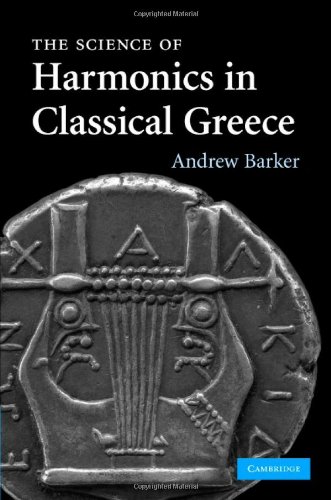
Ebook Info
- Published: 2007
- Number of pages: 496 pages
- Format: PDF
- File Size: 3.18 MB
- Authors: Andrew Barker
Description
The ancient science of harmonics investigates the arrangements of pitched sounds which form the basis of musical melody, and the principles which govern them. It was the most important branch of Greek musical theory, studied by philosophers, mathematicians and astronomers as well as by musical specialists. This 2007 book examines its development during the period when its central ideas and rival schools of thought were established, laying the foundations for the speculations of later antiquity, the Middle Ages and the Renaissance. It concentrates particularly on the theorists’ methods and purposes and the controversies that their various approaches to the subject provoked. It also seeks to locate the discipline within the broader cultural environment of the period; and it investigates, sometimes with surprising results, the ways in which the theorists’ work draws on and in some cases influences that of philosophers and other intellectuals.
User’s Reviews
Reviews from Amazon users which were colected at the time this book was published on the website:
⭐There are four disciplines that have substantial connections with ancient mathematics: harmonics, astronomy, optics, statics. Not enough has been said about harmonics in the history of science literature. It is not immediate what things are measured in harmonics and what it means to say that one note is higher than another note or what it means to assign ratios to intervals (diastemata), e.g. to say that the fourth is 4:3. The work of Aristoxenus was new to me, and he writes about finding a minimum interval against which other intervals can be measured (cf. Plato’s Republic 531a); this impinges on the question of minima naturalia in natural philosophy.We speak of one note being higher or lower than another note. It is not obvious from the phenomenon of hearing music why we should speak this way (namely if we do not have the connection between frequency and a note). “Just occasionally, a Greek writer speaks of notes as ‘above’ and ‘below’, ano and kato; but the usage is very rare. Where we would call a note ‘high’, a Greek would most commonly describe it as oxys; where we would call it ‘low’ it is barys. But oxys and barys do not mean ‘high’ and ‘low’; they mean ‘sharp’ and ‘heavy’. I have argued elsewhere that these designations are not conceptually neutral, amounting to nothing more than another way of labelling the same distinctions of pitch that we make, but that they radically condition the way in which the Greeks experienced and envisaged the phenomena.” (page 21)Another subject that appears in music theory is approximations to square roots. To divide an interval into two equal parts amounts to finding a square root, and the approximation 7:5 is used for the square root of 2. If a tone is 9:8, then a semitone is the square root of 9:8, and the approximation 17:16 is used.It would be helpful for scholars outside of music if the objects used in music theory were introduced formally. Without having long experience using musical instruments, the following terms may not say as much to the reader as the author wants them to: harmony, melody, attunement, note, scale, tone, semitone, interval, pitch, octave, fourth, fifth, enharmonic, diatonic, chromatic, concord, discord, modulation. If I am explaining different cuisines to an alien who is nourished by electricity, I will not casually mention the different pizza chains in North America before I defined precisely what food is, what pizza is, explain that pizza is sold, that stores can be part of chains, etc. Instead of saying that this book is bad because it doesn’t give definitions adequate for an outsider, I say that there is room in the literature for a book presenting Greek music theory as part of the history of science that builds up all the musical ideas from scratch.
⭐Une réorganisation du savoir Grec antique en matière de théorie de la musique. Une approche originale et synthétique à la charnière des mathématiques, de la musique et de la philosophie. Une nouvelle “topique” où toutes les difficultés fondamentales sont abordées et clairement cernées. Un nouveau regard sur la pensée antique et une nouvelle cristallisation du savoir. Ouvrage appelé à devenir un classique.Hugues Dufourt///A reorganization of ancient Greek knowledge in the field of music theory. An original and synthetic approach at the crossroads of mathematics, music and philosophy. A new “topic” where all the fundamental problems are addressed and clearly identified. A new look at ancient thought and a new crystallization of knowledge. Work destined to become a classic.Hugues Dufourt
⭐
Keywords
Free Download The Science of Harmonics in Classical Greece in PDF format
The Science of Harmonics in Classical Greece PDF Free Download
Download The Science of Harmonics in Classical Greece 2007 PDF Free
The Science of Harmonics in Classical Greece 2007 PDF Free Download
Download The Science of Harmonics in Classical Greece PDF
Free Download Ebook The Science of Harmonics in Classical Greece