

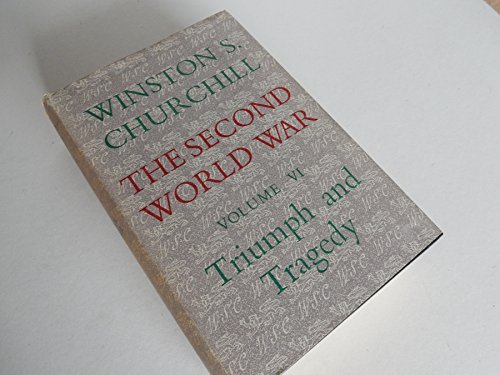
Ebook Info
- Published:
- Number of pages:
- Format: PDF
- File Size: 4.92 MB
- Authors:
Description
User’s Reviews
Reviews from Amazon users which were colected at the time this book was published on the website:
⭐Good read, completes the set of six. Good price
⭐Completed the series which was very good
⭐Arrived as advertised. I was filling a set of English editions.
⭐Sir Winston Leonard Spencer-Churchill (1874-1965) was a British statesman who was the Prime Minister of the United Kingdom from 1940 to 1945, and then again from 1951 to 1955. He won the Nobel Prize in Literature in 1953 for his historical works, such as (in addition to the present work)
⭐. In 1963, he was made an honorary citizen of the United States (one of only eight people so honored). The other volumes in this set are
⭐,
⭐,
⭐,
⭐, and
⭐. It is also available as a complete set:
⭐. [NOTE: page numbers below refer to the 683-page paperback edition.]He wrote in the Preface to this 1953 book, “This volume concludes my personal narrative of the Second World War. Between the Anglo-American landings in Normandy on June 6, 1944, and the surrender of all our enemies fourteen months later, tremendous events struck the civilized world. Nazi Germany was crushed, partitioned, and occupied; Soviet Russia established herself in the heart of Western Europe; Japan was defeated; the first atomic bombs were cast… I have told the story as I knew it and experienced it as Prime Minister and Minister of Defence of Great Britain… I have called this Volume ‘Triumph and Tragedy because the overwhelming victory of the Grand Alliance has failed so far to bring general peace to our anxious world.”He observes, “The ten Panzer divisions on the whole Western Front were spread-eagled from Belgium to Bordeaux. How strange that the Germans, now on the defensive, made the same mistake as the French in 1940 and dispersed their most powerful weapon of counter-attack!” (Bk. 1, Ch. 1, pg. 8)After finishing a visit to General Montgomery’s headquarters, “my aeroplane… awaited me. I was about to go on board when, to my surprise, Eisenhower arrived. He had flown from London to his advanced headquarters, and, hearing of my movements, intercepted me. He had not yet taken over the actual command of the army in the field from Montgomery; but he supervised everything with a vigilant eye, and no one knew better than he how to stand close to a tremendous event without impairing the authority he had delegated to others.” (Ch. 2, pg. 27)He records, “The long-awaited assault on England by unmanned missiles now began: the target was Greater London… The Flying Bomb, as we came to call it, was named ‘V1’ by Hitler, since he hoped—with some reason—that it was only the first of a series of terror weapons which German research would provide. To Londoners, the new weapon was soon known as the ‘doodlebug’ or ‘buzz bomb’ from the strident sound of its engine… This new form of attack imposed upon the people of London a burden perhaps even heavier than the aid-raids of 1940 and 1941. Suspense and strain were more prolonged. Dawn brought no relief, and cloud no comfort. The man going home in the evening never knew what he would find: his wife, alone all day or with the children, could not be certain of his safe return. The blind impersonal nature of the missile made the individual on the ground feel helpless. There was little that he could do, no human enemy that he could see shot down.” (Ch. 3, pg. 34)He adds, however, “We now know that Hitler had thought that the new weapon would be ‘decisive’ in fashioning his own distorted version of peace… But neither London nor the Government flinched, and I had been able to assure General Eisenhower… that we would bear the ordeal to the end, asking for no change in his strategy in France.” (Ch. 3, pg. 39) He continues, “we must not forget that Belgium suffered with equal bitterness when the Germans attempted to use the same vindictive weapons against its liberated cities. We did not allow the German attack to go unparried. Our bombing of German production centers, and other targets, happily reduced the scale of effort against Belgium as much as against ourselves… The people of Belgium bore this senseless bombardment in a spirit equal to our own.” (Ch. 3, pg. 47)He sent a communication to his Chiefs of Staff on September 8, 1944, which included the statement, “‘No one can tell what the future may bring forth…. Will the Germans withdraw from Italy? In which case they will greatly strengthen their internal position…. The fortifying and consolidating effect of a stand on the frontier of the native soil should not be underrated. It is at least as likely that Hitler will be fighting on January 1 as that he will collapse before then. If he does collapse before then, the reasons will be political rather than purely military.’ My view was unhappily to be justified.” (Ch. 13, pg. 170)Of discussions of a post-war United Nations, he comments, “The discussions had revealed many differences between the three Great Allies… The Kremlin had no intention of joining an international body on which they would be outvoted by a host of small Powers… I felt sure we could only reach good decisions with Russian while he had the comradeship of a common foe for a bond. Hitler and Hitlerism were doomed; but after Hitler what?” (Ch. 14, pg. 182)Of Stalin, he observed, “There is no doubt that in our narrow circle we talked with an ease, freedom, and cordiality never before attained between our two countries. Stalin made several expressions of personal regard which I feel sure were sincere. But I became even more convinced that he was by no means alone.” (Ch. 15, pg. 206)Of the Battle of the Ardennes, he said to the House of Commons on January 18, 1945, “I have seen it suggested that the terrific battle which has been proceeding since December 16 on the American front is an Anglo-American battle. In fact however the United States troops have done almost all of the fighting, and have suffered almost all of the losses… I never hesitate… to stand up for our own soldiers when their achievements have been cold-shouldered or neglected or overshadowed, as they sometimes are, but we must not forget that it is to American that the telegrams of personal losses and anxiety have been going during the past month…” (Ch. 27, pg. 243)He recalls, “There was another occasion during our stay at Yalta when things had not gone so smoothly. Mr. Roosevelt, who was host at a luncheon, said that he and I always referred to Stalin in our secret telegrams as ‘Uncle Joe.’ I had suggested that he should tell him this privately, but instead the President made it into a jocular statement to the company. This led to a difficult moment. Stalin took offense. ‘When can I leave this table?’ he asked in anger. Mr. [James] Byrnes saved the situation with an apt remark. ‘After all,’ he said, ‘you do not mind talking about Uncle Sam, so why should Uncle Joe be so bad?’ At this the Marshal subsided, and Molotov later assured me that he understood the joke.” (Bk. 2, Ch. 4, pg. 337)When dining with a Middle Eastern host, he recollects, “A number of social problems arose. I had been told that neither smoking nor alcoholic beverages were allowed in the Royal Presence. As I was host at luncheon I raised the matter at once, and said to the interpreter that if it was the religion of His Majesty to deprive himself of smoking and alcohol I must point out that my rule of life prescribed as an absolutely sacred rite smoking cigars and also the drinking of alcohol before, after, and if need be during all means and in the intervals between them. The King graciously accepted the position.” (Ch. 4, pg. 341)He points out, “It is easy, after the Germans are beaten, to condemn those who did their best to hearten the Russian military effort and to keep in harmonious contact with our great Ally, who had suffered so frightfully. What would have happened if we had quarreled with Russia while the Germans still had two or three hundred divisions on the fighting front? Our hopeful assumptions were soon to be falsified. Still, they were the only ones possible at the time.” (Ch. 4, pg. 345)He observes, “The destruction of German military power had brought with it a fundamental change in the relations between Communist Russia and the Western democracies. They had lost their common enemy, which was almost their sole bond of union. Henceforward Russian imperialism and the Communist creed saw and set no bounds to their progress and ultimate dominion, and more than two years were to pass before they were confronted again with an equal will-power…” (Ch. 8, pg. 391)He laments, “it may be said that Roosevelt died at the supreme climax of the war, and at the moment when his authority was most needed to guide the policy of the United States. When I received these tidings early in the morning of Friday, the 13th, I felt as if I had been struck a physical blow. My relations with this shining personality had played so large a part in the long, terrible years we have worked together. Now they had come to an end, and I was overpowered by a sense of deep and irreparable loss. I went down to the House of Commons… and in a few sentences proposed that we should pay our respects to the memory of our great friend by immediately adjourning. This unprecedented step on the occasion of the death of the head of a foreign State was in accordance with the unanimous wish of the Members…” (Ch. 9, pg. 403)In an April 17 address to Parliament, he noted, “at Yalta, I noticed that the President was ailing. His captivating smile, his gay and charming manner, had not deserted him, but his face had a transparency, an air of purification, and often there was a far-away look in his eyes. When I took my leave of him in Alexandria harbor I must confess that I had an indefinable sense of fear that his health and his strength were on the ebb. But nothing altered his inflexible sense of duty. To the end he faced his innumerable tasks unflinching… What an enviable death was his! He had brought his country through the worst of its perils and the heaviest of its toils. Victory had cast its sure and steady beam upon him.” (Ch. 9, pg. 407-409)He states, “Hitler’s Germany was doomed and he himself about to perish… The whole relationship of Russia with the Western allies was in flux. Every question about the future was unsettled between us. The understandings and agreements at Yalta, such as they were, had already been broken or brushed aside by the triumphant Kremlin. New perils, perhaps as terrible as those we had surmounted, loomed and glared upon the torn and harassed world.” (Ch. 11, pg. 437)He exults, “The unconditional surrender of our enemies was the signal for the greatest outburst of joy in the history of mankind. The Second World War had indeed been fought to the bitter end in Europe. The vanquished as well as the victors felt inexpressible relief. But for us in Britain and the British Empire, who had alone been in the struggle from the first day to the last and staked our existence on the result, there was a meaning beyond even what our most powerful ad valiant Allies could fee. Weary and worn, impoverished but undaunted and now triumphant, we had a moment that was sublime. We gave thanks to God for the noblest of all His blessings, the sense that we had done out duty.” (Ch. 13, pg. 469)He summarizes, “How stands the scene after eight years have passed? The Russian occupation line in Europe runs from Lübeck to Linz. Czechoslovakia had been engulfed. The Baltic States, Poland, Rumania and Bulgaria have been reduced to satellite States under totalitarian Communist rule. Austria is denied al settlement. Yugoslavia has broken loose. Greece alone is saved. Our armies are gone, and it will be a long time before even sixty divisions can be once again assembled opposite Russian forces… Only the atom bomb stretches its sinister shield before us. The danger of a Third World War, under conditions at the outset of grave disadvantage except in this new terrible weapon, casts its lurid shadow over the free nations of the world. Thus in the moment of victory was our best, and what might prove to have been our last, chance of durable world peace allowed composedly to fade away.” (Ch. 17, pg. 514)He suggests, “It would be a mistake to suppose that the fate of Japan was settled by the atomic bomb. Her defeat was certain before the first bomb fell, and was brought about by overwhelming maritime power. This alone had made it possible to seize ocean bases from which to launch the final attack and force her metropolitan Army to capitulate without striking a blow… We, an island Power, equally dependent on the sea, can read the lesson and understand our own fate had we failed to master the U-boats.” (Ch. 19, pg. 552)Of losing the 1945 election, he says, “The power to shape the future would be denied me. The knowledge and experience I had gathered, the authority and goodwill I had gained in so many countries, would vanish. I was discontented at the prospect… At luncheon my wife said to me, ‘It may well be a blessing in disguise.’ I replied, ‘At the moment it seems quite effectively disguised.’” (Ch. 21, pg. 577)Whether one reads it as history, or literature, this series will be absolute “must reading” for anyone even marginally interested in the Second World War. (At the very least, one should read an abridgement, such as
⭐).
⭐Sir Winston Leonard Spencer-Churchill (1874-1965) was a British statesman who was the Prime Minister of the United Kingdom from 1940 to 1945, and then again from 1951 to 1955. He won the Nobel Prize in Literature in 1953 for his historical works, such as (in addition to the present work)
⭐. In 1963, he was made an honorary citizen of the United States (one of only eight people so honored). The other volumes in this set are
⭐,
⭐,
⭐,
⭐, and
⭐. It is also available as a complete set:
⭐. [NOTE: page numbers below refer to the 683-page paperback edition.]He wrote in the Preface to this 1953 book, “This volume concludes my personal narrative of the Second World War. Between the Anglo-American landings in Normandy on June 6, 1944, and the surrender of all our enemies fourteen months later, tremendous events struck the civilized world. Nazi Germany was crushed, partitioned, and occupied; Soviet Russia established herself in the heart of Western Europe; Japan was defeated; the first atomic bombs were cast… I have told the story as I knew it and experienced it as Prime Minister and Minister of Defence of Great Britain… I have called this Volume ‘Triumph and Tragedy because the overwhelming victory of the Grand Alliance has failed so far to bring general peace to our anxious world.”He observes, “The ten Panzer divisions on the whole Western Front were spread-eagled from Belgium to Bordeaux. How strange that the Germans, now on the defensive, made the same mistake as the French in 1940 and dispersed their most powerful weapon of counter-attack!” (Bk. 1, Ch. 1, pg. 8)After finishing a visit to General Montgomery’s headquarters, “my aeroplane… awaited me. I was about to go on board when, to my surprise, Eisenhower arrived. He had flown from London to his advanced headquarters, and, hearing of my movements, intercepted me. He had not yet taken over the actual command of the army in the field from Montgomery; but he supervised everything with a vigilant eye, and no one knew better than he how to stand close to a tremendous event without impairing the authority he had delegated to others.” (Ch. 2, pg. 27)He records, “The long-awaited assault on England by unmanned missiles now began: the target was Greater London… The Flying Bomb, as we came to call it, was named ‘V1’ by Hitler, since he hoped—with some reason—that it was only the first of a series of terror weapons which German research would provide. To Londoners, the new weapon was soon known as the ‘doodlebug’ or ‘buzz bomb’ from the strident sound of its engine… This new form of attack imposed upon the people of London a burden perhaps even heavier than the aid-raids of 1940 and 1941. Suspense and strain were more prolonged. Dawn brought no relief, and cloud no comfort. The man going home in the evening never knew what he would find: his wife, alone all day or with the children, could not be certain of his safe return. The blind impersonal nature of the missile made the individual on the ground feel helpless. There was little that he could do, no human enemy that he could see shot down.” (Ch. 3, pg. 34)He adds, however, “We now know that Hitler had thought that the new weapon would be ‘decisive’ in fashioning his own distorted version of peace… But neither London nor the Government flinched, and I had been able to assure General Eisenhower… that we would bear the ordeal to the end, asking for no change in his strategy in France.” (Ch. 3, pg. 39) He continues, “we must not forget that Belgium suffered with equal bitterness when the Germans attempted to use the same vindictive weapons against its liberated cities. We did not allow the German attack to go unparried. Our bombing of German production centers, and other targets, happily reduced the scale of effort against Belgium as much as against ourselves… The people of Belgium bore this senseless bombardment in a spirit equal to our own.” (Ch. 3, pg. 47)He sent a communication to his Chiefs of Staff on September 8, 1944, which included the statement, “‘No one can tell what the future may bring forth…. Will the Germans withdraw from Italy? In which case they will greatly strengthen their internal position…. The fortifying and consolidating effect of a stand on the frontier of the native soil should not be underrated. It is at least as likely that Hitler will be fighting on January 1 as that he will collapse before then. If he does collapse before then, the reasons will be political rather than purely military.’ My view was unhappily to be justified.” (Ch. 13, pg. 170)Of discussions of a post-war United Nations, he comments, “The discussions had revealed many differences between the three Great Allies… The Kremlin had no intention of joining an international body on which they would be outvoted by a host of small Powers… I felt sure we could only reach good decisions with Russian while he had the comradeship of a common foe for a bond. Hitler and Hitlerism were doomed; but after Hitler what?” (Ch. 14, pg. 182)Of Stalin, he observed, “There is no doubt that in our narrow circle we talked with an ease, freedom, and cordiality never before attained between our two countries. Stalin made several expressions of personal regard which I feel sure were sincere. But I became even more convinced that he was by no means alone.” (Ch. 15, pg. 206)Of the Battle of the Ardennes, he said to the House of Commons on January 18, 1945, “I have seen it suggested that the terrific battle which has been proceeding since December 16 on the American front is an Anglo-American battle. In fact however the United States troops have done almost all of the fighting, and have suffered almost all of the losses… I never hesitate… to stand up for our own soldiers when their achievements have been cold-shouldered or neglected or overshadowed, as they sometimes are, but we must not forget that it is to American that the telegrams of personal losses and anxiety have been going during the past month…” (Ch. 27, pg. 243)He recalls, “There was another occasion during our stay at Yalta when things had not gone so smoothly. Mr. Roosevelt, who was host at a luncheon, said that he and I always referred to Stalin in our secret telegrams as ‘Uncle Joe.’ I had suggested that he should tell him this privately, but instead the President made it into a jocular statement to the company. This led to a difficult moment. Stalin took offense. ‘When can I leave this table?’ he asked in anger. Mr. [James] Byrnes saved the situation with an apt remark. ‘After all,’ he said, ‘you do not mind talking about Uncle Sam, so why should Uncle Joe be so bad?’ At this the Marshal subsided, and Molotov later assured me that he understood the joke.” (Bk. 2, Ch. 4, pg. 337)When dining with a Middle Eastern host, he recollects, “A number of social problems arose. I had been told that neither smoking nor alcoholic beverages were allowed in the Royal Presence. As I was host at luncheon I raised the matter at once, and said to the interpreter that if it was the religion of His Majesty to deprive himself of smoking and alcohol I must point out that my rule of life prescribed as an absolutely sacred rite smoking cigars and also the drinking of alcohol before, after, and if need be during all means and in the intervals between them. The King graciously accepted the position.” (Ch. 4, pg. 341)He points out, “It is easy, after the Germans are beaten, to condemn those who did their best to hearten the Russian military effort and to keep in harmonious contact with our great Ally, who had suffered so frightfully. What would have happened if we had quarreled with Russia while the Germans still had two or three hundred divisions on the fighting front? Our hopeful assumptions were soon to be falsified. Still, they were the only ones possible at the time.” (Ch. 4, pg. 345)He observes, “The destruction of German military power had brought with it a fundamental change in the relations between Communist Russia and the Western democracies. They had lost their common enemy, which was almost their sole bond of union. Henceforward Russian imperialism and the Communist creed saw and set no bounds to their progress and ultimate dominion, and more than two years were to pass before they were confronted again with an equal will-power…” (Ch. 8, pg. 391)He laments, “it may be said that Roosevelt died at the supreme climax of the war, and at the moment when his authority was most needed to guide the policy of the United States. When I received these tidings early in the morning of Friday, the 13th, I felt as if I had been struck a physical blow. My relations with this shining personality had played so large a part in the long, terrible years we have worked together. Now they had come to an end, and I was overpowered by a sense of deep and irreparable loss. I went down to the House of Commons… and in a few sentences proposed that we should pay our respects to the memory of our great friend by immediately adjourning. This unprecedented step on the occasion of the death of the head of a foreign State was in accordance with the unanimous wish of the Members…” (Ch. 9, pg. 403)In an April 17 address to Parliament, he noted, “at Yalta, I noticed that the President was ailing. His captivating smile, his gay and charming manner, had not deserted him, but his face had a transparency, an air of purification, and often there was a far-away look in his eyes. When I took my leave of him in Alexandria harbor I must confess that I had an indefinable sense of fear that his health and his strength were on the ebb. But nothing altered his inflexible sense of duty. To the end he faced his innumerable tasks unflinching… What an enviable death was his! He had brought his country through the worst of its perils and the heaviest of its toils. Victory had cast its sure and steady beam upon him.” (Ch. 9, pg. 407-409)He states, “Hitler’s Germany was doomed and he himself about to perish… The whole relationship of Russia with the Western allies was in flux. Every question about the future was unsettled between us. The understandings and agreements at Yalta, such as they were, had already been broken or brushed aside by the triumphant Kremlin. New perils, perhaps as terrible as those we had surmounted, loomed and glared upon the torn and harassed world.” (Ch. 11, pg. 437)He exults, “The unconditional surrender of our enemies was the signal for the greatest outburst of joy in the history of mankind. The Second World War had indeed been fought to the bitter end in Europe. The vanquished as well as the victors felt inexpressible relief. But for us in Britain and the British Empire, who had alone been in the struggle from the first day to the last and staked our existence on the result, there was a meaning beyond even what our most powerful ad valiant Allies could fee. Weary and worn, impoverished but undaunted and now triumphant, we had a moment that was sublime. We gave thanks to God for the noblest of all His blessings, the sense that we had done out duty.” (Ch. 13, pg. 469)He summarizes, “How stands the scene after eight years have passed? The Russian occupation line in Europe runs from Lübeck to Linz. Czechoslovakia had been engulfed. The Baltic States, Poland, Rumania and Bulgaria have been reduced to satellite States under totalitarian Communist rule. Austria is denied al settlement. Yugoslavia has broken loose. Greece alone is saved. Our armies are gone, and it will be a long time before even sixty divisions can be once again assembled opposite Russian forces… Only the atom bomb stretches its sinister shield before us. The danger of a Third World War, under conditions at the outset of grave disadvantage except in this new terrible weapon, casts its lurid shadow over the free nations of the world. Thus in the moment of victory was our best, and what might prove to have been our last, chance of durable world peace allowed composedly to fade away.” (Ch. 17, pg. 514)He suggests, “It would be a mistake to suppose that the fate of Japan was settled by the atomic bomb. Her defeat was certain before the first bomb fell, and was brought about by overwhelming maritime power. This alone had made it possible to seize ocean bases from which to launch the final attack and force her metropolitan Army to capitulate without striking a blow… We, an island Power, equally dependent on the sea, can read the lesson and understand our own fate had we failed to master the U-boats.” (Ch. 19, pg. 552)Of losing the 1945 election, he says, “The power to shape the future would be denied me. The knowledge and experience I had gathered, the authority and goodwill I had gained in so many countries, would vanish. I was discontented at the prospect… At luncheon my wife said to me, ‘It may well be a blessing in disguise.’ I replied, ‘At the moment it seems quite effectively disguised.’” (Ch. 21, pg. 577)Whether one reads it as history, or literature, this series will be absolute “must reading” for anyone even marginally interested in the Second World War. (At the very least, one should read an abridgement, such as
⭐).
⭐I am content with the volume and its condition and its delivery Well done – it all worked well and I’m enjoying reading this last vol. of the six to complete the full set.
⭐The book arrived fineIt is fineIt was much enjoyed thank youMost excellentThank you very much cs
⭐good condition
⭐Book was very musty smelling…made it hard to read for more than a few minutes
Keywords
Free Download The Second World War, Volume 6: Triumph and Tragedy by Winston S. Churchill (1954-01-01) in PDF format
The Second World War, Volume 6: Triumph and Tragedy by Winston S. Churchill (1954-01-01) PDF Free Download
Download The Second World War, Volume 6: Triumph and Tragedy by Winston S. Churchill (1954-01-01) PDF Free
The Second World War, Volume 6: Triumph and Tragedy by Winston S. Churchill (1954-01-01) PDF Free Download
Download The Second World War, Volume 6: Triumph and Tragedy by Winston S. Churchill (1954-01-01) PDF
Free Download Ebook The Second World War, Volume 6: Triumph and Tragedy by Winston S. Churchill (1954-01-01)