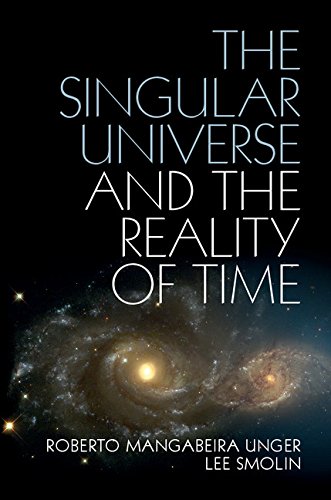
Ebook Info
- Published: 2014
- Number of pages: 565 pages
- Format: PDF
- File Size: 1.97 MB
- Authors: Roberto Mangabeira Unger
Description
Cosmology is in crisis. The more we discover, the more puzzling the universe appears to be. How and why are the laws of nature what they are? A philosopher and a physicist, world-renowned for their radical ideas in their fields, argue for a revolution. To keep cosmology scientific, we must replace the old view in which the universe is governed by immutable laws by a new one in which laws evolve. Then we can hope to explain them. The revolution that Roberto Mangabeira Unger and Lee Smolin propose relies on three central ideas. There is only one universe at a time. Time is real: everything in the structure and regularities of nature changes sooner or later. Mathematics, which has trouble with time, is not the oracle of nature and the prophet of science; it is simply a tool with great power and immense limitations. The argument is readily accessible to non-scientists as well as to the physicists and cosmologists whom it challenges.
User’s Reviews
Reviews from Amazon users which were colected at the time this book was published on the website:
⭐The Singular Universe and the Reality of Time, by Unger and Smolin, feel in many ways like the most important book I have read in a decade. Yet it is also one of the frustratingly most flawed books I have ever forced myself to read. Unger and Smolin’s title leaves the reader in no doubt what they will argue: they are in favor of a time model where the future is actually unknown, and disagree with all multiverse models. Unger takes on the job of arguing these points in philosophical terms, while Smolin argues the physics case.They are motivated by virtuous views. They clearly are fans of the Enlightenment, with its development of the moral principles of Human Rights, and Utility, and of its advancing knowledge through science. They clearly consider science to have been a key enabler of these as advances by banishing religious thought control. And they are concerned that the trends of thinking in science today is undercutting these Enlightenment values.Smolin addressed the problems with multiverses and science in an earlier work, The Trouble with Physics. The way multiverses can be multiplied without cost or consequence in contemporary physics thinking, and the way they can be tweaked with yet another postulated arbitrary term to account for any evidence found in this universe, makes them radically irrefutable. Irrefutability is has been the ultimate boundary definer between science and pseudo-science – views which are irrefutable are just nonsense – while science by being refutable becomes testable. But a growing faction of cosmologist physicists has been arguing for abandoning refutability because their preferred multiverses are irrefutable – but this had been science’s greatest weapon against religion.Also a trend over the last 100 years has been the mathematization of science. Math has been super effective in characterizing our world. But our world has time in it, while math has no time. Einstein, 100 years ago, by treating time and space as equivalent and dimensional terms, brought space into the realm of timeless math. Einstein proposed a Block Time, where past, present and future were all integrated with dimension in a 4D space-time. Feynman, 50 years ago, further showed that dimensionalizing time was highly useful in characterizing elementary particle interactions. Dimensional time, Block Time, B-theory time, sees time passing as traversing a trajectory along the time axis. But the space in front and being the “passage” already exists, so our perception of the immediacy of the present, and the uncertainty of the future, are actually just illusions. A mathematized science abandons time and treats it as an illusion.Science prioritizes observations over theory, and we observe time passing pretty directly. This abandonment of time is to prioritize mathematics theory over observation, and is a further major reversal of key science principles.Also, a key concept of science – causation, depends on time to be logically coherent. If time isn’t real, then there is no logical difference between a cause and a consequence, and the coupling of either to an event relies upon a concept whose logic has now been rejected. For mathematicized science, causation is replaced with correlation, and the key claim of science to answer “why” questions has been abandoned. Additionally, the moral principles of the Enlightenment were based on humanism, valuing human consciousness. But consciousness is a purely time-based phenomenon, and its major purpose seem to be to make decisions about an uncertain future. But if time is an illusion, then consciousness plausibly could be as well, and its primary apparent purpose of making choices is pointless if the future is pre-set. With no consciousness, then the object of humanistic values is also illusory, and there is no reason for morality.So, by pursuing a multiverse and Block Time, physicists threaten to undo testability, causation, explanations, evidence over theory, consciousness, and Enlightenment morality. Smolin and Unger considers these consequences to be disastrous, and have set out to persuade physicists to build up an alternate set of models to base our physics on.One interesting excursion they go on is a major weak point of the block time assumption – which treats the universe as fixed representation of timeless laws. The current consensus in physics is that there ARE really no laws. Instead, laws are just local regularities, which hold most of the time, but sometimes do not. The apparent laws come because of symmetries in physics – each symmetry produces an apparent law. However, about half of the symmetries we have identified have known violations – called symmetry breaking. Current thinking is that all symmetries are only local phenomenon, not universal. The term for this is “gauge symmetry”, and ALL symmetries will be broken somewhere or sometime. Which conflicts pretty directly with the “timeless law” concept. Smolin and Unger argue instead for a universe which is fundamentally unpredictable – symmetries can be stable, or NOT, during different epochs. We just happen to live in a stable one. The only constant, they hold is time itself.One of the biggest issues Smolin and Unger needed to confront was the need for a universal time. If time is the most fundamental thing in the universe, then time sequences can’t REVERSE if viewed by different observers, but this can happen in general relativity. Relativity is incompatible with universal time, and their worldview needs universal time. What Smolin offers is a fairly powerful argument. Einstein assumed that DIMENSION was basically constant, while time was relative. But one can reverse those assumptions, and consider space to be relative, and time a constant, and get basically the same answers as relativity produces. He lists three models, the most widely known being called Shape Dynamics, each of which address the time/space/gravity coupling that Einstein discovered, and which maintain a universal time and relativizes dimension. So Einstein conceived of time being relative, but he could have achieved the same insights with a relativistic dimension. This is a very effective argument to show that universal time is plausible, and physicists should proceed with trying to flesh out these alternative solutions to the one Einstein developed.The second primary area of challenge is with Fine Tuning. Smolin admits there are ~30 constants in the universe that appear to have very wide plausible ranges, but happen to all fall in a very narrow range, outside of which life would not be possible. Cosmologists are stumped in trying to explain this wildly improbable coincidence, and in order to avoid invoking Intelligent Design, they instead propose an evolutionary selective process: infinite universes created by a natural random process, but we could only appear in one of the very few that allowed evolution to create life. Smolin has no answer to explain Fine Tuning, but he argues that Multiverse claims will forever be untestable – making Cosmology no different from Theology. He proposes instead that Cosmologists stick with Cyclic universe models. Cyclic models cannot currently explain the fine Tuning, but they are testable in principle, so a Fine Tuning explanation could in principle be developed someday, and TESTED. This too is a fairly strong argument.I agree with the concern the two authors have about the direction of physics, and the risk to Enlightenment values and to science. And I agree with their recommendations as to the avenues physics should pursue. These are the things I saw as really admirable in the book.There were huge down sides though. The writing was painful to read. Unger took 5-10X the number of pages he should have to spell his points out. Ponderous phrasing, and points repeated multiple times, in paragraph after paragraph, page after page, and sometimes chapter after chapter, made his section seem interminable. Smolin took the discussion off into what seemed like excessive technical details in pretty much every chapter, such that my undergraduate physics background could not follow about half of what he said. Yet as this book is not really written as a technical paper, the details appeared to still not be sufficient to address concerns of his peers. I struggled through the writing anyway, because of the importance of the books ideas. But readers need to be warned – this is no beach read.There were also three major oversights in the team’s thinking that I saw. In reverse order: bouncing universes are not a new idea. They have been proposed repeatedly over the last half century. And the problem with the idea is that they don’t wipe the slate clean – entropy increases bounce/bounce. Increasing entropy should be revealed with increasing numbers of black holes after each bounce. And the starting density of black holes sets an upper limit to the number of bounces we could have had. Smolin , proposes an infinite history with possibly infinite bounces, AND he discusses the anomalies of the early state which appears to have had NO black holes. Zero initial balck hooes sound incompatible with even one bounce, much less infinite bounces. He offers no mention of this major refuting issue to his concept that I could discern. He emphasizes that science needs to embrace refutability, but I did not see much attention to the major potential refutations that his model should be addressing.A second set of major questions not addressed was the consequence of relativising dimension. After all this book was partially written because the consequences of relativising time were catastrophic for science. I presume that the effects of relativising dimension will be equivalently mind-blowing, but in different ways than relativistic time. Will there be other key assumptions behind science which relativistic dimension will undercut? The team seems to assume that everything will work out just fine with Shape Dynamics, but their optimism seems unjustifiable. This is unlikely to be an area that most of their readers will be able to even guess at an answer – we need the experts to weigh in for this sort of question. But the lack of discussion of what the down sides are to use of shape dynamics rather than relativity was a glaring shortfall.The final oversight I saw was in the pro-physicalism, anti-idealism argument. Smolin and Unger note that most mathematicians assume math is discovered – IE is real and exists somehow apart from humans. And the mathematization of physics basically makes physics and matter a reflection of a fundamental mathematical reality. They consider themselves on an anti-idealism campaign, in favor of physical “stuff”, whatever it is. And they call for treating math as purely speculative tool, which only fits our world by happenstance. BUT, they have misidentified the worldview they are in dispute with. Math is a subset of logic, which is a subset of ideas. Idealism is a worldview where logic/ideas have fundamental reality. And they have asserted that time and causation are fundamental – even more fundamental than matter – which has a constantly unstable set of properties. But TIME is an IDEA, and CAUSATION is a logic relationship. While they reject the reality of a derived subset of ideas – math – they have endorsed the reality of more fundamental ideas. What they propose is not physicalism, but a physical/idealist dualism, in which the ideas are more fundamental than the physical. As a dualist myself, I have no objection to this – but their misunderstanding of what they were proposing was frustrating.
⭐In his 2013 book
⭐, Lee Smolin argued that, despite its extraordinary effectiveness in understanding the behaviour of isolated systems, what he calls the “Newtonian paradigm” is inadequate to discuss cosmology: the history and evolution of the universe as a whole. In this book, Smolin and philosopher Roberto Mangabeira Unger expand upon that observation and present the case that the current crisis in cosmology, with its appeal to multiple universes and mathematical structures which are unobservable, even in principle, is a consequence of the philosophical, scientific, and mathematical tools we’ve been employing since the dawn of science attempting to be used outside their domain of applicability, and that we must think differently when speaking of the universe as a whole, which contains all of its own causes and obeys no laws outside itself. The authors do not present their own theories to replace those of present-day cosmology (although they discuss the merits of several proposals), but rather describe their work as a “proposal in natural philosophy” which might guide investigators searching for those new theories.In brief, the Newtonian paradigm is that the evolution of physical systems is described by differential equations which, given a set of initial conditions, permit calculating the evolution of a system in the future. Since the laws of physics at the microscopic level are reversible, given complete knowledge of the state of a system at a given time, its past can equally be determined. Quantum mechanics modifies this only in that rather than calculating the position and momentum of particles (or other observables), we calculate the deterministic evolution of the wave function which gives the probability of observing them in specific states in the future.This paradigm divides physics into two components: laws (differential equations) and initial conditions (specification of the initial state of the system being observed). The laws themselves, although they allow calculating the evolution of the system in time, are themselves timeless: they do not change and are unaffected by the interaction of objects. But if the laws are timeless and not subject to back-reaction by the objects whose interaction they govern, where did they come from and where do they exist? While conceding that these aren’t matters which working scientists spend much time thinking about, in the context of cosmology they pose serious philosophical problems. If the universe all that is and contains all of its own causes, there is no place for laws which are outside the universe, cannot be acted upon by objects within it, and have no apparent cause.Further, because mathematics has been so effective in expressing the laws of physics we’ve deduced from experiments and observations, many scientists have come to believe that mathematics can be a guide to exploring physics and cosmology: that some mathematical objects we have explored are, in a sense, homologous to the universe, and that learning more about the mathematics can be a guide to discoveries about reality.One of the most fundamental discoveries in cosmology, which has happened within the lifetimes of many readers of this book, including me, is that the universe has a history. When I was a child, some scientists (a majority, as I recall) believed the universe was infinite and eternal, and that observers at any time in the past or future would observe, at the largest scales, pretty much the same thing. Others argued for an origin at a finite time in the past, with the early universe having a temperature and density much greater than at present—this theory was mocked as the “big bang”. Discovery of the cosmic background radiation and objects in the distant universe which did not at all resemble those we see nearby decisively decided this dispute in favour of the big bang, and recent precision measurements have allowed determination of when it happened and how the universe evolved subsequently.If the universe has a finite age, this makes the idea of timeless laws even more difficult to accept. If the universe is eternal, one can accept that the laws we observe have always been that way and always will be. But if the universe had an origin we can observe, how did the laws get baked into the universe? What happened before the origin we observe? If every event has a cause, what was the cause of the big bang?The authors argue that in cosmology—a theory encompassing the entire universe—a global privileged time must govern all events. Time flows not from some absolute clock as envisioned by Newtonian physics or the elastic time of special and general relativity, but from causality: every event has one or more causes, and these causes are unique. Depending upon their position and state of motion, observers will disagree about the durations measured by their own clocks, and on the order in which things at different positions in space occurred (the relativity of simultaneity), but they will always observe a given event to have the same cause(s), which precede it. This relational notion of time, they argue, is primordial, and space may be emergent from it.Given this absolute and privileged notion of time (which many physicists would dispute, although the authors argue does not conflict with relativity), that time is defined by the causality of events which cause change in the universe, and that there is a single universe with nothing outside it and which contains all of its own causes, then is it not plausible to conclude that the “laws” of physics which we observe are not timeless laws somehow outside the universe or grounded in a Platonic mathematics beyond the universe, but rather have their own causes, within the universe, and are subject to change: just as there is no “unmoved mover”, there is no timeless law? The authors, particularly Smolin, suggest that just as we infer laws from observing regularities in the behaviour of systems within the universe when performing experiments in various circumstances, these laws emerge as the universe develops “habits” as interactions happen over and over. In the present cooled-down state of the universe, it’s very much set in its ways, and since everything has happened innumerable times we observe the laws to be unchanging. But closer to the big bang or at extreme events in the subsequent universe, those habits haven’t been established and true novelty can occur. (Indeed, simply by synthesising a protein with a hundred amino acids at random, you’re almost certain to have created a molecule which has never existed before in the observable universe, and it may be harder to crystallise the first time than subsequently. This appears to be the case. This is my observation, not the authors’.)Further, not only may the laws change, but entirely new kinds of change may occur: change itself can change. For example, on Earth, change was initially governed entirely by the laws of physics and chemistry (with chemistry ultimately based upon physics). But with the emergence of life, change began to be driven by evolution which, while at the molecular level was ultimately based upon chemistry, created structures which equilibrium chemistry never could, and dramatically changed the physical environment of the planet. This was not just change, but a novel kind of change. If it happened here, in our own recent (in cosmological time) history, why should we assume other novel kinds of change did not emerge in the early universe, or will not continue to manifest themselves in the future?This is a very difficult and somewhat odd book. It is written in two parts, each by one of the co-authors, largely independent of one another. There is a twenty page appendix in which the authors discuss their disagreements with one another, some of which are fundamental. I found Unger’s part tedious, repetitive, and embodying all of things I dislike about academic philosophers. He has some important things to say, but I found that slogging through almost 350 pages of it was like watching somebody beat a moose to death with an aluminium baseball bat: I believe a good editor, or even a mediocre one, could have cut this to 50 pages without losing anything and making the argument more clearly than trying to dig it out of this blizzard of words. Lee Smolin is one of the most lucid communicators among present-day research scientists, and his part is clear, well-argued, and a delight to read; it’s just that you have to slog through the swamp to get there.While suggesting we may have been thinking about cosmology all wrong, this is not a book which suggests either an immediate theoretical or experimental programme to explore these new ideas. Instead, it intends to plant the seed that, apart from time and causality, everything may be emergent, and that when we think about the early universe we cannot rely upon the fixed framework of our cooled-down universe with its regularities. Some of this is obvious and non-controversial: before there were atoms, there was no periodic table of the elements. But was there a time before there was conservation of energy, or before locality?
⭐The scientist writer in this pair of authors has allowed himself to be subverted by unscientific philosophic thinking. The book is riddled with baseless assertions, as if it is enough to write down an empirically vacuous but philosophically sounding phrase, and that’s it. That explains it, of course. The authors proclaim their great insight: ‘Time is real`. Of course. Now I understand, ….. I DON’T THINK. What if they had said “Time is XXX”? Would I still understand? No . The assumption made in this book is that we all “know” what is real, don’t we? Doesn’t everyone? Do you see the point I’m making? In Science, as opposed to Philosophy, you cannot define your way out. You just do experiments and compare them to predictions of your theories. You don’t believe those theories. You don’t disbelieve them. They are just fabrications designed to give a working understanding of our environment. They don’t have absolute truth values. They have degrees of contextual usefulness. So, I really don’t know what Unger and Smolin mean when they use the word ‘real’. I do know what it means in Science. It’s whatever data I have collected in my detectors. That’s all. Philosophy is not Science and should keep a respectful distance away from it. Philosophers: don’t try to tell scientists what quantum theory and time mean, unless you are prepared to do experiments. Sort out morality and that sort of issue, where you might do some good.
⭐This book is probably going to get bad reviews. Don’t let that put you off too much. Lee Smolin’s (LS) section is excellent, well-written, rewarding, rich in content and accessible to expert and non-expert. If you have any interest in cosmology, it is a must-read. Roberto Mangabeira Unger’s (RMU) section, by contrast, is hard going. He has good things to say but says them in a very tedious style. I would therefore recommend that you read only chapter one of RMU’s part to get his main points then go straight to all of LS’s part. In spite of this, unless you are new to cosmology, the book is worth buying.Both authors make the same argument which is that the universe cannot be understood by scaling up current physics. RMU argues the case as a philosopher and LS as a scientist. But both put forward the same positive set of principles that a new cosmology needs and give well-argued reasons for their advantages.The authors state that the book is not “popular science”. I would recommend it to avid readers of popular science and philosophy (which I am) but not casual ones.
⭐RMU & LS want to encourage scientists to investigate the cosmos guided by their three ideas (singular universe, reality of time, regional applicability of mathematics). The first problem is that each one of those ideas is philosophically complex, and contrary to the prevailing views of many physicists, cosmologists and theorists. RMU & LS’s chosen approach is to argue that by adopting their ideas, difficult cosmological questions could be simplified or even answered. The justification for their argument is pinned to the explanatory empirical success of science. However, the second problem is that they are making this argument at a time when the empirical character of science is being contested, and they themselves seem not to have a very clear understanding of what the character of science should be. RMU & LS can make neither a sufficient methodological nor metaphysical argument for their program. In the first case they lack the background in the philosophy of science. In the second, and following from the first, they think that an empirical justification is enough and they need not do metaphysics.One question/frustration that has also kept coming back to me is how RMU could have failed so badly to guide and support Smolin. It’s great that a physicist wanted to work with a philosopher, but very few of his colleagues will feel it worthwhile if philosophers are not able to clarify and present problems and arguments in compelling ways. Not only is RMU’s own contribution to this book mostly a fat waste of time, but he hasn’t done Smolin’s work any favours either.
⭐Probably the most complex book i have read in a long time.It assumed a fair level of initial knowledge in both Physics and Philosophy but if you can do the work then the ideas that are discussed within this text are well worth itIn particular is the treatment of Mathematics and the discussion about it not being the fundamental science and his treatment of the infinite as being purely a mathematical work around that we should always keep in mind does not reflect anything real in the universeIt took me a long long time to get through this text, but highly worth the effort
⭐In depth thinking about understanding the evolution of our universe.
Keywords
Free Download The Singular Universe and the Reality of Time: A Proposal in Natural Philosophy 1st Edition in PDF format
The Singular Universe and the Reality of Time: A Proposal in Natural Philosophy 1st Edition PDF Free Download
Download The Singular Universe and the Reality of Time: A Proposal in Natural Philosophy 1st Edition 2014 PDF Free
The Singular Universe and the Reality of Time: A Proposal in Natural Philosophy 1st Edition 2014 PDF Free Download
Download The Singular Universe and the Reality of Time: A Proposal in Natural Philosophy 1st Edition PDF
Free Download Ebook The Singular Universe and the Reality of Time: A Proposal in Natural Philosophy 1st Edition