

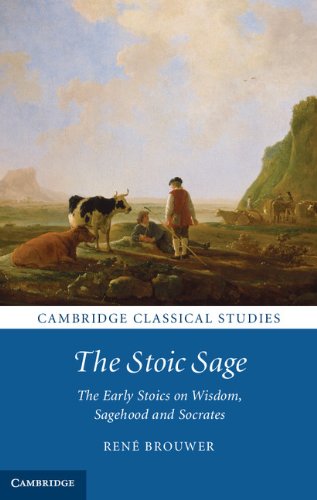
Ebook Info
- Published: 2014
- Number of pages: 241 pages
- Format: PDF
- File Size: 3.21 MB
- Authors: René Brouwer
Description
After Plato and Aristotle, the Stoics, from the third century BCE onwards, developed the third great classical conception of wisdom. This book offers a reconstruction of this pivotal notion in Stoicism, starting out from the two extant Stoic definitions, ‘knowledge of human and divine matters’ and ‘fitting expertise’. It focuses not only on the question of what they understood by wisdom, but also on how wisdom can be achieved, how difficult it is to become a sage, and how this difficulty can be explained. The answers to these questions are based on a fresh investigation of the evidence, with all central texts offered in the original Greek or Latin, as well as in translation. The Stoic Sage can thus also serve as a source book on Stoic wisdom, which should be invaluable to specialists and to anyone interested in one of the cornerstones of the Graeco-Roman classical tradition.
User’s Reviews
Reviews from Amazon users which were colected at the time this book was published on the website:
⭐I used this text for additional reading to give context to Meditations (Marcus Aurelius).
⭐It’s really unfortunate that Cambridge Press chose to price this book so darn high, otherwise it would have probably reached a wider audience, given current interest in Stoicism. Oh well. I have published a four-part commentary on my blog (howtobeastoic dot org), if people are interested in a more in-depth discussion of The Stoic Sage. Brouwer begins with a couple of definitions of the Sage, i.e., the ideal Stoic practitioner, and how the concept informed Stoic philosophy in general. He then goes on to discuss how the transition from lay person to Sage may occur according to the Stoics — something similar, one might say, to achieving Enlightenment in Buddhism. The third chapter explores the Stoic conception of Sagehood in more depth, arguing among other things that no Stoic has ever claimed to actually be a Sage (unlike Epicurus, from one of the rival schools, who apparently unabashedly went around labeling himself with the title). The final chapter is all about Socrates, the figure that arguably came closest, for the Stoics, to being an actual Sage. The volume is scholarly in nature, and yet accessible to a well educated reader, and probably a worthy addition to your library, if you have an interest in Stoicism, ancient philosophy, or virtue ethics.
Keywords
Free Download The Stoic Sage: The Early Stoics on Wisdom, Sagehood and Socrates (Cambridge Classical Studies) in PDF format
The Stoic Sage: The Early Stoics on Wisdom, Sagehood and Socrates (Cambridge Classical Studies) PDF Free Download
Download The Stoic Sage: The Early Stoics on Wisdom, Sagehood and Socrates (Cambridge Classical Studies) 2014 PDF Free
The Stoic Sage: The Early Stoics on Wisdom, Sagehood and Socrates (Cambridge Classical Studies) 2014 PDF Free Download
Download The Stoic Sage: The Early Stoics on Wisdom, Sagehood and Socrates (Cambridge Classical Studies) PDF
Free Download Ebook The Stoic Sage: The Early Stoics on Wisdom, Sagehood and Socrates (Cambridge Classical Studies)