

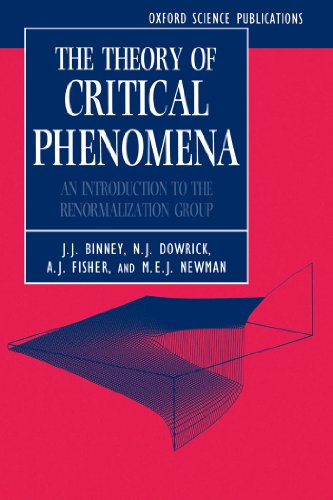
Ebook Info
- Published: 1992
- Number of pages: 480 pages
- Format: PDF
- File Size: 25.31 MB
- Authors: J. J. Binney
Description
The successful calculation of critical exponents for continuous phase transitions is one of the main achievements of theoretical physics over the last quarter-century. This was achieved through the use of scaling and field-theoretic techniques which have since become standard equipment in many areas of physics, especially quantum field theory.This book provides a thorough introduction to these techniques. Continuous phase transitions are introduced, then the necessary statistical mechanics is summarized, followed by standard models, some exact solutions and techniques for numerical simulations. The real-space renormalization group and mean-field theory are then explained and illustrated. The final chapters cover the Landau-Ginzburg model, from physical motivation, through diagrammatic perturbation theory and renormalization to therenormalization group and the calculation of critical exponents above and below the critical temperature.
User’s Reviews
Reviews from Amazon users which were colected at the time this book was published on the website:
⭐I am a PhD math student with fairly sparse formal training in physics and yet I find the book very easy to follow. I was looking for a book which would help me understand the thought processes of a physicist in this area and I think it is doing the job very well. The appendix is amazing and I was blown away by the fact they actually included the solutions to the end-of-chapter problem sets.
⭐The writing of the book is very precise. The logic is very clear.
⭐The book is great. But the printing of the paperback version is of very low resolution, and this makes it unpleasant to read.
⭐Examples in this book are great
⭐As a first-year graduate student, this is a fantastic level for me. I’m getting the sense the authors had us in mind as they discuss things like relevance to broader topics in physics, experiments, etc. It’s not just an expert writing to experts. It is a group of good teachers (who are experts) writing to the curious learner with a bachelor’s level understanding of physics.
⭐Ero alla ricerca di un libro per iniziare con la teoria dei fenomeni critici passo dopo passo. Ho trovato altri libri – come Parisi – troppo avanzati per il mio livello e spesso troppo concise. Questo libro sembra stia facendo il suo lavoro! Totalmente consigliato!
⭐
⭐I was looking for a book to get started with the theory of critical phenomena step by step. I found other books – like Parisi – too advanced for my level and often too concise. This book seems to be doing the job! Totally reccomended!
⭐Just as I expected. Great book.
⭐Excelente obra para quem gosta do tema.
⭐
Keywords
Free Download The Theory of Critical Phenomena: An Introduction to the Renormalization Group (Oxford Science Publications) 1st Edition in PDF format
The Theory of Critical Phenomena: An Introduction to the Renormalization Group (Oxford Science Publications) 1st Edition PDF Free Download
Download The Theory of Critical Phenomena: An Introduction to the Renormalization Group (Oxford Science Publications) 1st Edition 1992 PDF Free
The Theory of Critical Phenomena: An Introduction to the Renormalization Group (Oxford Science Publications) 1st Edition 1992 PDF Free Download
Download The Theory of Critical Phenomena: An Introduction to the Renormalization Group (Oxford Science Publications) 1st Edition PDF
Free Download Ebook The Theory of Critical Phenomena: An Introduction to the Renormalization Group (Oxford Science Publications) 1st Edition