Ebook Info
- Published: 1956
- Number of pages: 464 pages
- Format: PDF
- File Size: 7.96 MB
- Authors: Thomas L. Heath
Description
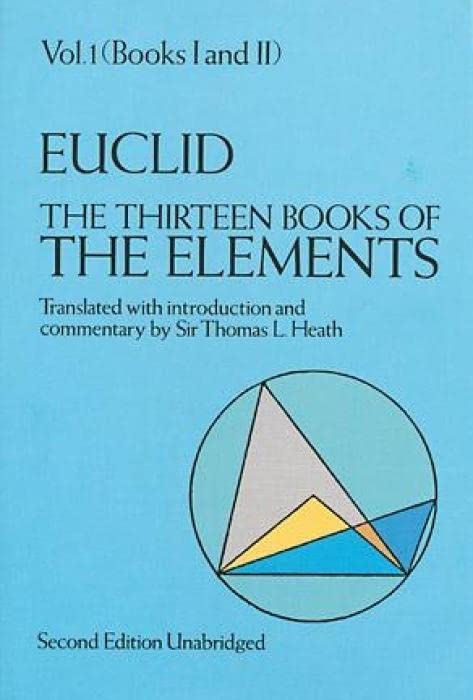
This is the definitive edition of one of the very greatest classics of all time — the full Euclid, not an abridgement. Using the text established by Heiberg, Sir Thomas Heath encompasses almost 2,500 years of mathematical and historical study upon Euclid.This unabridged republication of the original enlarged edition contains the complete English text of all 13 books of the Elements, plus a critical apparatus that analyzes each definition, postulate, and proposition in great detail. It covers textual and linguistic matters; mathematical analyses of Euclid’s ideas; classical, medieval, Renaissance, modern commentators; refutations, supports, extrapolations, reinterpretations, and historical notes, all given with extensive quotes.“The textbook that shall really replace Euclid has not yet been written and probably never will be.” — Encyclopaedia Britannica.Volume 1. 151-page Introduction: life and other works of Euclid; Greek and Islamic commentators; surviving mss., scholia, translations; bases of Euclid’s thought. Books I and II of the Elements, straight lines, angles, intersection of lines, triangles, parallelograms, etc.Volume 2. Books III-IX: Circles, tangents, segments, figures described around and within circles, rations, proportions, magnitudes, polygons, prime numbers, products, plane and solid numbers, series of rations, etc.Volume 3. Books X to XIII: planes, solid angles, etc.; method of exhaustion in similar polygons within circles, pyramids, cones, cylinders, spheres, etc. Appendix: Books XIV, XV, sometimes ascribed to Euclid.
User’s Reviews
Editorial Reviews: Excerpt. © Reprinted by permission. All rights reserved. The Thirteen Books of Euclid’s Elements Volume IBy Thomas L. HeathDover Publications, Inc.Copyright © 1956 Dover Publications, Inc.All rights reserved.ISBN: 978-0-486-60088-8ContentsVOLUME I., INTRODUCTION., Chap. I. Euclid and the traditions about him, Chap. II. Euclid’s other works, Chap. III. Greek commentators other than Proclus, Chap. IV. Proclus and his sources, Chap. V. The Text, Chap. VI. The Scholia, Chap. VII. Euclid in Arabia, Chap. VIII. Principal Translations and Editions, Chap. IX. §1. On the nature of elements, The Elements., Book I. Definitions, Postulates, Common Notions, Book II. Definitions, Excursus I. Pythagoras and the Pythagoreans, Excursus II. Popular names for Euclidean Propositions, Greek Index to Vol. I., English Index to Vol. I., CHAPTER 1EUCLID AND THE TRADITIONS ABOUT HIM.As in the case of the other great mathematicians of Greece, so in Euclid’s case, we have only the most meagre particulars of the life and personality of the man.Most of what we have is contained in the passage of Proclus’ summary relating to him, which is as follows:”Not much younger than these (sc. Hermotimus of Colophon and Philippus of Medma) is Euclid, who put together the Elements, collecting many of Eudoxus’ theorems, perfecting many of Theaetetus’, and also bringing to irrefragable demonstration the things which were only somewhat loosely proved by his predecessors. This man lived in the time of the first Ptolemy. For Archimedes, who came immediately after the first (Ptolemy), makes mention of Euclid: and, further, they say that Ptolemy once asked him if there was in geometry any shorter way than that of the elements, and he answered that there was no royal road to geometry. He is then younger than the pupils of Plato but older than Eratosthenes and Archimedes; for the latter were contemporary with one another, as Eratosthenes somewhere says.”This passage shows that even Proclus had no direct knowledge of Euclid’s birthplace or of the date of his birth or death. He proceeds by inference. Since Archimedes lived just after the first Ptolemy, and Archimedes mentions Euclid, while there is an anecdote about some Ptolemy and Euclid, therefore Euclid lived in the time of the first Ptolemy.We may infer then from Proclus that Euclid was intermediate between the first pupils of Plato and Archimedes. Now Plato died in 347/6, Archimedes lived 287–212, Eratosthenes c. 284–204 B.C. Thus Euclid must have flourished c. 300 B.C., which date agrees well with the fact that Ptolemy reigned from 306 to 283 B.C.It is most probable that Euclid received his mathematical training in Athens from the pupils of Plato; for most of the geometers who could have taught him were of that school, and it was in Athens that the older writers of elements, and the other mathematicians on whose works Euclid’s Elements depend, had lived and taught. He may himself have been a Platonist, but this does not follow from the statements of Proclus on the subject. Proclus says namely that he was of the school of Plato and in close touch with that philosophy. But this was only an attempt of a New Platonist to connect Euclid with his philosophy, as is clear from the next words in the same sentence, “for which reason also he set before himself, as the end of the whole Elements, the construction of the so-called Platonic figures.” It is evident that it was only an idea of Proclus’ own to infer that Euclid was a Platonist because his Elements end with the investigation of the five regular solids, since a later passage shows him hard put to it to reconcile the view that the construction of the five regular solids was the end and aim of the Elements with the obvious fact that they were intended to supply a foundation for the study of geometry in general, “to make perfect the understanding of the learner in regard to the whole of geometry.” To get out of the difficulty he says that, if one should ask him what was the aim ([TEXT NOT REPRODUCIBLE IN ASCII]) of the treatise, he would reply by making a distinction between Euclid’s intentions (1) as regards the subjects with which his investigations are concerned, (2) as regards the learner, and would say as regards (1) that “the whole of the geometer’s argument is concerned with the cosmic figures.” This latter statement is obviously incorrect. It is true that Euclid’s Elements end with the construction of the five regular solids; but the planimetrical portion has no direct relation to them, and the arithmetical no relation at all; the propositions about them are merely the conclusion of the stereometrical division of the work.One thing is however certain, namely that Euclid taught, and founded a school, at Alexandria. This is clear from the remark of Pappus about Apollonius: “he spent a very long time with the pupils of Euclid at Alexandria, and it was thus that he acquired such a scientific habit of thought.”It is in the same passage that Pappus makes a remark which might, to an unwary reader, seem to throw some light on the personality of Euclid. He is speaking about Apollonius’ preface to the first book of his Conics, where he says that Euclid had not completely worked out the synthesis of the “three- and four-line locus,” which in fact was not possible without some theorems first discovered by himself. Pappus says on this: “Now Euclid—regarding Aristaeus as deserving credit for the discoveries he had already made in conics, and without anticipating him or wishing to construct anew the same system (such was his scrupulous fairness and his exemplary kindliness towards all who could advance mathematical science to however small an extent), being moreover in no wise contentious and, though exact, yet no braggart like the other [Apollonius] —wrote so much about the locus as was possible by means of the conics of Aristaeus, without claiming completeness for his demonstrations.” It is however evident, when the passage is examined in its context, that Pappus is not following any tradition in giving this account of Euclid: he was offended by the terms of Apollonius’ reference to Euclid, which seemed to him unjust, and he drew a fancy picture of Euclid in order to show Apollonius in a relatively unfavourable light.Another story is told of Euclid which one would like to believe true. According to Stobaeus, “some one who had begun to read geometry with Euclid, when he had learnt the first theorem, asked Euclid, ‘But what shall I get by-learning these things?’ Euclid called his slave and said ‘Give him threepence, since he must make gain out of what he learns.'”In the middle ages most translators and editors spoke of Euclid as Euclid of Megara. This description arose out of a confusion between our Euclid and the philosopher Euclid of Megara who lived about 400 B.C. The first trace of this confusion appears in Valerius Maximus (in the time of Tiberius) who says that Plato, on being appealed to for a solution of the problem of doubling the cubical altar, sent the inquirers to “Euclid the geometer.” There is no doubt about the reading, although an early commentator on Valerius Maximus wanted to correct “Eucliden” into “Eudoxum,” and this correction is clearly right. But, if Valerius Maximus took Euclid the geometer for a contemporary of Plato, it could only be through confusing him with Euclid of Megara. The first specific reference to Euclid as Euclid of Megara belongs to the 14th century, occurring in the [TEXT NOT REPRODUCIBLE IN ASCII] of Theodorus Metochita (d. 1332) who speaks of “Euclid of Megara, the Socratic philosopher, contemporary of Plato,” as the author of treatises on plane and solid geometry, data, optics etc.: and a Paris MS. of the 14th century has “Euclidis philosophi Socratici liber elementorum.” The misunderstanding was general in the period from Campanus’ translation (Venice 1482) to those of Tartaglia (Venice 1565) and Candalla (Paris 1566). But one Constantinus Lascaris (d. about 1493) had already made the proper distinction by saying of our Euclid that “he was different from him of Megara of whom Laertius wrote, and who wrote dialogues”; and to Commandinus belongs the credit of being the first translator to put the matter beyond doubt: “Let us then free a number of people from the error by which they have been induced to believe that our Euclid is the same as the philosopher of Megara” etc.Another idea, that Euclid was born at Gela in Sicily, is due to the same confusion, being based on Diogenes Laertius’ description of the philosopher Euclid as being “of Megara, or, according to some, of Gela, as Alexander says in the [TEXT NOT REPRODUCIBLE IN ASCII].”In view of the poverty of Greek tradition on the subject even as early as the time of Proclus (410–485 A.D.), we must necessarily take cum grano the apparently circumstantial accounts of Euclid given by Arabian authors; and indeed the origin of their stories can be explained as the result (1) of the Arabian tendency to romance, and (2) of misunderstandings.We read that “Euclid, son of Naucrates, grandson of Zenarchus, called the author of geometry, a philosopher of somewhat ancient date, a Greek by nationality domiciled at Damascus, born at Tyre, most learned in the science of geometry, published a most excellent and most useful work entitled the foundation or elements of geometry, a subject in which no more general treatise existed before among the Greeks: nay, there was no one even of later date who did not walk in his footsteps and frankly profess his doctrine. Hence also Greek, Roman and Arabian geometers not a few, who undertook the task of illustrating this work, published commentaries, scholia, and notes upon it, and made an abridgment of the work itself. For this reason the Greek philosophers used to post up on the doors of their schools the well-known notice: ‘Let no one come to our school, who has not first learned the elements of Euclid.'” The details at the beginning of this extract cannot be derived from Greek sources, for even Proclus did not know anything about Euclid’s father, while it was not the Greek habit to record the names of grandfathers, as the Arabians commonly did. Damascus and Tyre were no doubt brought in to gratify a desire which the Arabians always showed to connect famous Greeks in some way or other with the East. Thus Nairaddin, the translator of the Elements, who was of us in Khurasan, actually makes Euclid out to have been “Thusinus” also. The readiness of the Arabians to run away with an idea is illustrated by the last words of the extract. Everyone knows the story of Plato’s inscription over the porch of the Academy: “let no one unversed in geometry enter my doors”; the Arab turned geometry into Euclid’s geometry, and told the story of Greek philosophers in general and “their Academies.”Equally remarkable are the Arabian accounts of the relation of Euclid and Apollonius. According to them the Elements were originally written, not by Euclid, but by a man whose name was Apollonius, a carpenter, who wrote the work in 15 books or sections. In the course of time some of the work was lost and the rest became disarranged, so that one of the kings at Alexandria who desired to study geometry and to master this treatise in particular first questioned about it certain learned men who visited him and then sent for Euclid who was at that time famous as a geometer, and asked him to revise and complete the work and reduce it to order. Euclid then re-wrote it in 13 books which were thereafter known by his name. (According to another version Euclid composed the 13 books out of commentaries which he had published on two books of Apollonius on conics and out of introductory matter added to the doctrine of the five regular solids.) To the thirteen books were added two more books, the work of others (though some attribute these also to Euclid) which contain several things not mentioned by Apollonius. According to another version Hypsicles, a pupil of Euclid at Alexandria, offered to the king and published Books XIV. and XV., it being also stated that Hypsicles had “discovered” the books, by which it appears to be suggested that Hypsicles had edited them from materials left by Euclid.We observe here the correct statement that Books XIV. and XV. were not written by Euclid, but along with it the incorrect information that Hypsicles, the author of BookXIV., wrote Book XV. also.The whole of the fable about Apollonius having preceded Euclid and having written the Elements appears to have been evolved out of the preface to Book XIV. by Hypsicles, and in this way; the Book must in early times have been attributed to Euclid, and the inference based upon this assumption was left uncorrected afterwards when it was recognised that Hypsicles was the author. The preface is worth quoting:”Basilides of Tyre, O Protarchus, when he came to Alexandria and met my father, spent the greater part of his sojourn with him on account of their common interest in mathematics. And once, when examining the treatise written by Apollonius about the comparison between the dodecahedron and the icosahedron inscribed in the same sphere, (showing) what ratio they have to one another, they thought that Apollonius had not expounded this matter properly, and accordingly they emended the exposition, as I was able to learn from my father. And I myself, later, fell in with another book published by Apollonius, containing a demonstration relating to the subject, and I was greatly interested in the investigation of the problem. The book published by Apollonius is accessible to all—for it has a large circulation, having apparently been carefully written out later—but I decided to send you the comments which seem to me to be necessary, for you will through your proficiency in mathematics in general and in geometry in particular form an expert judgment on what I am about to say, and you will lend a kindly ear to my disquisition for the sake of your friendship to my father and your goodwill to me.”The idea that Apollonius preceded Euclid must evidently have been derived from the passage just quoted. It explains other things besides. Basilides must have been confused with [TEXT NOT REPRODUCIBLE IN ASCII], and we have a probable explanation of the “Alexandrian king,” and of the “learned men who visited” Alexandria. It is possible also that in the “Tyrian” of Hypsicles’ preface we have the origin of the notion that Euclid was born in Tyre. These inferences argue, no doubt, very defective knowledge of Greek: but we could expect no better from those who took the Organon of Aristotle to be “instrumentum musicum pneumaticum,” and who explained the name of Euclid, which they variously pronounced as Uclides or Icludes, to be compounded of Ucli a key, and Dis a measure, or, as some say, geometry, so that Uclides is equivalent to the key of geometry!Lastly the alternative version, given in brackets above, which says that Euclid made the Elements out of commentaries which he wrote on two books of Apollonius on conics and prolegomena added to the doctrine of the five solids, seems to have arisen, through a like confusion, out of a later passage in Hypsicles’ Book XIV.: “And this is expounded by Aristaeus in the book entitled ‘Comparison of the five figures,’ and by Apollonius in the second edition of his comparison of the dodecahedron with the icosahedron.” The “doctrine of the five solids” in the Arabic must be the “Comparison of the five figures” in the passage of Hypsicles, for nowhere else have we any information about a work bearing this title, nor can the Arabians have had. The reference to the two books of Apollonius on conics will then be the result of mixing up the fact that Apollonius wrote a book on conics with the second edition of the other work mentioned by Hypsicles. We do not find elsewhere in Arabian authors any mention of a commentary by Euclid on Apollonius and Aristaeus: so that the story in the passage quoted is really no more than a variation of the fable that the Elements were the work of Apollonius.CHAPTER 2EUCLID’S OTHER WORKS.IN giving a list of the Euclidean treatises other than the Elements, I shall be brief: for fuller accounts of them, or speculations with regard to them, reference should be made to the standard histories of mathematics.I will take first the works which are mentioned by Greek authors.1. The Pseudaria.I mention this first because Proclus refers to it in the general remarks in praise of the Elements which he gives immediately after the mention of Euclid in his summary. He says: “But, inasmuch as many things, while appearing to rest on truth and to follow from scientific principles, really tend to lead one astray from the principles and deceive the more superficial minds, he has handed down methods for the discriminative understanding of these things as well, by the use of which methods we shall be able to give beginners in this study practice in the discovery of paralogisms, and to avoid being misled. This treatise, by which he puts this machinery in our hands, he entitled (the book) of Pseudaria, enumerating in order their various kinds, exercising our intelligence in each case by theorems of all sorts, setting the true side by side with the false, and combining the refutation of error with practical illustration. This book then is by way of cathartic and exercise, while the Elements contain the irrefragable and complete guide to the actual scientific investigation of the subjects of geometry.”The book is considered to be irreparably lost. We may conclude however from the connexion of it with the Elements and the reference to its usefulness for beginners that it did not go outside the domain of elementary geometry. (Continues…)Excerpted from The Thirteen Books of Euclid’s Elements Volume I by Thomas L. Heath. Copyright © 1956 Dover Publications, Inc.. Excerpted by permission of Dover Publications, Inc.. All rights reserved. No part of this excerpt may be reproduced or reprinted without permission in writing from the publisher.Excerpts are provided by Dial-A-Book Inc. solely for the personal use of visitors to this web site.
Reviews from Amazon users which were colected at the time this book was published on the website:
⭐The image is misplaced in the ebook in proposition 7 of book 1. Print is good.Also in the ebook, the font size of the italic part in proposition 4 of book 1, is incorrect.
⭐This review is for Euclid’s Elements: Vol I – Books I and II (Dover).I purchased a copy advertised as New, but the book arrived with some stains and a slightly bent cover. The pages are bound together with a fat, uneven glob of glue, which looks ugly. The size of the text for Euclid’s Elements is acceptable, and the size of the illustrations is also acceptable; but the size of the text for commentary and notes, which form the majority of the book, is small.In nine chapters, the Introduction covers in depth everything one could want to know about Euclid’s Elements; thus the Introduction as a whole is more of a scholarly reference than a primer for new readers. Chapter 9 is still indispensable as a primer for new readers like myself.The Notes to each definition, postulate, common notion, and proposition blend the author’s observations with thousands of years of commentary on Euclid. It’s an incredible work of scholarship. The commentary ranges from the immediately useful to the seemingly esoteric, beyond what I care to understand right now. I like that. I also like that the edition includes the Greek text. I can’t read Greek, but the translator often comments on difficult phrases and passages. Understanding these passages is easier with the full Greek text included on the page.Five stars for the content of this book. It’s outstanding. Four stars for this book from Amazon for having some slight physical defects.
⭐I’m not sure that Euclid itself needs another review; its place in mathematics history is well established and other reviewers have done a good job explaining the Elements. I finished working through the “propositions” in the first two books (the contents of this volume) — I recommend that if you are considering exploring the Elements, that you get out pen and paper and actually work through the steps. You don’t necessarily need to draw every single line out using only a straightedge and compass, but without doing the work yourself it can be hard to appreciate how the proofs work.What I mainly want to talk about is this edition specifically. Editions of the Elements are available online for free, and there are other printed editions that contain only the proofs and diagrams, without all the introduction and commentary. So the primary question should be whether the contents of this edition are worth it. In short, I think that if you are interested in Greek philosophy and the history of mathematics, this edition contains a great deal of useful information. If you are mainly interested in the Elements itself, you may do better to go with another edition.Thomas Heath was writing in the early 20th century, and he may have expected his reading audience to be more familiar with Aristotelian philosophy and geometry in general than we are today. His 152-page introduction is divided into 9 chapters. The first chapter is a fairly accessible introduction to Euclid’s life and the legends we have about him. Chapters 2-4 are about the work of previous Greek mathematicians and later commentators on Euclid; these chapters are more dense and probably not of interest to the general reader. Chapters 5-8 are a fairly tedious listing of various manuscripts, editions, translations, and adaptations of Euclid — it’s hard to imagine many people being interested in the content of these chapters unless they were specialist researchers. Chapter 9 is worth reading if you are interested in Greek philosophy, and especially if you have some understanding of Aristotle. In ancient Greece, philosophy often dealt with mathematics, and this chapter is a nicely detailed discussion of the philosophical underpinnings of Euclid’s techniques, and explanations of terms such as “definition” and “axiom” (in terms of Greek philosophy).The next 90 or so pages is about the definitions, postulates, and “common notions”. Once again, these notes deal extensively with Greek philosophy and the philosophy of mathematics in general. For instance, the commentary on definition 1 (the point) discusses Aristotelian and pre-Euclidean definitions, criticism of Euclid’s definition by later commentators, and “modern” (i.e. late 19th century) definitions. A lot of this content may not be accessible to someone without philosophy or geometry. Some of this may make more sense if you come back to it later — for instance, the 20 pages of commentary on the infamous Postulate 5 are a lot easier to appreciate once you’ve worked through Propositions 29-32 (which use the Postulate).This more or less applies to the commentary on the Propositions as well. A lot of the commentary is devoted to (a) Pre-Euclidean mathematics, (b) criticism of later commentators, and (c) modern treatments of the subject.I suppose that anyone considering The Elements probably has some interest in the history of mathematics, and Heath’s information is incredibly detailed and informative. But as I said earlier, unless you have some prior background in Aristotle and geometry in general, it may be difficult to digest.
⭐I am pretty much interested in geometry. I am, in fact, enthusiastic, and enthusiastic people usually do have strange habits regarding their subjects of enthusiasm. I, for one, like to buy all of the geometry books I can lay my hand on regardless of its relevance to my studies or usefulness for reading.And this book, being a classic, was on top of my demanded books list until I bought it around 1998. As usual with these books, I postponed its reading until the new millennium. But when I read it I was very disappointed.The material of this book is one of the most beautiful afforded by a mathematics book. It is very interesting, but, alas, it is written in a forbidding notation. I can understand high level math books in Algebra and Analysis, but this book confused me with words. Frankly, I do not see why a math book is supposed to explained in words after all this development of mathematics.Unfortunately, most historian mathematicians disagree with my view. They see that writing the elements of Euclid (The first rigorous set of axioms and lemmas) in the modern notation is unfaithful to the original manuscript. Well, I have got no problem with that, but at least try to make it up to date so that people could go through it.You see that I gave it 4 stars. Yes the material of the book was excellent, and it rather deserved 5 stars, but for this tedious presentation.One other thing I hated a bout this volume was the introduction. It had taken about one third of the book, and after the definitions of the first book, there are notes on the definitions and postulates that take another third of the book. These notes are not all that easy and at a higher level than the postulates of Euclid, and I found them irrelevant. I do not understand here why did not the author, who made notes on the definitions, make a section explaining all the postulates in modern notation.As for the material, the volume covers Books I and II of Euclid’s 13 books of the elements. The first book introduces a set of definitions and goes on characterizing triangles. It, even, proves the Pythagorean theorem. This proof was a bit difficult, a simpler proof can be found else where, but, after all, it is amazing how mathematicians could have solved such a problem thousands of years ago.He introduced the famous constructions of straight edge and a compass, he would construct an isosceles triangle starting from a given segment by merely using a straight edge and a compass. Later on, Galois studied this construction in his famous Galois theory (try Artin’s Galois theory, although I do not guarantee it).The second books deals with areas of triangles and rectangles, and Euclid’s notation shows it incompetence when he uses the same name for two different things. For in the first book he used to say that two triangles are equal if all their angles and sides are equal, but in the second book he would define two triangles to be equal if they had the same area!All in all, I enjoyed the book, and would have enjoyed it more if not for the drawbacks.
⭐Nobody with an interest in Geometry, or the history of Western Civilisation should be without a copy of this book. What you get is far more than just the theorems and proofs to be found in the first two books of Euclid. Indeed, if this is all you want, one of the online versions of Euclid will probably be more to your taste. The book contains a mass of scholarly but fascinating detail on topics such as Euclid’s predecessors, contemporary reaction, commentaries by later Greek mathematicians, the work of Arab mathematicians inspired by Euclid, the transmission of the text back to Renaissance Europe, and a list and potted history of the various translations and editions of Euclid from then on. The section on the postulates and axioms (and of course the all-important parallel postulate) is wonderful.When we come to the actual theorems the amount of detail is just as impressive – references to earlier results are annotated, and textual variations are noted (especially where the proofs may have been amended by later writers in an attempt to correct gaps). In many cases alternative proofs are given – sometimes several different ones, with the history and references for each.
⭐I’m just nit-picking here, just bear with me. (These books are great otherwise).According to Dover Publication’s website, these books should be 5 1/2 x 8 1/2.Volume II and III are.Volume I, however, is 5 1/4 x 8 1/2, one quarter of an inch narrower.All three seem to have been manufactured by LSC Communications the same year 2020. Other differences are present: the name Euclid in the spine of Vol I and II are parallel to the spine of the book, while it is not in Vol. III. In the back cover, upper left corner, Vol. I says “Mathematics”, Vol. II says “Mathematics/ History and Philosophy”, and Vol. III says “Mathematics”, but underlined. Dover logo is bigger in Vol. III too.You can expect these kind of changes when several years have passed, between different editions of the same book by the same book publisher. But this is supposed to be the same edition, printed the same year, by the same company.I wonder who green-lighted all those changes.At least they’re the same height, so in the bookshelf all three will look even.
⭐Full marks for this book also from me. I belong to those who, despite anengineering education, had never read Euclid directly before. Having nowseen this book for the first time, I think that anyone who is interestedin mathematics and ancient Greek culture, can hardly fail to find Euclid’sElements extremely interesting.The mathematics itself in Euclid’s Elements is beautiful. The styleof presentation used by Euclid is terse, and some of his mathematicalterms took me a few minutes to get used to (like “rectangle” for”multiplication”); but Euclid’s presentation is very exact and logical,and is easy to follow. I think that no mathematical background is needed,and that simple interest suffices to read the book and to understandthe mathematics. Speaking humorously, the book may even have a slightly”dangerous” 🙂 side for those who like puzzles — danger of addictionto a mental play world of circles, lines, and angles :-). The topic ofEuclid is pure, not applied, mathematics.I find Euclid’s mathematics by no means “crude” or “simplistic”.Euclid’s Elements, in the later books, goes well beyond elementary-schoolgeometry, and in my view this is a book clearly aimed at adult readers,not children. It’s of course clear that mathematics has expanded verysubstantially beyond Euclid since the 1700s and 1800s — for example,to mention just one thing, there is no such thing in Euclid as numericalcomputation of the (“Cartesian”) coordinates of things; Euclid alwayskeeps within the world of straight unmarked ruler and compasses(dividers). Having said this however, I’m amazed at how sophisticatedEuclid’s mathematics gets in the later books. The basis in Euclid’sElements is definitely plane geometry, but books XI – XIII (in Volume 3)do expand things into 3D geometry (“solid geometry”).Reading this book, what I found also interesting to discover is thatEuclid was a scholar/scientist whose work is firmly based on the corpus ofgeometrical theory that already existed at that time. That is, Euclid’sElements is a presentation of the mainstream scientific geometry of thetime, not a work of a romantic “loner genius”.Euclid’s presentation is extremely beautiful in some points. Each theoremis proved by a simple diagram plus mostly just a few lines of text.(Only very few theorems, in the later books, take him more than about 15lines of text.) Heath indents Euclid’s text in an agreeable way thatI think is helpful for following Euclid’s formulations. Admittedly,Euclid’s later theorems often base very heavily on earlier theorems;but on the other hand, there is definite beauty itself in the logicalstructure of how Euclid derives his later theorems from earlier ones.This edition (Heath, Dover) provides a “full scholarly apparatus” ofnotes, introductions, identification of sources, literature references,etc. This scholarly stuff is easy to skip if you want to go directly toEuclid’s maths, but I have to say I did find some of Heath’s notes helpfulfor some of the terms used by Euclid (like “rectangle” and “gnomon”).The introductions by Heath are somewhat voluminous, and occupy the first45 % of Volume 1. (Euclid’s books I and II, which occupy the rest ofVolume 1, end with the so-called “Pythagorean” theorem.) There is agood keyword index in each volume.Despite being an English translation, this edition does contain somesnippets of the original Greek: Aside from the translation and copiousnotes, Heath provides the original Greek for all of Euclid’s very terseDefinitions which begin most of the Books, plus also provides in eachvolume an index of Greek mathematical terms (both in Greek script).What I appreciated also is that Volume 1 has one “facsimile” image of onepage from a Greek manuscript from 888 AD. My impression is that armedwith Heath’s book (plus a little basic knowledge of classical Greek),it should be easy to read the original Greek.Described edition: Dover, Heath, 2nd Ed. (1st printed 1956), 3 volumes.
⭐Excellent reproduction of a timeless classic. The notes certainly helped to make the text more understandable and explain how Euclid thought.
⭐Livro excelente segundo meu filho que o está lendo
⭐
Keywords
Free Download The Thirteen Books of the Elements, Vol. 1: Books 1-2 2nd Edition in PDF format
The Thirteen Books of the Elements, Vol. 1: Books 1-2 2nd Edition PDF Free Download
Download The Thirteen Books of the Elements, Vol. 1: Books 1-2 2nd Edition 1956 PDF Free
The Thirteen Books of the Elements, Vol. 1: Books 1-2 2nd Edition 1956 PDF Free Download
Download The Thirteen Books of the Elements, Vol. 1: Books 1-2 2nd Edition PDF
Free Download Ebook The Thirteen Books of the Elements, Vol. 1: Books 1-2 2nd Edition