

Ebook Info
- Published: 2013
- Number of pages: 560 pages
- Format: PDF
- File Size: 4.27 MB
- Authors: Don Oberdorfer
Description
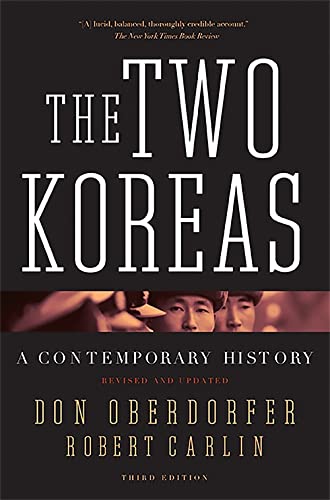
An acclaimed history of the Korean Peninsula from World War II to the present day North Korea is an impoverished, famine-ridden nation, but it is also a nuclear power whose dictator Kim Jong-un regularly threatens his neighbors and adversaries, the United States in particular, with destruction. Even though Kim and President Donald Trump’s responses to him dominate the daily headlines, the idea that North Korea is a menace is not a new one. Indeed, ever since Korea was first divided at the end of World War II, the tension between its northern and southern halves has riveted-and threatened to embroil — the rest of the world. In this landmark history, veteran journalist Don Oberdorfer and Korea expert Robert Carlin grippingly describe how a historically homogenous people became locked in a perpetual struggle for supremacy — and how other nations including the United States have tried, and failed, to broker a lasting peace.
User’s Reviews
Editorial Reviews: Review “[A] lucid, balanced, thoroughly credible account of the last 25 years on both sides of the armistice line.”―NewYork Times Book Review”Riveting…. The Two Koreas majestically fulfills Oberdorfer’s goal of drawing attention to the role outside powers have played in the two Koreas’ history.” ―WashingtonPost”[A] gripping narrative…. The Two Koreas is a masterful analysis of one of the enduring Achilles’ heels of US foreign policy.”―Los Angeles Review of Books”[Oberdorfer’s] gripping narrative should chasten our leaders and inform our citizenry about the continuing perils and costs of America’s involvement with Korea…Oberdorfer is often definitive on that subject, deploying information that even specialists do not know.”―Bruce Cumings, Los Angeles Times”A comprehensive and informative…account of postwar Korean history, from the Korean War to the rise of democracy in the South to the nuclear-weapons crisis in the North.”―The Globe and Mail”Engrossing, informative, wise. A rare achievement, the best account yet of a tragically divided country.” ―Ezra Vogel, Director, Asia Center, Harvard University “This truly important work will, without question, become the standard against which other books on modern Korea will be judged.” ―Donald P. Gregg, former U.S. Ambassador to South Korea”Oberdorfer is one of America’s keenest analysts of the international scene.” ―James A. Baker III, former U.S. Secretary of State”Combining the depth and authority of a first-rate textbook with the readability of a good novel, [The Two Koreas] has proven to be a wonderful teaching tool for instructors and students alike.” ―Carter J. Eckert, Professor of Korean History, Harvard University”A most timely book to understand what could happen if North Korea implodes or attacks South Korea.” ―St. Louis Post-Dispatch”What emerges from The Two Koreas is a portrait of precisely why the peninsula is so volatile: two rivals competing for national legitimacy in a culture where compromise is tantamount to defeat…. Oberdorfer refrains from punditry and predictions, letting his powerful material tell the story.” ―BostonGlobe About the Author Don Oberdorfer wrote for the Washington Post for twenty-five years, and was later on the Chairman of the U.S.-Korea Institute at Johns Hopkins School of Advanced International Studies. He died in 2015. Robert Carlin is a Visiting Fellow at the Center for International Security and Cooperation at Stanford University and former chief of the Northeast Asia Division in the Bureau of Intelligence and Research, U.S. Department of State. He lives in Washington, D.C.
Reviews from Amazon users which were colected at the time this book was published on the website:
⭐very informative material.
⭐Very informative!
⭐This book is advertised as a history of the two Koreas – but it is not really, rather, it is a DIPLOMATIC history of the various crises brought on by the Koreas, mostly North Korea; the reactions of their big power sponsors – the United States, Russia, and China – and various other countries and international organizations. There is just enough national history for the reader to understand the background of the various diplomatic crises and manouevers, but that’s all. And for every page of KOREAN history, there are five to ten pages of the histories of Ambassadors, diplomats, cabinet secretaries, heads of state, etc.This was claerly the author’s area of expertese – as a reporter for the Washington Post, Mr. Oberdorfer had lots of access to all of these government players from all of these governments. And true, he gives just enough actual history for the reader to be able to follow the diplomatic action. But I was really looking for a true history of the Koreas: including their social structures, artistic and literary activity, and all the other parts of a country’s history that are unrelated to their foreign services. So if this book had been presented as a diplomatic history of the Korean crises, it wouldbe excellent. Just I would not have bought it, since its more the history of the COUNTRIES that I was looking for, not of the interaction of their foreign services with various ambassadors! Color me very dissatisfied – the one star is for the 20% of the book which is actual national history, which is quite well done, for its brief appearance. But I have very little interest in Secretary Kissinger et alia, and spending 300 pages reading about them and their manoevers is when I was expecting to learn more of the national histories of the two Koreas was extremely frustrating and tedious. So buyer beware!
⭐Don Oberdorfer’s “The Two Koreas: A Contemporary History” is the perfect first book for anyone interested in the history and trauma in Korea over the last 50 years. This text was required reading in a graduate-level course on the Government and Security in Korea.Oberdorfer knows Korea. From his first visit in 1953 as an Army Lieutenant through his interviews of the presidential candidates before the 1987 election, and his visit to Pyongyang in 1991, Oberdorfer continually followed Korean politics – mostly from the seat of a press member for the Washington Post. As he recounts in the text, Oberdorfer was sitting in the National Theater in Seoul on August 15th, 1974 when the shots rang out at ROK President Park Chung Hee, killing the ROK First Lady, the president survived. This personal touch of first hand accounts, compiled with interviews of major actors in Korean politics (both U.S., North Korean, and South Korean), is seamlessly rolled together in a readable narrative that draws the reader into this contemporary history.The text covers the inside stories and under-the-table events which occurred between the Republic of Korea and the Democratic People’s Republic of Korea from mostly first hand sources in the form of interviews with the participants.I highly recommend this book for anyone studying Korea, Asian politics, or the military situation on the Korean peninsula. A 40-page notes and sources section serves the reader with the basis for Oberdorfer’s statements and claims, and lends itself to more in depth research of the primary sources.
⭐I looked at this book as an introduction to the broad strokes of modern Korean history, and for my purposes it worked wonderfully. I learned a lot, and the book brought a lot of new questions into my mind.That being said, I went immediately from this book to
⭐. And I mean within a few hours of finishing The Two Koreas. Cuming’s book is far more expansive and goes back farther into history, but I am very glad I read The Two Korea’s first, so that I would have the big picture in mind while reading Cumings.Also, I agree with other reviewers that said the author bringing in his personal stories got a little annoying and there could have been more natural ways to introduce the same information.So for people just looking for a light overview of the topic, I would recommend this book. But for those looking to delve deeper into Korean politics and culture, it will not be sufficient.
⭐This book provides a detailed retelling of all the events of note that happened in the Korean peninsula since the last century. It was especially useful for me since it helped me get a grip on how the “nuclear crisis” accusations gained so much tract. By examining the failures and succeses of the past, I am now better equipped to understand the recent diplomatic initiatives by all parties.
⭐Very helpful to understand US policy in Korea and it’s effect on current US/South Korea relations, as well as the current crisis. Covers a good bit of modern Korean history along with events in Europe, China, Russia and the US during the same time period. Well worth the time spent reading, certainly not dry, however also not sensationalized.
⭐Once again, this book is on the State Department reading list. Oberdorfer provides a well-researched, thorough perspective on the strategic, diplomatic, economic and social implications of the ongoing relationship between the divided Korea, and the influence of relations with nations such as China, the United States and Russia. It is particularly noteworthy for the attention it focuses on the current and recent leadership in both Koreas, and the respective pedigrees of those leaders as a means to explain their allegiances and goals. A recommended read for anyone with any interest in East Asian and Pacific political affairs.
⭐Although I was aware of the history I was puzzled why there has been such slow progress over all these years. This book explained the dilemmas over time and made me feel sad for the Koreans who are under such underlying stress partly due to presidential policy changes thousands of miles from then. A very interesting read
⭐An excellent and detailed, and largely unbiased account of the history of the Korean peninsular, most particularly the past fifty years. The author has personal knowledge of the political goings-on between, the North, the USA and the South, which the popular media simply are not aware of. It puts a rather different complexion on things.
⭐Having spent much time in both North and South Korea, I can recommend this book.
⭐Un immenso.Peccato non sia stato ancora tradotto in italiano, sarebbe utilissimo a fini di ricerca, studio, passione e altro.Da leggere.A very detailed story of the Korean peninsula since the separation in 1945. A lot of information, mostly a book for fans of history of for students in the field. Unfortuantly, it’s not always easy to follow because the story is not always told in chronogical order.
Keywords
Free Download The Two Koreas: A Contemporary History in PDF format
The Two Koreas: A Contemporary History PDF Free Download
Download The Two Koreas: A Contemporary History 2013 PDF Free
The Two Koreas: A Contemporary History 2013 PDF Free Download
Download The Two Koreas: A Contemporary History PDF
Free Download Ebook The Two Koreas: A Contemporary History