

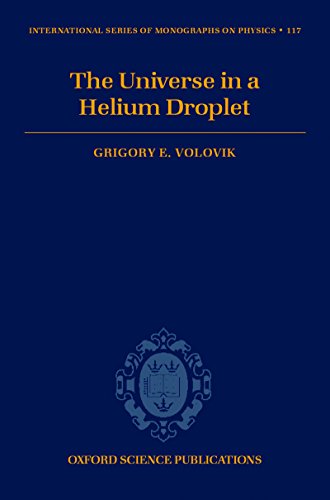
Ebook Info
- Published: 2003
- Number of pages: 536 pages
- Format: PDF
- File Size: 3.64 MB
- Authors: Grigory E. Volovik
Description
There are fundamental relations between three vast areas of physics: particle physics, cosmology and condensed matter physics. The fundamental links between the first two areas, in other words, between micro- and macro- worlds, have been well established. There is a unified system of laws governing the scales from subatomic particles to the Cosmos and this principle is widely exploited in the description of the physics of the early Universe. The main goal of thisbook is to establish and define the connection of these two fields with condensed matter physics.According to the modern view, elementary particles (electrons, neutrinos, quarks, etc.) are excitations of a more fundamental medium called the quantum vacuum. This is the new ‘aether’ of the 21st Century. Electromagnetism, gravity, and the fields transferring weak and strong interactions all represent different types of the collective motion of the quantum vacuum. Among the existing condensed matter systems, a quantum liquid called superfluid 3He-A most closely represents the quantum vacuum.Its quasiparticles are very similar to the elementary particles, while the collective modes of the liquid are very similar to electromagnetic and gravitational fields, and the quanta of these collective modes are analogues of photons and gravitons. The fundamental laws of physics, such as the laws ofrelativity (Lorentz invariance) and gauge invariance, arise when the temperature of the quantum liquid decreases.This book is written for graduate students and researchers in all areas of physics.
User’s Reviews
Reviews from Amazon users which were colected at the time this book was published on the website:
⭐This is a superb book. Only complaint are the cheesy illustrations for a topic so deep. You can read this for years in order to understand it. It is about as heavy as Misner, Thorne and Wheeler’s Gravitation even thought it weighs half as much. Dr. Volovik is either a genius of the first order, a brilliant applied mathematician, or proof that if you squeeze systems of equations of a very general order you can get almost anything to come out. Topology and Geometry on the level of Weinberg’s Theory of Fields volumes 1,2 and 3 are nice prerequisites. This is not a novel.
⭐cerebral expansion
⭐What is the Universe made of?I remember that long ago, I read “Geometrodynamics,” which hypothesized that the Universe might be made entirely of empty space! Curved space, of course. “Imagine,” I told a cosmologist friend. “Mass without Mass! Charge without Charge!””Yes,” said my friend. “Equations without Solutions. Theories without Content.”My friend continued, sarcastically, “To say the Universe is empty is a mistake, caused by making a sign error in the equation 1 + 1 = 2, and getting 1 + 1 = 0. That’s the problem when you make an odd number of sign errors instead of an even number of them. After all, there are only three kinds of cosmologists, those who can count and those who can not.”Since then, I’ve read books that got me to picture the Universe in other ways. As a collection of harmonic oscillators. As real poles in a complex plane. As strings. As a cellular automaton. As a set of binary values. And as an n-dimensional brane.Now we have a very interesting and award-winning monograph which gets us to think of the Universe as a droplet of superfluid Helium. And I was reminded of my earlier conversation when the author began by saying:”A number of different vortices with an intricate structure of the multi-component order parameter have been experimentally observed in the superfluid phases of Helium-3, but the mathematics which is used to treat them is as simple as the equation 1 + 1 = 0.”Of course, by this Volovik means that two soliton walls annihilate each other.In any case, this is a book for some of you Acoustics People out there. Yes, you. Ahoy! You who work with waves and oscillations in superfluid liquid Helium! Abandon your futile searches for Sixth Sound. And Fifth Sound. Switch to Cosmology! Here is a Model you can all understand!The idea of this book is to find a condensed matter system analog to support the idea that elementary particles are excitations of a more fundamental medium called the quantum vacuum. And superfluid Helium3-A comes closest. When the temperature is non-zero, this “vacuum” is excited. The helium quasiparticles are very similar to the chiral elementary particles of the Standard Model. The helium “collective modes are very similar to gravitational, electromagnetic, and SU(2) gauge fields, and quanta of these modes are analogs of gravitons, photons, and weak bosons.”This comparison can remove the need for the ultraviolet renormalization we see in quantum field theory. And it may get us to dispose of quantum gravity entirely, and conclude that gravity simply is not fundamental.James Bjorken, in a paper on Emergent Gauge Bosons, said that he likes the fact that Volovik’s model supplies a solution to the cosmological constant problem (without having to invoke supersymmetry or any fine tuning). After all, a cold quantum liquid in equilibrium will have a pressure due to surface corrections, and that pressure will scale as an inverse power of droplet size. Bjorken tells us in the introduction to this book that “the vacuum dark pressure scales with the vacuum dark energy, and thus is measured by the cosmological constant, which indeed scales as the inverse square of the ‘size’ of the universe.” Volovik says the cosmological constant is not a constant but a dynamical quantity which is either continuously or in a stepwise manner adjusted to perturbations.This is how the helium droplet model serves to explain why the cosmological constant is so small, 120 orders of magnitude less than predicted by relativistic quantum field theory, and solves the coincidence problem of having the cosmological constant on the order of the present mass of the universe. The model also provides a (non-inflationary) rationale for the Universe being flat and answers the question of why the vacuum is (almost) non-gravitating.Volovik explains that his model can also be used to construct analogs of black holes in the laboratory. “Quasiparticles cannot escape from the region of liquid which moves faster than they can propagate. Such regions serve as black holes.” Two superfluid liquids sliding along each other can be used to construct an analog of an event horizon. And we might deduce something about collapse of black holes from this.One problem for me is that this model would make the speed of light other than a fundamental constant. After all, the analogy is to the speed of sound in Helium3-A, which varies between 3 centimeters per second and 10,000 centimeters per second, depending on the direction of propagation! In our world, we wouldn’t notice that. But there could be “external” observers who would. It all sounded too eerily similar to Tom Van Flandern’s discussion of the speed of light. Van Flandern said that while the speed of light is the same for all observers, no matter what their velocities, that’s true “for any wave in any medium, if one uses only waves of various types in that medium for the measurement.” And I had given only two stars to Van Flandern’s book!More seriously, as Volovik admits, when one goes from microscopic theories to a more phenomenological approach, one runs into problems of non-locality.The author tells us that so far, there has indeed been a success in using a superfluid Helium3 simulation. The Iordanskii force has been experimentally identified in rotating superfluid Helium3-B. And it provides verification of the analog of the gravitational Aharonov-Bohm effect!You’ll learn quite a bit about particle physics, cosmology, and even liquid helium if you read this book.
Keywords
Free Download The Universe in a Helium Droplet (International Series of Monographs on Physics Book 117) 1st Edition in PDF format
The Universe in a Helium Droplet (International Series of Monographs on Physics Book 117) 1st Edition PDF Free Download
Download The Universe in a Helium Droplet (International Series of Monographs on Physics Book 117) 1st Edition 2003 PDF Free
The Universe in a Helium Droplet (International Series of Monographs on Physics Book 117) 1st Edition 2003 PDF Free Download
Download The Universe in a Helium Droplet (International Series of Monographs on Physics Book 117) 1st Edition PDF
Free Download Ebook The Universe in a Helium Droplet (International Series of Monographs on Physics Book 117) 1st Edition