

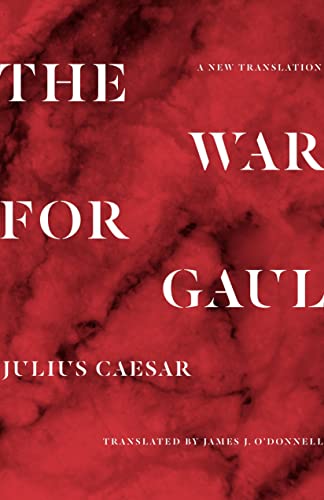
Ebook Info
- Published: 2019
- Number of pages: 324 pages
- Format: PDF
- File Size: 3.43 MB
- Authors: Julius Caesar
Description
A new translation that captures the gripping power of one of the greatest war stories ever told―Julius Caesar’s pitiless account of his brutal campaign to conquer GaulImagine a book about an unnecessary war written by the ruthless general of an occupying army―a vivid and dramatic propaganda piece that forces the reader to identify with the conquerors and that is designed, like the war itself, to fuel the limitless political ambitions of the author. Could such a campaign autobiography ever be a great work of literature―perhaps even one of the greatest? It would be easy to think not, but such a book exists―and it helped transform Julius Caesar from a politician on the make into the Caesar of legend. This remarkable new translation of Caesar’s famous but underappreciated War for Gaul captures, like never before in English, the gripping and powerfully concise style of the future emperor’s dispatches from the front lines in what are today France, Belgium, Germany, and Switzerland.While letting Caesar tell his battle stories in his own way, distinguished classicist James O’Donnell also fills in the rest of the story in a substantial introduction and notes that together explain why Gaul is the “best bad man’s book ever written”―a great book in which a genuinely bad person offers a bald-faced, amoral description of just how bad he has been.Complete with a chronology, a map of Gaul, suggestions for further reading, and an index, this feature-rich edition captures the forceful austerity of a troubling yet magnificent classic―a book that, as O’Donnell says, “gets war exactly right and morals exactly wrong.”
User’s Reviews
Editorial Reviews: Review “This modern commentary on the Commentaries also ‘lets you see Caesar the man and politician, not just the general he wanted you to see.'”—Robert S. Davis, New York Journal of Books”I rather like O’Donnell’s asceticism. He sent me back to the original for first time in decades and drove home how rarely we approach these old warhorses with fresh eyes. . . . [O’Connell] will convince you that Caesar was a very bad man indeed.”—Michael Kulikowski, London Review of Books”A vigorous, modern, and uncluttered translation.”—Lawrence Freedman, Foreign Affairs”Certainly one for the school library shelves or young friends and relatives (classicists or not) who may well be less acquainted with Caesar.”—Adrian Spooner, Classics for All Reviews”[A]n excellent translation . . . one that poses important questions about Caesar, his actions in Gaul, and the dying years of the Republic.”—Anthony Smart, Bryn Mawr Classical Review”James O’Donnell has turned De bello Gallico into lucid, convincing, contemporary English. It’s a masterclass in translation, and a dangerously appealing introduction to ‘the best bad man’s book ever written’.”—Christopher Whitton, Greece and Rome Review “James O’Donnell’s version of The War for Gaul is as gripping and readable as Caesar’s itself. Brisk, terse, and potent, the translation captures the meaning of the original. It is a marvelous achievement. I sat, I read, I loved.”―Barry Strauss, author of The Death of Caesar“To publicize his campaigns in Gaul, Julius Caesar invented a new genre―and a direct, swift, but careful narrative style, like a tight skin around the events he recounts. James O’Donnell admirably renders this style in English, ventriloquizing Caesar’s mysterious genius.”―Sarah Ruden, translator of Augustine’s Confessions”This book invites us to rethink Caesar’s war commentaries not as epic history or grand adventure, but as highly political presentations. The introduction and notes provide rich context, penetrating insight, and grim wit, making clear that Caesar aims not merely to inform but to seduce. As James O’Donnell so strikingly puts it, ‘as you put down this volume, you have become Caesar.’ “―Steven Saylor, author of The Throne of Caesar“The War for Gaul is Caesar’s report of his conquest of Gaul, an amoral war and a vastly destructive prelude to political revolution at Rome. O’Donnell does full justice to Caesar’s Latin, giving us an account as terse and understated as the original. The introductions preceding each Commentary give the modern reader a sense of the context that the ancient reader brought to the story and show us Caesar in the process of becoming Caesar.”―Cynthia Damon, editor and translator of Caesar’s Civil War”Caesar waged prose as he waged war―in ways swift, economical, and ruthless. One sign of the businesslike slaughter of this book is its author’s famous use of the third person about himself. He made the mere word ‘Caesar’ a weapon to be wielded against his foes. O’Donnell enhances this fine translation by prefacing each yearly report from Gaul with a description of what was going on in Rome at the same time, allowing us to see how profoundly the two streams of action affected each other.”―Garry Wills, author of Rome and Rhetoric: Shakespeare’s “Julius Caesar” “Most translations of Caesar give the impression that his style is weighty, ponderous, and, frankly, boring, but nothing could be further from the truth. James O’Donnell’s version of The War for Gaul is much more successful than others in rendering Caesar’s taut, forceful prose in English. In replicating the economy and sweep of Caesar’s narrative, O’Donnell’s version wins hands down.”―James M. May, St. Olaf College “No one has come close to capturing Caesar’s verbal celerity in anything like the way James O’Donnell has. His disciplined application of a terse, bracing style is both readable and simulates something of the experience of the original audience. This makes for a gripping read and brings out what made Caesar famous as an author in his own time. A genuinely distinctive and valuable translation.”―Andrew M. Riggsby, author of Caesar in Gaul and Rome About the Author James J. O’Donnell is professor of history, philosophy, and religious studies and University Librarian at Arizona State University. His books include Pagans, The Ruin of the Roman Empire, and Augustine: A New Biography (all HarperCollins). Read more
Reviews from Amazon users which were colected at the time this book was published on the website:
⭐I studied Latin in high school, and like generations of students before me, Caesar was the first author I encountered in more than a sentence-long way. We read through all of the First Commentary as well as selected parts of the Commentary on Caesar’s first expedition to Britain.In latter years I’ve come to realize that the seemingly arbitrary order in which Latin is taught actually makes a great deal of sense, in that it proceed from a simple and unadorned style–Caesar’s Commentaries–through ever more complex and sophisticated uses: with Cicero we learn the use of formal rhetoric, with Virgil we encounter epic poetry, with Ovid we are introduced to lyric poetry, and finally with Juvenal and others we truly learn how to play with the language.The point of this digression is that, as high schoolers, I very much doubt that the reproaches of Caesar our translator makes in the pages of this book would have meant a great deal. At that age and stage in our education, only a tiny minority–even among Latin students!–would have been aware of the larger historical–let alone political and sociological–context in which Caesar wrote…or taken much interest.No one disputes that Caesar often acted brutally both in battle and in dealing with his defeated adversaries. This would put him in the same category as pretty much every ancient leader whom history has memorialized: Xerxes, Hannibal, the Scipios, the Parthian general who crushed Crassus at Carrhae, and no doubt others whom I could find. The notion that Caesar was somehow exceptionally “bad” or “frightful” to use the translator’s own term is overwrought.Oh…did Caesar use an irenic tone to describe his accomplishments? Of course he did…as the translator admits, these were self-serving instruments of propaganda dressed up as sober After-Action Reports. But how is that different than in the modern, indeed the contemporary era? Let he who has never tweaked a report to make himself look better than he deserves, cast the first stone.General Sherman famously observed that “War is Hell.” General Lee said that “It is a good thing that war is so terrible, else we should become too fond of it.” And the anti-war folk-singer Phil Ochs concludes his immortal “Draft-Dodger Rag” with the ironic line “…And if you ever have a war without blood and gore, I’ll be the first to go!”So, while I appreciate the addition of historical, political, economic and sociological context, I could have done without the finger-wagging and the hand-wringing.Five stars for the translation and the basic, unadorned parts of the commentary on the Commentaries.One star off for the anti-war, ahistorical, presentist parts of the commentary. Net rating: four stars.
⭐I loved this translation. Easy flowing, modern language which in my opinion does a very good job reflecting the spirit of the original work in its original context. The translator notes introducing each year of the war are helpful and appropriate.It is clear that this masterful propaganda piece must be read with a critical mind. But, the constant lecturing about how bad character Caesar was is seriously overdone. You do not serve the best steak you can make with incessant lectures about the horrors of cattle industry. It is not so hard to tolerate the lectures, but it would have been much easier not to serve them in the first place. I think the translator has done his great effort a serious disservice by this.
⭐
Keywords
Free Download The War for Gaul: A New Translation in PDF format
The War for Gaul: A New Translation PDF Free Download
Download The War for Gaul: A New Translation 2019 PDF Free
The War for Gaul: A New Translation 2019 PDF Free Download
Download The War for Gaul: A New Translation PDF
Free Download Ebook The War for Gaul: A New Translation