

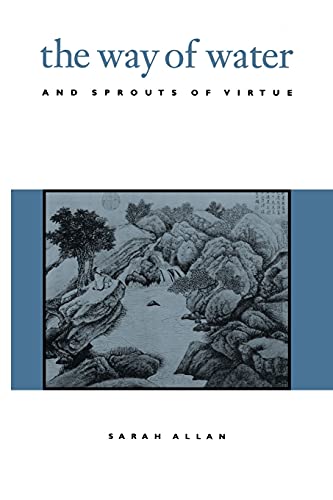
Ebook Info
- Published: 1997
- Number of pages: 196 pages
- Format: PDF
- File Size: 1.65 MB
- Authors: Sarah Allan
Description
Explicates early Chinese thought and explores the relationship between language and thought.
User’s Reviews
Editorial Reviews: Review “I find this book unique among recent efforts to identify and explain essential features of early Chinese thought because of its emphasis on imagery and metaphor.” ― Christian Jochim, San Jose State University About the Author Sarah Allan is Burlington Northern Foundation Professor of Chinese Studies in honor of Richard M. Bressler at Dartmouth College. She is the author of The Shape of the Turtle: Myth, Art, and Cosmos in Early China, also published by SUNY Press; The Heir and the Sage: Dynastic Legend in Early China; Chinese Bronzes: A Selection from European Collections (with Li Xueqin); and Oracle Bone Collections in Great Britain (with Li Xueqin and Qi Wenxin); and editor of Legend, Lore and Religion in China (with Alvin P. Cohen) and Dunhuang Manuscripts in British Collections (with others).
Reviews from Amazon users which were colected at the time this book was published on the website:
⭐This book is a challenge to read. It will open your eyes to the natural origin of culture in China. Based on meditation on nature, especially on water and plants the Chinese discovered how to live fully and successfully in the complex world of 300 BCE. The book can guide modern readers away from the Web World into their own search for genuine values and inner peace and harmony.
⭐This book is amazing! A must self help read
⭐Excellent choice for both the scholar and beginning interested in Daoism or the Daodejing. Wonderful connections and explanations of the eastern view of man’s interrelationship with nature. This book is especially relevant with the current situation of global climate change and mass extinctions.
⭐Sarah Allan’s work is extremely interesting!
⭐This is a great book that happens to have been written by my professor here at Dartmouth College. I would recommend it for anyone interested in Eastern philosophy and classic studies.
⭐This is a great book for people who are seriously interested in ancient Chinese philosophy. The book mainly deals with Confucius, Laozi, Mencius, Zhuangzi, and a little bit of Xunzi. Its basic arguement is that all philosophical thought around that period can be connected through the metaphors which they use to explain their ideas. Mainly, this counts for the metaphor “water,” which is frequently used by virtually all ancient Chinese philosophers as a way of explaining their point. The author shows that in ancient China the properties of water were considered equal to the properties of human nature. Another popular metaphor among ancient Chinese philosophers is that of the plant and in particular its sprouts, which is once more connected to human nature. In her conclusion the author shows that through their metaphors a lot of the points made by the various philosophers are quite similar. This helps you understand why later on Chinese philosophy grew together and become a more collective principle.
⭐Sarah Allan’s The Way of Water and the Sprouts of Virtue is an absorbing book that yields productive insight into the thematic watersheds of Chinese philosophical discourse. Enjoyable for the general reader, it is also a substantial work of scholarship that holds appeal for specialists in sinology and Chinese philosophy. Drawing on the theoretical work of linguist/philosophers George Lakoff and Mark Johnson (Metaphors We Live By; Philosophy in the Flesh, etc.), Allan endeavors to unearth what she calls the “root metaphors” of early Chinese thought. She argues persuasively that the unique conceptual metaphors of Chinese thinking are to be found in the concrete natural imagery of water and plant life. Allan’s project is based upon solid and meticulous scholarship into important early texts from the Confucian and Daoist traditions, as well as more obscure and difficult sources such as inscriptions on bronze and jade. The book includes Allan’s own lucid and well-informed translations of key passages from such texts as the Analects, the Mengzi, the Zhuangzi, and the Daodejing. The Way of Water and Sprouts of Virtue is a wonderful contribution.
⭐CAUTION: Printed in the GERMANY, not the official printing company! the printing quality is extremely terrible:( hate the petty corporation between Cambridge University Press and Amazon.
Keywords
Free Download The Way of Water and Sprouts of Virtue (Suny Series, Chinese Philosophy & Culture) (SUNY series in Chinese Philosophy and Culture) in PDF format
The Way of Water and Sprouts of Virtue (Suny Series, Chinese Philosophy & Culture) (SUNY series in Chinese Philosophy and Culture) PDF Free Download
Download The Way of Water and Sprouts of Virtue (Suny Series, Chinese Philosophy & Culture) (SUNY series in Chinese Philosophy and Culture) 1997 PDF Free
The Way of Water and Sprouts of Virtue (Suny Series, Chinese Philosophy & Culture) (SUNY series in Chinese Philosophy and Culture) 1997 PDF Free Download
Download The Way of Water and Sprouts of Virtue (Suny Series, Chinese Philosophy & Culture) (SUNY series in Chinese Philosophy and Culture) PDF
Free Download Ebook The Way of Water and Sprouts of Virtue (Suny Series, Chinese Philosophy & Culture) (SUNY series in Chinese Philosophy and Culture)