

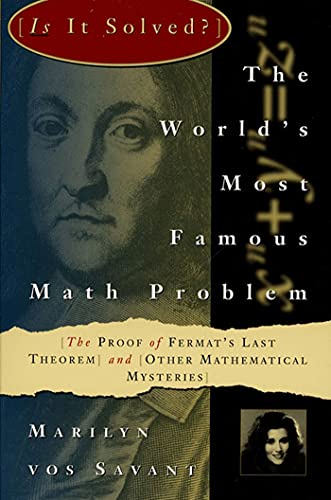
Ebook Info
- Published: 1993
- Number of pages:
- Format: PDF
- File Size: 3.80 MB
- Authors: Marilyn vos Savant
Description
June 23, 1993. A Princeton mathematician announces that he has unlocked, after thousands of unsuccessful attempts by others, the greatest mathematical riddle in the world. Dr. Wiles demonstrates to a group of stunned mathematicians that he has provided the proof of Fermat’s Last Theorem (the equation x” + y” = z”, where n is an integer greater than 2, has no solution in positive numbers), a problem that has confounded scholars for over 350 years.Here in this brilliant new book, Marilyn vos Savant, the person with the highest recorded IQ in the world explains the mathematical underpinnings of Wiles’s solution, discusses the history of Fermat’s Last Theorem and other great math problems, and provides colorful stories of the great thinkers and amateurs who attempted to solve Fermat’s puzzle.
User’s Reviews
Opiniones editoriales Review “A delightful, informative, and accurate book about the probable proof of Fermat’s Last Theorem. [This book is] highly recommended even to readers who think they hate math.” ―Martin Gardner“Within a few minutes of the conclusion of his [Dr. Wiles’s] final lecture, computer mail messages were winging around the world as mathematicians alerted each other to the startling and wholly unexpected result.” ―the New York Times About the Author Marilyn vos Savant’s “Ask Marilyn” column is featured in Parade magazine every Sunday. She lives in New York City.
Reviews from Amazon users which were colected at the time this book was published on the website:
⭐Marilyn vos Savant probably misunderstood mathematical induction at the time she wrote this book in 1993. Mathematical induction, in spite of the word induction, is not what is called inductive reasoning (generalizing from examples.)…Another possibility is that she just pretended to misunderstand mathematical induction, so as to be able to make a chain of plausible reasoning to undercut Andrew Wiles’s proof, and thereby have a sensational thesis to sell her book. There is no proof that she did a dishonest thing like that. More likely, the Monte Hall question made her overconfident and eager for more controversy, and she wrote the book too fast. This problem with mathematical induction is the worst flaw in the book that I can see, although others have stressed the confusion about non-Euclidean geometry…There are lots of good things in here that a person wanting to learn can gain from, like history of Fermat’s Last Theorem and history of Zeno’s Paradox. This is an okay popular math book, at least as measured by the quality that publishers are willing to publish these days. (An example of an EXCELLENT popular math book is by Mark Ronan, Symmetry and the Monster.)
⭐
⭐The item i bought is a book. I have not red it yet but what i can say is that it has arrived until my home in Italy with a very little late. It seems very new, and i payed less than i would have done in a library. I’m happy to have bought it through Amazon!
⭐
⭐I love Marilyn vos savant’s writing so much, but I was really disappointed with this book. She claims she wrote the book in three weeks, but I can’t believe it took her that long. I really have little to say positive about the book, and felt that there may have been a project in there, somewhere, but it didn’t congeal in the book. The execution is poor, the explication of the material is poor, and the writing is slightly below snuff, in comparison to what she usually does in terms of quality. Quite honestly, I don’t know why she felt discussing Fermat’s Last Theorem merited discussing other longstanding problems, each in two or three sentences. Not only would such be insufficient for most non-mathematicians, such discussions are done quite a bit better in numerous books for the non-mathematician and dilettante.I rarely go into the substance of a book in an Amazon review, but I can’t recommend this book to anyone, so I am going to go ahead and discuss where she may have had a point (but didn’t argue it far enough). (Note also that this possible argument is not really accessible to the layman, either.) She claims that a solution to Fermat’s Last Theorem using hyperbolic geometry does not solve the problem, because it would be like applying Bolyai’s squaring of the circle (non-Euclidean geometry) to Euclidean geometry. I would have loved for her to explain this more, because she may have had a point (or demonstrated the folly of her suggestion), but, insofar as I can tell, she doesn’t. I appreciate her brilliant effectuation of philosophy to present a take on Wiles’s solution, but she failed to make the necessary philosophical point to give her claim weight: she never noted why the ontological distinctions between Euclidean and hyperbolic geometry instantiates problems for the number theoretic equation. After all, some exponents (e.g., n=1 and 2) of the equation adhere to Euclidean geometry, but n > 2 may not, and, in fact, do not. That larger `n’ in the number theoretic equation do not adhere to particular geometric ontologies is a contingent fact: we are talking about number theory, which doesn’t, as far as I know, subject itself to particular geometric ontological constraints. That the Chinese Remainder Theorem may have this or that spatial representation that completely corresponds to it is philosophically interesting, possibly useful, but does not constrain other results in number theory that do not adhere to that same type of spatial representation, or even ontological features of the space of representation. The point is that vos Savant never made clear why there should be any fuss about the ontological differences in geometry that some exponents adhere to, while others do not. If anyone has heard a response on this point, please contact me through my Amazon community page (my website and contact information can be found there), because I am interested in this philosophical point, but see no possible way to support the argument. I also want to note that, as far as I know, vos Savant is incorrect about Wiles’ solution being for all `n’. If that were true, it is probably not, contra what she says in the book, a problem for Wiles’s proof. I say “may,” because there are proofs in mathematics that simply handwave and stipulate “for certain values and boundary condition,” that such-and-such is the case. That is standard fare vis-à-vis mathematical modus operandi.She is right on what point, but only partially: Wiles’ proof was not Fermat’s proof. What I find interesting about this whole situation is that nobody, including vos Savant, is talking about the fact that Fermat probably couldn’t have solved this problem, because it may have required something like hyperbolic geometry for a real proof. If he did have a proof, then that would be very, very fascinating, because it would have been so wildly different from Wiles that there is almost no telling what it would have entailed. Honestly, I would have liked vos Savant make a comment to this point, but she was probably so wrapped up saying how wrong Wiles’s proof is that she overlooked it. Likely, Fermat never had a proof, and only thought he did. I am not personally familiar with how rigorous a mathematician he was, but I would still take the leap in ignorance and speculate that he never had a proof. If there is an innate tendency for higher values of `n’ to be correlated to non-Euclidean geometry, then the tools available would not have been inadequate for Fermat to have provided a proof, and a fortiori there was not proof using the “tools of Fermat.”I really wanted this book to be good, but it wasn’t.
⭐
⭐Isn’t it just marvelous, finally a chance to polish up my knowledge of the worlds most famous maths problem. I can’t tell you how much me and my wife have enjoyed, and been entregued by this. Night-after-night, just laying down on the hay, having a laugh with this top quality piece of material. Maths world here I come.
⭐
⭐This book was written hastily to cash in on the publicity surrounding FLT. It qualifies as something of a scam, since the author not only has no expertise in the area, but the book itself has little to do with the actual proof. It consists mainly of simple explanations of basic mathematical methods and traditional math problems. The book’s short length is padded by extensive quotes from other books. For a much better book on the same topic, I recommend “Fermat’s Enigma” by Simon Singh.
⭐
⭐This little book offers an anecdotal overview of Fermat’s last theorem and Wiles’s proof. The total commentary about these two subjects is insignificant. At best this book offers a brief intro to mathematical thought, proofs, and history, though none of these things haven’t been written about countless times before. Armed with a subscription to Scientific America and a couple of basic math or logic books from the library, it seems one would have equivalent references to those used in the making of this book. Thats all.
⭐
Keywords
Free Download The World’s Most Famous Math Problem: The Proof of Fermat’s Last Theorem and Other Mathematical Mysteries in PDF format
The World’s Most Famous Math Problem: The Proof of Fermat’s Last Theorem and Other Mathematical Mysteries PDF Free Download
Download The World’s Most Famous Math Problem: The Proof of Fermat’s Last Theorem and Other Mathematical Mysteries 1993 PDF Free
The World’s Most Famous Math Problem: The Proof of Fermat’s Last Theorem and Other Mathematical Mysteries 1993 PDF Free Download
Download The World’s Most Famous Math Problem: The Proof of Fermat’s Last Theorem and Other Mathematical Mysteries PDF
Free Download Ebook The World’s Most Famous Math Problem: The Proof of Fermat’s Last Theorem and Other Mathematical Mysteries