

Ebook Info
- Published: 2008
- Number of pages: 464 pages
- Format: PDF
- File Size: 1.57 MB
- Authors: Detlev Claussen
Description
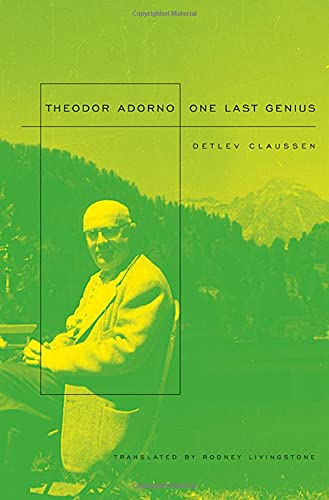
He was famously hostile to biography as a literary form. And yet this life of Adorno by one of his last students is far more than literary in its accomplishments, giving us our first clear look at how the man and his moment met to create “critical theory.” An intimate picture of the quintessential twentieth-century transatlantic intellectual, the book is also a window on the cultural ferment of Adorno’s day—and its ongoing importance in our own. The biography begins at the shining moment of the German bourgeoisie, in a world dominated by liberals willing to extend citizenship to refugees fleeing pogroms in Eastern Europe. Detlev Claussen follows Theodor Wiesengrund Adorno (1903–1969) from his privileged life as a beloved prodigy to his intellectual coming of age in Weimar Germany and Vienna; from his exile during the Nazi years, first to England, then to the United States, to his emergence as the Adorno we know now in the perhaps not-so-unlikely setting of Los Angeles. There in 1943 with his collaborator Max Horkheimer, Adorno developed critical theory, whose key insight—that to be entertained is to give one’s consent—helped define the intellectual landscape of the twentieth century. In capturing the man in his complex relationships with some of the century’s finest minds—including, among others, Arnold Schoenberg, Walter Benjamin, Thomas Mann, Siegfried Kracauer, Georg Lukács, Hannah Arendt, and Bertolt Brecht—Claussen reveals how much we have yet to learn from Theodor Adorno, and how much his life can tell us about ourselves and our time.
User’s Reviews
Editorial Reviews: From Publishers Weekly Starred Review. Most people first encounter Theodor Adorno (1903–1969) as one of the leading lights of the Marxist philosophers known as the Frankfurt School and as the collaborator with Max Horkheimer on Dialectic of Enlightenment, which argued that the Enlightenment emphasis on reason gave rise to Nazi politics and genocide. Yet Adorno’s writings ranged widely from aesthetics and music to ethics and literature. This elegant translation of Claussen’s 2003 biography of his teacher provides the first glimpse of the depth of Adorno’s life and thought. In masterful strokes, Claussen traces Adorno’s life and work from his middle-class Jewish childhood in Frankfurt and Vienna and his university work on Kierkegaard to his friendships with Walter Benjamin and Thomas Mann, among others, and his later intellectual partnership with Horkheimer. Weaving in colorful excerpts of Adorno’s writings, Claussen demonstrates the centrality of music and aesthetics to the philosopher and offers fresh insights into his life. Thanks to its depth and thoroughness, this lovingly crafted study will most certainly become the definitive portrait of Adorno, and it is also a captivating portrait of the incredibly shifting times, from Weimar to the Nazi regime, through which Adorno passed. 19 b&w photos. (Apr.) Copyright © Reed Business Information, a division of Reed Elsevier Inc. All rights reserved. Review By examining Adorno’s life through a circle of modernist companions who ended up dispersed all over the world, Detlev Claussen raises the question of whether biography can be written at all under the broken conditions of modernity. In his descriptions of German-Jewish lives, Claussen shows the complexities of living in the shadow of Auschwitz, and undermines the crude myths and interpretations that have sometimes plagued scholarship of Adorno and his milieu. (Lydia Goehr, Columbia University)Writing as a sympathetic admirer rather than as an outsider or critic, Claussen moves the reader through his narrative the way a good novelist does. He has clearly mastered Adorno’s difficult writings and is wonderfully in control of his subject’s intellectual and personal milieu. His prose is lively and unburdened by technical jargon. Even for a veteran Adorno observer, this remarkable book contains many new findings and revisions of conventional wisdom. (Martin Jay, University of California, Berkeley)This elegant translation of Claussen’s 2003 biography of his teacher provides the first glimpse of the depth of Adorno’s life and thought. In masterful strokes, Claussen traces Adorno’s life and work from his middle-class Jewish childhood in Frankfurt and Vienna and his university work on Kierkegaard to his friendships with Walter Benjamin and Thomas Mann, among others, and his later intellectual partnership with Horkheimer. Weaving in colorful excerpts of Adorno’s writings, Claussen demonstrates the centrality of music and aesthetics to the philosopher and offers fresh insights into his life. Thanks to its depth and thoroughness, this lovingly crafted study will most certainly become the definitive portrait of Adorno, and it is also a captivating portrait of the incredibly shifting times, from Weimar to the Nazi regime, through which Adorno passed. (Publishers Weekly (starred review) 2008-02-11)Claussen, a student of Adorno’s, has written what has been hailed as among the best books on its famously recalcitrant subject. (Brian Sholis Bookforum 2008-04-01)Claussen is a journalist as well as an academic, and his skill at revealing the narrative story of a life, along with the theoretical underpinnings both influencing and influenced by that life, demonstrates the interweaving possible between his own two disciplines…Claussen chooses to reveal the individual by placing him within a foreground of his intellectual and cultural peers, who included Walter Benjamin, Thomas Mann, Max Horkheimer, and Bertolt Brecht, a cohort forced by the 20th century’s political and social upheavals to live peripatetic lives. Richly detailed and elegantly translated. (Francisca Goldsmith Library Journal 2008-03-01)Fascinating…The best thing about Mr. Claussen’s book is the way it helps us to understand the extremities of Adorno’s experience, which gave rise to such hope and such despair. (Adam Kirsch New York Sun 2008-04-09)Detlev Claussen’s biography of Adorno is a remarkable achievement. Central to the success of this book is the fact that its author is not solely a biographer but is also a distinguished sociologist and social theorist, and he is able to identify and respond to each of the difficulties that Adorno poses…In its entirety, this is a brilliant book that movingly disentangles and pieces together highly complex relations of personal, historical, and intellectual life. It is difficult to imagine how biography could be more successful in examining theoretical existence or how it could more accurately elucidate thought in so many of its formative dimensions. (Chris Thornhill Times Higher Education Supplement 2008-04-10)A former student of Adorno’s, Mr. Claussen is on intimate terms with the late master’s work, especially his correspondence with compatriots such as Thomas Mann, Bertolt Brecht and Walter Benjamin. (Thomas Meaney Wall Street Journal 2008-04-18)[A] magisterial biography…As a student of Adorno’s during the ’60s, Claussen, who teaches sociology at the University of Hanover, knows his mentor’s philosophy, as well as his character, intimately. (Richard Wolin Bookforum 2008-06-01)Claussen is illuminating on his subject’s politics, cultural heritage, historical context, musicology, intellectual liaisons and reflections on the culture industry…Theodor Adorno: One Last Genius is a strenuously intellectual biography, the only sort the master himself might just have approved, in which the bare facts of his life always come to us interwoven with historical currents and philosophical wrangles. (Terry Eagleton London Review of Books 2008-06-19)Claussen superbly examines every aspect of Adorno’s life and career, digging like an investigative reporter into “Teddy’s” relations with Max Horkheimer, Herbert Marcuse, Walter Benjamin, and other famous contemporaries and friends, clarifying the Frankfurt School’s evolving ethos, and zeroing in on Adorno’s awkward relation to his Jewishness. (Carlin Romano Chronicle of Higher Education 2008-06-20)As Detlev Claussen’s densely textured biography proves time and again, the conflicts and rapprochements between generations were as essential to Adorno’s personal and intellectual development as was his persistent sense of exile. (Brian Dillon Irish Times 2008-07-26) About the Author Detlev Claussen is a journalist and a Professor of Social Theory, Culture, and Sociology at the University of Hanover.Rodney Livingstone is Professor Emeritus in German Studies at the University of Southampton. He is well known as a translator of books by Walter Benjamin, Theodor W. Adorno, and Max Weber, among others. Read more
Reviews from Amazon users which were colected at the time this book was published on the website:
⭐Great detailed modern biography of a great philosopher. This helps put depth into his works and inspires a rereading of some of his great works.
⭐This book was a slight disappointment for me but only because I was expecting a regular biography or even a conventional critical study, but, as the author’s introduction points out, Adorno himself harbored deep suspicions about the biographical genre, and so Mr. Claussen, one of Adorno’s last students, has written a different kind of book about his revered teacher.I will admit that the advantages of the author’s approach to the life of Theodor Adorno (1903-1969), as trumpeted by the publisher’s dustjacket and the accompanying critical blurbs, were partially lost on me. I was hoping for a more conventional approach, one that would supply enough interesting and even intimate biographical details and provide the reader with something of the relevant intellectual background to make the ideas discussed more understandable. But such was not always the case.I will be more to the point–this book is NOT for someone seeking a first look at the life and thought of Theodor Adorno. Some contexts are provided, and sometimes with amazing detail, but more often than not they seemed remote and in some cases of little apparent value in trying to understand Adorno the man (the extended discussions, for example, of the situation and prospects of the German Jewish bourgeoisie by the early 20th century did not merit the space devoted to it). Adorno’s main ideas peek out of nowhere in the narrative as Claussen presents them in a consciously unsystematic manner, and, unless one already has some knowledge of their meaning, their significance can be lost on the first-time reader.And true to what the author states in the introductory chapter, appropriately entitled “Instead of an Overture” (p. 4ff.), the book reads as if the author wanted to present Adorno not directly as a biographical subject, but rather as a man who until his death in 1969 continued to interact with some of the most significant intellectual and cultural figures of the last century–Walter Benjamin, Ernst Bloch, Friedrich Pollack, Siegfried Kracauer, Georg Lukacs, Fritz Lang, Thomas Mann, Hanns Eisler, Bertolt Brecht, Max Horkheimer, Herbert Marcuse, Gershom Scholem, Alban Berg, and Arnold Schoenberg.These long sections really constitute the meat of the book and they are in their own right fascinating, but the general reader will find himself at some points straining to keep all the pieces together and arrive at a greater sense of continuity. It would have made the book longer, but a little more discursive material added to these sections would have made them, I think, more rewarding to read. In fact any of the above figures taken individually had more space devoted to his relationship with Adorno than did his wife, Gretel Karplus, who only merits passing mention along the way. The book begins in a regular narrative fashion with Adorno’s youth in Frankfurt but it passes quickly into a jumbled, back-and-forth manner of presentation in which events from the 1950s or 1960s are freely mixed with events from thirty years before, and vice-versa.But Theodor Adorno remains a man whose ideas are of continuing interest and influence. One wonders, for example, what he would have thought about the techno-barbarism of our own hyper-manipulative ‘culture industry’ busy as it is multiplying media at every turn and blessing them with a self-critical autonomy that only serves to blind people to their thoroughly coercive nature. And the book does clear up a few things along the way: Claussen deals with the misunderstanding that has accompanied Adorno’s notorious remark, “To write poetry after Auschwitz is barbaric” simply by providing the line that follows it, “And this corrodes even the knowledge of why it has become impossible to write poetry today…”, namely, people will keep on writing poetry in the wake of Auschwitz, but will they do it with any consciousness of what that might mean, or will they just continue scribbling in accordance with the prevailing modes of bourgeois self-regard while blinkered to the reifying ideologies of our material culture? [Here’s a hint–Adorno categorically rejected the idea of art for art’s sake…]There are no doubt other more conventional treatments of Adorno out there, but this book–inspired by the love, respect, and sympathy of one man for his teacher who would no doubt have approved of its aim–CONSCIOUSLY does its own thing.[Note: After reading this book I picked up Stefan Mueller-Doohm’s “Adorno: A Life” and found it to be exactly the kind of biography I was seeking. If you are making the effort to familiarize yourself with Adorno and his work, get the Mueller-Doohm book because it does an admirable job of covering not just his personal life and his interactions with other great artists and thinkers but it also includes expositions of his books and ideas together with just about the right of amount of contextualization.]
⭐This is an intellectual biography of Theodor W. Adorno (1903 -1969), an outstanding member of the Franfurt School, which engaged in original leftish social critical thinking. It presents the thinking of Adorno as developing in personal interaction with other brilliant minds, such as Walter Benjamin, Ernest Bloch, Bertold Brecht, Max Horkheimer and others.It is a pity that the English version does not include an introduction providing background information. Therefore, reading first a history of the Frankfurt school, such as by Rolf Wiggershaus, is recommended. But there is a cardinal insight to learn from this biography, beyond many details of interest mainly to specialists.Striking are the impacts on Adorno of the terrible events of the 20th century, in particular the Holocaust and the Gulag. He lost great hopes for the future. As he summed it up towards the end of his life: “It would be advisable…to think of progress in the crudest, most basic terms: that no one should go hungry anymore, that there should be no more torture, no more Auschwitz. Only then will the idea of progress be free from lies.” (p. 338).This is a profound message. To the modern affluent reader it may seem exaggerated, in view of obvious progress. But this was the delusion of the bourgeois European society till the First World War demolished their world. I do not go as far as Georg Lukács who warned on staying in “Grand Hotel Abyss,” enjoying oneself while ignoring approaching calamities (p. 85). But, with humanity having acquired, thanks to science and technology, the capability to destroy itself, widespread trust in assured progress lacks a reliable basis. This historic lesson makes the book worth pondering.Professor Yehezkel DrorThe Hebrew University of Jerusalem[…]
⭐The Frankfurt School: Its History, Theory and Political Significance
⭐This is an intellectual biography of Theodor W. Adorno (1903 -1969), an outstanding member of the Franfurt School, which engaged in original leftish social critical thinking. It presents the thinking of Adorno as developing in personal interaction with other brilliant minds, such as Walter Benjamin, Ernest Bloch, Bertold Brecht, Max Horkheimer and others.It is a pity that the English version does not include an introduction providing background information. Therefore, reading first a history of the Frankfurt school, such as by Rolf Wiggershaus, is recommended. But there is a cardinal insight to learn from this biography, beyond many details of interest mainly to specialists.Striking are the impacts on Adorno of the terrible events of the 20th century, in particular the Holocaust and the Gulag. He lost great hopes for the future. As he summed it up towards the end of his life: “It would be advisable…to think of progress in the crudest, most basic terms: that no one should go hungry anymore, that there should be no more torture, no more Auschwitz. Only then will the idea of progress be free from lies.” (p. 338).This is a profound message. To the modern affluent reader it may seem exaggerated, in view of obvious progress. But this was the delusion of the bourgeois European society till the First World War demolished their world. I do not go as far as Georg Lukács who warned on staying in “Grand Hotel Abyss,” enjoying oneself while ignoring approaching calamities (p. 85). But, with humanity having acquired, thanks to science and technology, the capability to destroy itself, widespread trust in assured progress lacks a reliable basis. This historic lesson makes the book worth pondering.Professor Yehezkel DrorThe Hebrew University of Jerusalem
Keywords
Free Download Theodor W. Adorno: One Last Genius in PDF format
Theodor W. Adorno: One Last Genius PDF Free Download
Download Theodor W. Adorno: One Last Genius 2008 PDF Free
Theodor W. Adorno: One Last Genius 2008 PDF Free Download
Download Theodor W. Adorno: One Last Genius PDF
Free Download Ebook Theodor W. Adorno: One Last Genius