Ebook Info
- Published: 2000
- Number of pages: 512 pages
- Format: PDF
- File Size: 20.23 MB
- Authors: Ding-Zhu Du
Description
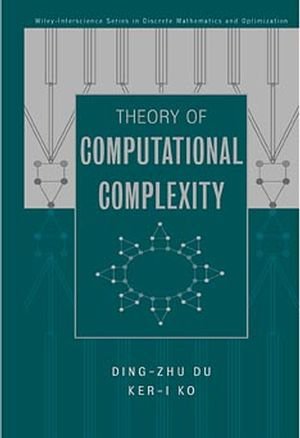
A complete treatment of fundamentals and recent advances in complexity theory Complexity theory studies the inherent difficulties of solving algorithmic problems by digital computers. This comprehensive work discusses the major topics in complexity theory, including fundamental topics as well as recent breakthroughs not previously available in book form. Theory of Computational Complexity offers a thorough presentation of the fundamentals of complexity theory, including NP-completeness theory, the polynomial-time hierarchy, relativization, and the application to cryptography. It also examines the theory of nonuniform computational complexity, including the computational models of decision trees and Boolean circuits, and the notion of polynomial-time isomorphism. The theory of probabilistic complexity, which studies complexity issues related to randomized computation as well as interactive proof systems and probabilistically checkable proofs, is also covered. Extraordinary in both its breadth and depth, this volume: * Provides complete proofs of recent breakthroughs in complexity theory * Presents results in well-defined form with complete proofs and numerous exercises * Includes scores of graphs and figures to clarify difficult material An invaluable resource for researchers as well as an important guide for graduate and advanced undergraduate students, Theory of Computational Complexity is destined to become the standard reference in the field.
User’s Reviews
Editorial Reviews: Review “Here one finds both a basic introduction and comprehensive treatments, especially of topics that have borne spectacular fruit in just the last few years…” (Choice, Vol. 38, No. 10, June 2001) “Graduate students in this area of computer science will simply find htis book indispensable.” (CHOICE, June 2001) “Du and Ko present the fundamentals of complexity theory, including NP-completeness theory, the polynomial-time hierarchy, relativization…” (SciTech Book News, Vol. 24, No. 4, December 2000) Overall, I would recommend this book as an excellent addition to the literature. (Bulleting of the London Mathematical Society, Volume 33, 2001) “The book…is a graduate text…however, it can also be used profitably by researchers in theory…the selection by the authors of the book under review is excellent.” (Mathematical Reviews, Issue 2001k) Excerpt from publisher’s description: “…promises to become the standard reference on computational complexity.” (Zentralblatt MATH, Vol. 963, 2001/13) “the book promises to become the standard reference on computational complexity” (Zentralblatt MATH, Vol.963, No.13 2001) From the Back Cover A complete treatment of fundamentals and recent advances in complexity theory Complexity theory studies the inherent difficulties of solving algorithmic problems by digital computers. This comprehensive work discusses the major topics in complexity theory, including fundamental topics as well as recent breakthroughs not previously available in book form. Theory of Computational Complexity offers a thorough presentation of the fundamentals of complexity theory, including NP-completeness theory, the polynomial-time hierarchy, relativization, and the application to cryptography. It also examines the theory of nonuniform computational complexity, including the computational models of decision trees and Boolean circuits, and the notion of polynomial-time isomorphism. The theory of probabilistic complexity, which studies complexity issues related to randomized computation as well as interactive proof systems and probabilistically checkable proofs, is also covered. Extraordinary in both its breadth and depth, this volume: * Provides complete proofs of recent breakthroughs in complexity theory * Presents results in well-defined form with complete proofs and numerous exercises * Includes scores of graphs and figures to clarify difficult material An invaluable resource for researchers as well as an important guide for graduate and advanced undergraduate students, Theory of Computational Complexity is destined to become the standard reference in the field. About the Author DING-ZHU DU, PhD, is a professor in the Department of Computer Science at the University of Minnesota. KER-I KO, PhD, is a professor in the Department of Computer Science at the State University of New York at Stony Brook. Read more
Reviews from Amazon users which were colected at the time this book was published on the website:
⭐The book presents material designed perhaps for an advanced graduate class on computational complexity.In order to follow the material it covers you need to have already mastered a class on theory of computation or have some mathematical maturity due to the language used in this book. If you want to learn, you should definitely not start with this book, you should probably go with Sipser’s book, which I have found really useful. This book on the other hand covers far more material and serves better as a reference book, since it contains a compendium of most of what computational complexity covers as a field.It also contains a very interesting literature review summary at the end of each chapter that tells you the development of each topic and the main publications, authors involved in the process.
⭐If you want to understand this book, you need to have mastered the material in Sipser first. It would also help to have prior coursework in combinatorial optimization and approximation algorithms.If you have reached the level in your studies such that reading this book is a useful endeavor, then I would say this book and Arora and Barak are the two best books from which to learn. Of course Garey and Johnson remains a good reference.
⭐THis is my textbook so I don’t have a choice but it is horribly written and completely unintelligible. I had to go get a different text from the library.
⭐worst book ever! lots of mistakes! Do not buy it.
⭐I can only concur with my fellow Ann Arborite – dense, badly written, often wrong, the works. There’s really no perfect textbook that covers this material, but Papadimitriou beats this one handily – plus, he quotes the Clash.
Keywords
Free Download Theory of Computational Complexity 1st Edition in PDF format
Theory of Computational Complexity 1st Edition PDF Free Download
Download Theory of Computational Complexity 1st Edition 2000 PDF Free
Theory of Computational Complexity 1st Edition 2000 PDF Free Download
Download Theory of Computational Complexity 1st Edition PDF
Free Download Ebook Theory of Computational Complexity 1st Edition