

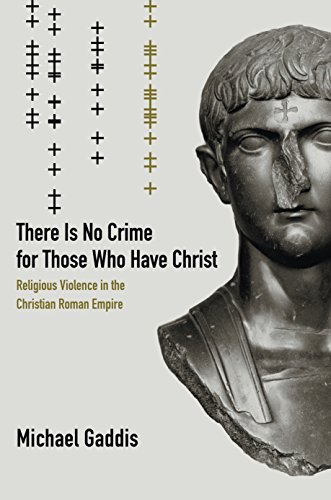
Ebook Info
- Published: 2005
- Number of pages: 418 pages
- Format: PDF
- File Size: 1.47 MB
- Authors: Michael Gaddis
Description
“There is no crime for those who have Christ,” claimed a fifth-century zealot, neatly expressing the belief of religious extremists that righteous zeal for God trumps worldly law. This book provides an in-depth and penetrating look at religious violence and the attitudes that drove it in the Christian Roman Empire of the fourth and fifth centuries, a unique period shaped by the marriage of Christian ideology and Roman imperial power. Drawing together materials spanning a wide chronological and geographical range, Gaddis asks what religious conflict meant to those involved, both perpetrators and victims, and how violence was experienced, represented, justified, or contested. His innovative analysis reveals how various groups employed the language of religious violence to construct their own identities, to undermine the legitimacy of their rivals, and to advance themselves in the competitive and high-stakes process of Christianizing the Roman Empire.Gaddis pursues case studies and themes including martyrdom and persecution, the Donatist controversy and other sectarian conflicts, zealous monks’ assaults on pagan temples, the tyrannical behavior of powerful bishops, and the intrigues of church councils. In addition to illuminating a core issue of late antiquity, this book also sheds light on thematic and comparative dimensions of religious violence in other times, including our own.
User’s Reviews
Reviews from Amazon users which were colected at the time this book was published on the website:
⭐This book should be read more widely. People who are in love with what came out of the Nicean and early Constantinople Councils should read what the people were like who made weighty decisions we are still having to live down.
⭐In late November 2006, the New Republic gave this book a stellar review. The book might also be read profitably alongside another good book on early Christian history: “The Closing of the Western Mind.”
⭐I hadn’t known that in the Christian antique world, there was a championing, at least among some, of the idea of “sacred violence.” Primarily, this manifested itself in gangs of monks attacking pagan temples and synagogues, and in the Empire coercively pursuing unity among the various factions.Gaddis covers the “late antiquity” period in Christian history, from Diocletian’s persecution to the Council of Chalcedon in 451. The roots of the violence that would occur from Constantine’s time onward has its roots in the experience of the early Christian community, whose worldview was shaped by martyrdom and persecution. To my surprise, I learned that the early martyrs never saw themselves as passive victims of violence for worshiping as they pleased. Rather, they saw martyrdom as a spiritual combat against the demons of the persecutors. When Diocletian’s edict was posted, one Christian angrily ripped it down, meaning that at least some wanted to actively seek out martyrdom. Records indicate that those who were killed in retaliation for smashing idols were not to be honored as martyrs, indicating that the practice was fairly common. The concept of martyrdom, which literally means witness, expanded to include avenging dangers to the faith. Gaddis covers lots of material in his excellent book, and here are some more important points:* The early monastic movement does not come off well. Zealots who wandered the country side smashing temples were almost all monks. Further, there was virtually no check on their behavior, and they saw themselves as inflicting God’s anger on His enemies. The pagan orator Libanus angrily denounced “black-robed tribes” who wandered the countryside in Syria, terrorizing peasants, begging for food and money, and generally committing banditry. The Egyptian monk Shenoute, after ransacking a prominent Pagan’s house in search of idols, was charged with crimes. His reply was “there is no crime for those who have Christ.”* Some famous saints had a dark side. For instance, John Chrysostom once preached that his congregants were to admonish blasphemers, and if that didn’t work, to hit them. “Sanctify thy hand by the blow.” A local synod accused Chrysostom of hitting a man and forcing him to take communion while his mouth was bleeding. Ambrose, who is perhaps best remembered for rebuking Theodosius after massacring civilians in a battle, also urged him not to prosecute monks who had ransacked several Pagan temples.* The State, like the zealots, felt it had to use violence, but to bring about unity, not purity. Augustine was particularly important in this regard.* The State was also afraid to take strong action against the monks and mobs, out of fear that they would be seen as “persecutors.” Persecution was a core concept in that time.* In fact, many zealots saw the continued presence of idolatry and heresy as a form of persecution, and believed that the Empire was “persecuting” Christians for its continued tolerance of Paganism.Gaddis’ study gives the reader on how violence was understood within the worldview of early Christian history. Essentially, violence was used to maintain boundaries between different religious communities, or to unite them. As the author notes at the end, Shenoute’s claim, that there is no crime for those who have Christ, did not go uncontested.
⭐Michael Gaddis’ work touches on some of the same territory covered by Ramsay MacMullen in his recent work, Voting About God. These works compliment each other well. MacMullen focuses on the actual church councils but touches upon the violence, while Gaddis looks more closely at the violence itself, its origins, its role in the imperial system, and its appropriation by the Christian movement.The author’s writing style, while not as engaging as that of MacMullen, is still very good and easy to follow. His prose is not turgid or difficult and it is not bogged down by foreign turns of phrase, or, as often happens in scholarly works, chunks of untranslated Latin, Greek, or German text.I do think the author makes certain basic assumptions that are by no means proven. Necessarily, given the scope of his work, he cannot go far back into the imperial past and offer a in-depth treatment of repression and toleration and it needs to be understood that the Roman system was by no means unusually intolerant for the period. On the other hand, he does not fall into the trap of Richard Horsley, who seems to include Rome as a foremost member of the “Axis of Evil.” Too, he treats the “persecutions” as though they happened exactly as Christian mythology claims, which is by no means proven. A good case can be made that none of the first nine persecutions claimed by apologists took place. The last, that of Diocletian, is more problematic, but even here we do not know enough about what Diocletian did, or why, since we have only the account of his opponents to go on. As MacMullen has elsewhere noted, the weight and bias of Christian sources distorts our view of this era.These faults aside, Gaddis pulls no punches when it comes to examining the violent nature of late imperial rule, something MacMullen has also touched on in several of his works. It was a dark, brutal period, and Gaddis sees the origins of violence in the need for consensus. This, he thinks, motivated Diocletian, and he believes it motivated Constantine and the Christian rulers who followed him to the throne.But it is not only the secular leadership of the empire but the rank and file who embraced violence. Gaddis does well to point out that just because a group sees itself as persecuted does not mean that it is, and that in the case of these early Christians, even the existence of polytheism was seen as persecution of a sort. Christians stopped at nothing to show their displeasure, from acts of violence guaranteed to see them beaten, imprisoned, or killed (both by pagan or Christian authorities) to open persecution of polytheists, so-called heretics, and Jews. Like MacMullen, Gaddis makes clear that Christian hatred was as great or greater for other Christians than for pagans.What sets this book apart is its focus on religious violence. It is by no means the first book to examine monotheistic violence but it’s focus on the early Christian empire makes it especially interesting as it is this period which set the tone for all that happened in the centuries following. It is a book every Christian should read. It will disabuse them of the notion that the “conversion” was some sort of peaceful process, or the myth that pagans rushed to worship the Christian god as soon as it became the state religion. As MacMullen has said, Christianity was imposed from above through violent measures, measures that had no limit, and Gaddis does not disagree.
⭐This is a great, scholarly, work, by an accomplished writer. Much research went into the making of this book, as is evidenced by the plethora of reference notes to back it up. The bibliography is extensive and is divided into modern works and ancient sources.From this book, my research has branched into many different directions, which for me is a little frustrating, but exciting nonetheless. Definintely not a dead-end book.He give a thourough analysis of religious violence from both pagan and Christian perspectives and explains the history of this time period in a way this is often not explained. He shows history how it was, not how he wants it to be. I have been so used to hearing false histories or “the history of the victor’s” that it is enlightening to see this author finally delve into the true historical record and uncover much of what has lain in the dark for far too long.I strongly recommend this book to anyone with a serious interest in the Late Roman Empire, or early Christianity.
⭐Michael Gaddis has written a valuable insight into the use of violence in its various forms as perpetrated by Christians, mostly against other factions of Christians, in the period between Diocletian and the Council of Chalcedon. Particularly strong areas for me were the coverage of the Donatist schism (and their even more extreme offshoot the Circumcellions) and the strong-arm tactics applied at the Councils of Ephesus and Chalcedon, characterised as manifestation of holy zeal and hierarchical power respectively. Consideration is also given to the justifications provided, and some may be applicable to extremism today (and the book in a couple of places does touch upon this) – an interesting idea that the willingness to die in the minds of many of these people justified the willingness to kill.
Keywords
Free Download There Is No Crime for Those Who Have Christ: Religious Violence in the Christian Roman Empire (Transformation of the Classical Heritage Book 39) in PDF format
There Is No Crime for Those Who Have Christ: Religious Violence in the Christian Roman Empire (Transformation of the Classical Heritage Book 39) PDF Free Download
Download There Is No Crime for Those Who Have Christ: Religious Violence in the Christian Roman Empire (Transformation of the Classical Heritage Book 39) 2005 PDF Free
There Is No Crime for Those Who Have Christ: Religious Violence in the Christian Roman Empire (Transformation of the Classical Heritage Book 39) 2005 PDF Free Download
Download There Is No Crime for Those Who Have Christ: Religious Violence in the Christian Roman Empire (Transformation of the Classical Heritage Book 39) PDF
Free Download Ebook There Is No Crime for Those Who Have Christ: Religious Violence in the Christian Roman Empire (Transformation of the Classical Heritage Book 39)