Ebook Info
- Published: 1999
- Number of pages: 208 pages
- Format: EPUB
- File Size: 0.00 MB
- Authors: Yukio Mishima
Description
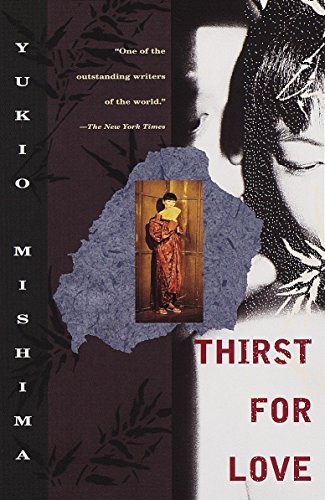
Sexual torment, jealousy, and impossible-to-resolve longing, Mishima’s Thirst for Love is a portrait of the corrosive power of frustrated desire. The protaganist is Etsuko, a young widow whose philandering husband died horribly from typhoid. After moving into the house of her father-in-law, her misery deepens as she numbly submits to the old man’s advances. But soon Etsuko falls in love with the young servant, Saburo. Tormented by his indifference yet invigorated by her anguish, she makes one last, catastrophic, bid for his attentions. Praise for Yukio Mishima “One of the outstanding writers of the world.”—The New York Times “Like his Western counterparts—Mann, Joyce, Pound, Elliot, and Yeats—Mishima manages in his art to attain the laughter of the gods.”—San Francisco Examiner
User’s Reviews
Editorial Reviews: From Library Journal Published in the United States during the 1960s but written years earlier, this Mishima trio, while vastly different in plot, all sport the common theme of idealism destroyed by reality. Nearly three decades after his death, Mishima continues to be a compelling novelist. (LJ 1/15/63, LJ 3/15/68, LJ 9/1/69) Copyright 1999 Reed Business Information, Inc. About the Author Yukio Mishima was born in Tokyo in 1925. He graduated from Tokyo Imperial University’s School of Jurisprudence in 1947. His first published book, The Forest in Full Bloom, appeared in 1944. He established himself as a major author with Confessions of a Mask (1949). From then until his death he continued to publish novels, short stories, and plays each year. His crowning achievement, The Sea of Fertility tetralogy—which contains the novels Spring Snow (1969), Runaway Horses (1969), The Temple of Dawn (1970), and The Decay of the Angel (1971)—is considered one of the definitive works of twentieth-century Japanese fiction. In 1970, at the age of forty-five and the day after completing the last novel in the Fertility series, Mishima committed seppuku (ritual suicide)—a spectacular death that attracted worldwide attention.
Reviews from Amazon users which were colected at the time this book was published on the website:
⭐Before I tracked down my whole Mishima paperback stash, I was way out of chronological order. I remember jumping from the very late Spring Snow to the earlier Forbidden Colors and noting the remarkable difference in tone, the poetics of Spring Snow seemed to be at odds with the more brash and peremptory (artistically adolescent?) voice of Forbidden Colors. My impression was happily disproven when I read his first novel, Confessions of a Mask, with the full palate of poetry and horror of his later work, wrought with, here, the same consummate craft. I’ve come to surmise, not speaking Japanese at all and having no true context, that there are good translators as well as less-then-good ones. Confession of a Mask was translated by Meredith Weatherby. I immediately and rapturously followed her subsequent Mishima translation, The Sound Of Waves, the astonishing beauty of Mishima’s prose foremost, particularly in his evocations of natural landscape. I’ve read many more along my Mishima binge, but avoided Thirst For Love, as it, and Forbidden Colors shared the same translator: Arthur H. Marks.I’m happy to say that Thirst is such a great work as not even he can ruin it.Etsuko is widowed by her abusive, constantly straying husband. She goes to live with her father-in-law and his family. Soon the advances of the aged patriarch are a forgone conclusion. She, in turn, is tortured by her own desires and jealousies for an estate worker, Saburo.While the bare bones may seem melodramatic, Mishima employs italics as the voice of the unspoken of various characters. If we were merely aware of what was said, we would never know the cynicism, the madness of Etsuko. In fact, there comes a moment when she doesn’t realize she is thinking out loud, and the madness is complete. It becomes more than just insightful dialogue; it’s a superb, multi-layered psychological narrative. We are always aware of the intricacies of the interpersonal dynamics at every precarious moment through the subtlest means.I was astonished by its depth of field of all the various shades of victimization and victimhood; masochism and manipulation, vicious wounds inflicted on others and ourselves. A novel of obsession and suffering, of insight and opposition. RIght up there with my favorite Mishima novels.
⭐Disclaimer: I am a HUGE Yukio Mishima fan. Like most of his other novels, this book shows off his wonderful writing style and prose. Probably the best two aspects of this novel are the prose and the theme. What is weakest (as many other reviewers state) is the characterization.Etsuko is really the only character that Mishima fleshed out. Yakichi is well characterized by his constant inability to act on things. But otherwise, the remaining characters all seem to be rather flat archetypes. The pseudo-intellectual and his wife, Saburo the bumbling gardener that Etsuko lusts after, and the housekeeper (Miho was it?) who rarely appears and when she does she is a sniveling mess.Now on to one point: Koreyoshi Kurahara directed an AMAZING adaptation of this novel. This is one of those very rare instances where I think the film adaptation was better than the novel. Knowing Mishima and his fondness for stage and screen, I think he may have imagined the story playing out almost as a play or on the screen but then adapted it to a novel form. This is also apparent because of the setting mostly in and around the family household. Plus, the dinner near the end is so much creepier with Beethoven’s 5th symphony being played loudly by one of the family members.Link for the Criterion release of the film (in a set):
⭐The theme however, and the philosophical questions posed, are deep and meaningful. The relationship of Etsuko, widowed and involved in a romantic relationship with her father-in-law is very strange yet rooted in classical literature and psychology. The constant reminders of the decay of the classic Japanese family is apparent with every page.Etsuko is really the only morally strong character – and I mean that because she stands up for her beliefs, misguided as they may be. It’s interesting to see the other characters talk a line of BS, but really fail to say anything meaningful or to act on their own beliefs. The fact that they are so ineffectual serves as a metaphor for the traditional Japanese country families who wanted things to get better, and always talked about making things better, but never acted on it.Mishima constantly bemoaned the future of Japan, believing Japanese tradition was being sacrificed in the name of progress. This message is much more clearly illustrated in his other novels I feel. I will list a few recommended novels by this amazing author, but suffice to say the Sea of Fertility tetrology is one of his most important contributions to world literature. Yukio Mishima committed seppuku (Japanese ritual suicide) just after finishing ‘Decay of the Angel’ the final book in that series.Other Mishima novels to read (probably before this one):
⭐
⭐
⭐And for some amazing short stories:
⭐I have read many, but not all of Mishima’s works, so please add any other recommendations under comments. Thanks!
⭐This book in my opinion stands shoulder to shoulder with the rest of Mishima’s work. If desire itself is taken as the main character, it works magnificently. The book is an excoriating study of the insatiability of desire. Mishima dissects our ‘thirst for love’ through his characters experience of; exploitation, abandonment, sublimation, avoidance, humiliation, infidelity as well as Etsuko’s dark response.Etsuko, a widowed and cheated on middle aged woman, has had her desire frustrated by circumstances throughout her life. Mishima charts her attempts to negotiate an actual unfulfilling love and an imagined seemingly unobtainable one. This book is the antithesis of
⭐The Sound Of Waves
⭐and forms a shocking contrast to it. Yet Mishima writes with such genius evoking humans feelings and manipulations with searing honesty. His description of the minutia of desire is remarkable.He gives us no truly sympathetic or unsympathetic characters – even the object of Etsuko’s desire, the ‘innocent’ Saburo could be seen as thoughtless. The narrative’s compelling force comes from the dragging into the light the shadowy feelings and actions we all know and would probably rather forget. For that reason many may find this book a painful experience. For me though the brave light it shines in the dark corners of the human psyche is worth it.
⭐Book described as used but in good condition and this is a fair description of the book I received.
⭐In many ways, typical of Japanese literature, slow moving, restrained emotion, yet I liked it on it’s level.
⭐satisfied
⭐Unfortunately this book is below expectations and I’ve been not able to finish it… Anyhow a deep book, and Mishima is a great writer, in this case it’s simply me… I was expecting something different, it’s a poetic and descriptive book … not so passionate, dark and weird as I was hoping. My error basically…but maybe my comments are helping your expectations.I would not like to add much more comments, because books are also about feelings and personal taste.Let’s say that I’ve read Murakami (both the Murakami…) and they are – to my personal view – into another level of reader’s involvement, since the firs lines.I hope my comment could be of any help.
Keywords
Free Download Thirst for Love in EPUB format
Thirst for Love EPUB Free Download
Download Thirst for Love 1999 EPUB Free
Thirst for Love 1999 EPUB Free Download
Download Thirst for Love EPUB
Free Download Ebook Thirst for Love