

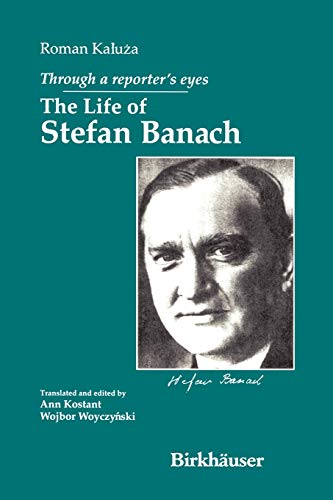
Ebook Info
- Published: 2004
- Number of pages: 182 pages
- Format: PDF
- File Size: 25.20 MB
- Authors: Roman Kaluza
Description
* Based on original archival sources, dozens of interviews with people who knew and remember Banach, and conversations with mathematicians who are familiar with Banach’s work and its impact on modern mathematics* Presents engaging descriptions of Banach’s personality and the unusual milieu in which he worked* Originally written in Polish, the English edition has been revised to include new materials and many photographs
User’s Reviews
Editorial Reviews: From the Back Cover 1995 marked the 50th anniversary of Stefan Banach’s death. Until now, the general English speaking public has had no access to an in-depth life story of a mathematician whose name is one of those most often encountered in modern mathematical research. This small volume, originally written in Polish by a well-known reporter, is an effort to fill that gap in the biographical literature. It is based on original archival sources, dozens of interviews with people who knew and remember Banach, and conversations with mathematicians who are familiar with Banach’s work and its impact on modern mathematics. The author presents engaging descriptions of Banach’s personality and the unusual milieu in which he worked. Further, Chapter V focuses on the famous Scottish café, which like Banach himself, has achieved a mythical dimension in mathematical lore. The English edition has been revised to include new materials and many photographs, and to reflect the interests of a broader international audience.”All in all, it is a fascinating story that is told well.”–Pre-publication review, Don Albers, MAA
Reviews from Amazon users which were colected at the time this book was published on the website:
⭐Stefan Banach’s narrative is one that is left aside by mainstream science. He is somewhat akin to Claude Shannon in that he came up with a theory that does has tangible implications for us. His efforts are part of a cascade of events that led to marvelous applications. The reason we aren’t exposed to him is the advanced nature of his work. How does one approach the genius of this Polish mathematician. Think about the television series “Star Trek” by Gene Roddenberry. Space, a mathematical frontier, these our the theoretical voyages of Stefan Banach … How does one go from advanced theory in Linear Algebra and explain how important Linear Operators are in Quantum Mechanics and demonstrate that P.A.M. Dirac who won the Nobel Prize in Physics may have utilized the concepts of operators. Big deal, right? Every time a patient gets an MRI, which is based on nuclear magnetic resonance, the ideas of quantum mechanics are at work. Stefan Banach’s operators made quantum mechanics workable and doable. He took quantum which was like clay and helped mold it into something more tangible. He “invented” a theory that made a theory approachable because let’s face it, mathematics is an essential tool. And for that they named a mathematical space after him, the Banach space that one can learn about in advanced real analysis for the curious. The next time you have the chance to sip some cognac, maybe give a fleeting thought to Banach. His mathematical thinking was that refined and sophisticated.
⭐I gifted
⭐Anybody studying Math should read this book!
⭐Wonderful Book – Great service
⭐In the preface to this book, Roman Kaluza states that “this book contains little of mathematical character,” and hence this is not a work on the important mathematical developments of Stefan Banach during his productive life. Nevertheless, it offers a detailed and comprehensive look inside the Polish mathematical and educational communities in the time between the wars. Although Banach left no correspondence or memoirs from which to examine his life, Kaluza does an admirable job reconstructing his career through a comprehensive study of university archives, newsletters, interviews with students and acquaintances, and the recollections of Banach’s contemporaries.Most mathematicians initially become familiar with the name of Stefan Banach through their studies of functional analysis, topology (the Banach space), or through the paradoxical Banach-Tarski theorem, yet they learn nothing about the man himself. This role is well served by Kaluza’s book, which may be roughly divided into two parts. The first half of the book addresses the academic development and mathematical work of Banach. The second half concerns the personal and social aspects of Banach’s life. Joining these two parts is a fascinating chapter on the Scottish Café, which has attained legendary status in Polish mathematical history, where Banach and other mathematicians struggled with a wide range of important mathematical topics over coffee and cognac.The first four chapters of the book concentrate on the education and subsequent mathematical contributions of Banach during his career. As a schoolchild, he attended the Henryk Sienkiewwicz Gymnasium in Cracow, a school concentrating in the humanities. An excellent mathematics student, he tutored from the age of 15 and was largely self-taught in the more advanced aspects of his subject. Upon graduation, we learn that he decided to enter into engineering, believing that “mathematics was so highly developed, it would be impossible to do anything new.” Enrolling in Lvov Polytechnic, Banach soon realised that a future did exist in mathematics. His meeting with Huglo Steinhaus in Lvov represented a turning point in Banach’s life. This meeting is colourfully described by Kaluza using excerpts from the memoirs of Steinhaus. We learn that not only did Banach become acquainted and begin to collaborate with one of Poland’s leading mathematicians, it was through Steinhaus that he meets his wife.The years from 1919 to 1929 represented Banach’s most prolific period of research. After the publication of his first paper (in collaboration with Steinhaus) in 1918, Banach produced a remarkable string of results. One of his earliest papers remains his most influential. In “Sur l’équation functionelle f(x + y) = f(x) + f(y),” he demonstrates that measureable solutions to this equation are necessarily continuous, and thus linear. Banach followed this paper with four more in a similar vein, providing the necessary background for his developments in the theory of functional analysis. These early papers, published while Banach was still a student, lead to his Ph.D. thesis on complete normed metric spaces, known now as Banach spaces. Despite his emphasis on the non-mathematical nature of Banach’s life, Kaluza does an admirable job in conveying to the reader a sense of the content of Banach’s work. He considers the mathematical content of these early papers individually, albeit briefly. At this point the inclusion of a few simple equations instead of unnecessarily long descriptions would be beneficial.Banach went on to receive his Ph.D. in 1921, and by 1924 was promoted to the “highest possible rank in the [Polish] scientific community” – Professor Ordinarus of mathematics.Kaluza moves from this most productive period to consider the rest of Banach’s mathematical work, from his founding (with Hugo Steinhaus) of the Studia Mathematica in 1929 to his death in 1945. The Studia Mathematica was an important journal that conveyed the recent Polish successes in functional analysis and set theory. Kaluza shows that the Studia was the first mathematical journal to specialise in these areas, thus attracting not only Polish but internationally renowned scholars. In 1932 Banach published his influential monograph The Theory of Linear Operations. This treatise consolidated his published results on linear functional analysis along with a substantial amount of new theorems and applications. During the late 1930s, Banach’s output declined sharply, primarily due to the geopolitical situation in Europe. His last (non-posthumous) papers, on non-divergent series of orthogonal functions, appeared in 1940.To connect the largely intellectual history of the first part of the book to Banach’s personal and social life described in the second half, Kaluza provides a fascinating chapter on the legendary Scottish Café. This café, situated near the Lvov institute, became the centre of Polish mathematics during the 1930s. Frequented by Banach, Steinhaus, Ernst Zermelo, and other prominent mathematicians on a regular basis, Kaluza describes the heated discussions on mathematics, politics, and just about anything else occurred between patrons of the café. A major product of these discussions was what became known as The Scottish Book, a large notebook kept at the café where mathematicians could enter problems and offer solutions. This famous notebook, contained entries by Banach and the Polish community, as well as luminaries such as Henri Lebesgue, John von Neumannm, and René Fréchet, was eventually published by Birkhäuser in 1981.The final half of Through a reporter’s eyes concerns the personal and social life of Banach. Kaluza draws heavily upon interviews with Banach’s former students and the recollections of his contemporaries. We learn that he was a rather unconventional academic, prone to cancelling large blocks of classes at a time, and spending up to twelve hours a day in the cafés of Lvov. However, he was greatly admired by the student body and regarded as highly talented teacher who could convey the most difficult of concepts with great clarity. The ending of the book describes Banach’s life in Lvov under the Nazi and Soviet occupations of World War II. By that time, the thriving Polish academic community of the 1920s and 1930s had disbanded; many sought refuge in England or the United States, and many others were jailed at home. In a chilling description of life under the Nazi occupation, Kaluza details how Banach spent a few months in prison and the remainder of the time working as a “feeder of lice in the Rudolf Weigl Bacteriological Institute,”, the standard work-duty for many former academics. Banach suffered greatly under these conditions, and was described by Jadwiga Hallaunbrenner, a Lvov mathematician, as being “exhausted, starved, and wasted away.” With the end of the war, Banach was offered the position of Minister of Education in the new Soviet-controlled Polish government, but died soon thereafter of cancer on the 31st of August 1945.Three appendices included in this work warrant mention. The first, entitled “Mathematics in Stefan Banach’s Time,” provides a short description of the emergent and increasingly abstract mathematics of the early twentieth century. It provides some background for the non-mathematician in the areas of mathematical logic and set theory to accompany the exposition of Banach’s results in the first half of the book. The second appendix is a list of selected publications of Banach. This list includes all his major mathematical papers and textbooks, and thus represents an invaluable source for the historian of mathematics. Finally, a selected bibliography provides a list of articles and reminisces about Banach. Unfortunately, for the English reader, almost all of these are in Polish.Through a reporter’s eyes provides the reader with a short and engaging version of Banach’s life. Although this book is described by the author as having a journalistic rather than scientific character, an honest attempt is made to convey the import of Banach’s most significant results. The method of summarizing the results of Banach’s papers individually is especially useful as anyone with further interest is provided with an exact reference. There are a few minor errors in the first half (some of which may be the result of translation) that mostly concern background material. For example, at one point Kaluza seems to suggest that Cauchy was the creator of the delta-epsilon definition of a limit (it was Weierstraß), and at another point refers to French as being the lingua franca of early twentieth century mathematics, when it was in fact German. Nevertheless, especially considering the fact that Banach left no correspondence, Kaluza does an excellent job in digging through the archives to reconstruct Banach’s life. I would recommend this book to anyone interested in early twentieth century mathematics and the European scientific education system. It will also prove to be an important companion to any future historical study of Polish mathematics.
⭐It is an ex-library book, but in some poor conservation. Most curious than interesting content. Nevertheless, it would be acceptable.
Keywords
Free Download Through a Reporter’s Eyes: The Life of Stefan Banach 1995th Edition in PDF format
Through a Reporter’s Eyes: The Life of Stefan Banach 1995th Edition PDF Free Download
Download Through a Reporter’s Eyes: The Life of Stefan Banach 1995th Edition 2004 PDF Free
Through a Reporter’s Eyes: The Life of Stefan Banach 1995th Edition 2004 PDF Free Download
Download Through a Reporter’s Eyes: The Life of Stefan Banach 1995th Edition PDF
Free Download Ebook Through a Reporter’s Eyes: The Life of Stefan Banach 1995th Edition