

Ebook Info
- Published: 2011
- Number of pages: 512 pages
- Format: PDF
- File Size: 4.50 MB
- Authors: Andrea Frova
Description
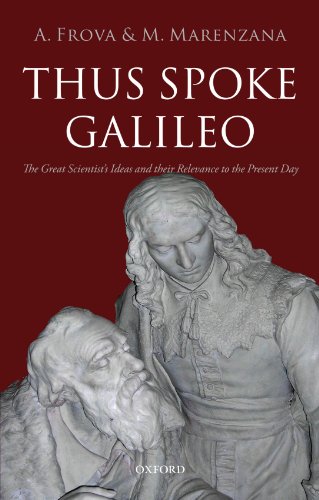
You might know what is said about Galileo, but not many people know what Galileo himself actually said. His elusive and often misquoted discourse has resulted, over the years, in slurs against his name and reputation as a scientist. Let him speak then, so that he can bring to everyone’sattention his message of reason, of intellectual honesty, and of free thinking. A message that, more than ever, is of great relevance in the rampant irrationality of the new millennium. The exposition begins with a blunt ‘self-portrait’. A ‘forgery’ of course, based mainly on extracts from Galileo’s writings and private letters; something he would never have dared, nor been allowed, to write for the public. The selection of writings offered includes many of the subjects that wereclosest to Galileo’s heart and mind with lively commentary from both the literary, scientific, and historical viewpoints. For those who want to know the mathematics behind Galileo’s theories, each chapter closes with a separate self contained summary.Thus Spoke Galileo will allow the reader to appreciate the work and the writing-style of a great scientist and author who had a tremendous influence on the modern world.
User’s Reviews
Reviews from Amazon users which were colected at the time this book was published on the website:
⭐This is a fairly useful introduction to Galileo’s science. It consists mostly of selected extracts from Galileo’s writings with extensive modern commentary. By and large it seems quite alright. However, I soon came across one passage of commentary that damaged my faith in the authors and made me disinclined to pursue the work further. It concerns the following argument by Galileo:Falling objects speed up. According to what law? Maybe this: average speed over an interval is proportional to distance fallen. For example, when an object has fallen 4 feet, its average speed has been 4 feet per second during this fall. And when it has fallen 8 feet its average speed has been 8 feet per second during this fall. This might seem like a reasonable hypothesis that captures the idea that the body is gradually speeding up. But Galileo claims that this hypothesis is “as false and impossible as [the hypothesis] that motion should be completed instantaneously; and here is a very clear demonstration of it”: If the object covers 8 feet with an average speed of 8 feet per second, then the whole fall takes one second. And if it covers 4 feet with an average speed of 4 feet per second, then that whole fall also takes one second. “But for one and the same body to fall eight feet and four feet in the same time is possible only in the case of instantaneous motion; but observation shows us that the motion of a falling body occupies time …; therefore it is not true that its velocity increases in proportion to the space.” (315)Galileo’s argument is perfectly good, but the authors claim it is not:”Whoa there! We must call a halt here and comment on the mistake … which surely will not have escaped the reader. [Galileo’s] statement ‘If the [average] velocities are in proportion to the spaces traversed … then these spaces are traversed in equal intervals of time’ is incorrect … Galileo’s reasoning is the equivalent of taking for the velocity its average value with respect to space, rather than with respect to time, as is correct.” (316)No, Galileo’s argument does not involve such a fallacy. Why would the authors think it does? This is hard to understand, and it is not made clearer by their attempt at giving “a clarifying example”:”In covering the distance of 100 km between two cities, a car driver travels half the distance at a velocity of 50 km/h, and the other half at 150 km/h. What are the average velocity and the travelling time? According to Galileo’s reasoning the average velocity would be 100 km/h and the travelling time 1 h exactly [which is of course wrong].” (316)But why on earth would “Galileo’s reasoning” lead to such a conclusion in this case? This example simply has nothing to do with what Galileo was saying, so of course “Galileo’s reasoning” doesn’t say anything about it. How did the authors even come up with such a far-fetched “clarifying example” in the first place? As they themselves say, they are trying to disprove the statement: “If the average velocities are in proportion to the spaces traversed … then these spaces are traversed in equal intervals of time.” Obviously, as a matter of basic logic, the right way to do this is to provide an example where average velocities ARE in proportion to the spaces traversed yet the spaces are NOT traversed in equal intervals of time. So why do the authors instead give us some weird car example that has nothing to do with either condition? It doesn’t make any sense.All the more disturbing, then, when the authors go on to wax about the “deep” metaphysical significance of Galileo’s “error”:”Galileo was led into this error by his preference—in his desire to arrange reality into a geometric order—for the domain of space rather than that of time; and also by the fact that he did not appreciate sufficiently the deep, inseparable connection that exists between motion and time.” (316)Alas, these authors (like so many others of their ilk) should have spent more time on basic math and less time on “deep” metaphysical BS. Then they would have noticed that the alleged “error” was theirs, not Galileo’s.
⭐I often find the best way to read someone’s writings is by getting one’s hands on a good guided intro — some book that walks you through the person’s writings, so when you read them you have some context and can figure out what the heck is going on. I recently got interested in reading some of Galileo’s writings, but there didn’t seem to be a guided intro out there — the best I could find was the anthology “The Essential Galileo,” which has some explanatory footnotes along with the text. When I went to the library to get “The Essential Galileo,” however, I fortuitously found “Thus Spoke Galileo.”. It was exactly the book I was looking for! “Thus Spoke Galileo” basically walks you through Galileo’s most famous works — The Starry Messenger, Dialogue on the Two Chief Systems, Discourse on the Two New Sciences, etc. About half the book is the actual texts, and the other half (interspersed) is introduction to and summary of the texts. The authors summarize the basic ideas in the text you’re about to read, and also give you a lot of helpful context, such as the established theories Galileo rejected. There are also a number of helpful diagrams to illustrate theories and experiments being discussed. Even though this book isn’t a straight anthology, the texts are still well-selected: most of the texts in here are also in “The Essential Galileo”, which I believe is the standard Galileo anthology, so you’re getting a good survey of Galileo’s most important writings. If you’re looking to read some of Galileo’s works, you can’t go wrong by using this book to start doing so. I wish there was a book like this for every person whose works I want to read! (One final note: don’t be put off by the first chapter, which is an imagined first-person summary of Galileo’s life by Galileo himself. This is completely unlike the rest of the book.)
⭐
⭐
Keywords
Free Download Thus Spoke Galileo: The great scientist’s ideas and their relevance to the present day in PDF format
Thus Spoke Galileo: The great scientist’s ideas and their relevance to the present day PDF Free Download
Download Thus Spoke Galileo: The great scientist’s ideas and their relevance to the present day 2011 PDF Free
Thus Spoke Galileo: The great scientist’s ideas and their relevance to the present day 2011 PDF Free Download
Download Thus Spoke Galileo: The great scientist’s ideas and their relevance to the present day PDF
Free Download Ebook Thus Spoke Galileo: The great scientist’s ideas and their relevance to the present day