

Ebook Info
- Published: 2031
- Number of pages: 433 pages
- Format: PDF
- File Size: 54.22 MB
- Authors: Gonzalo Muga
Description
But all the clocks in the city Began to whirr and chime: ’O let not Time deceive you, You cannot conquer Time. W. H. Auden It is hard to think of a subject as rich, complex, and important as time. From the practical point of view it governs and organizes our lives (most of us are after all attached to a wrist watch) or it helps us to wonderfully ?nd our way in unknown territory with the global positioning system (GPS). More generally it constitutes the heartbeat of modern technology. Time is the most precisely measured quantity, so the second de?nes the meter or the volt and yet, nobody knows for sure what it is, puzzling philosophers, artists, priests, and scientists for centuries as one of the enduring enigmas of all cultures. Indeed time is full of contrasts: taken for granted in daily life, it requires sophisticated experimental and theoretical treatments to be accurately “produced. ” We are trapped in its web, and it actually kills us all, but it also constitutes the stuff we need to progress and realize our objectives. There is nothing more boring and monotonous than the tick-tock of a clock, but how many fascinating challenges have physicists met to realize that monotony: Quite a number of Nobel Prize winners have been directly motivated by them or have contributed 1 signi?cantly to time measurement.
User’s Reviews
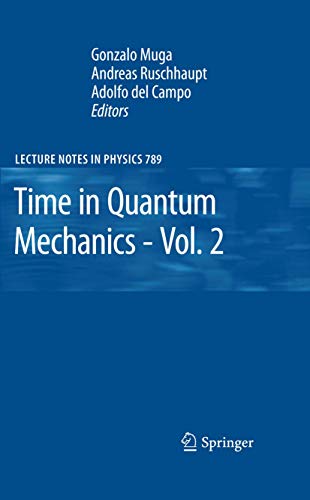
Editorial Reviews: From the Back Cover The treatment of time in quantum mechanics continues to be a key challenge in the foundation of quantum theory. This book follows Time in Quantum Mechanics―Volume 1 and is the second volume to detail the problems, attempts and achievements in defining, formalizing and measuring different time quantities in quantum theory. It touches upon numerous related issues as well.Time in Quantum Mechanics―Volume 2 opens with a brief historical overview. It then offers eleven tutorial reviews which cover many open questions regarding fundamental concepts and time observables as well as a number of quantum dynamical effects and their associated characteristic time scales. In addition, the volume contains a tutorial review on atomic clocks that explains that while we do not know what time is, we know very well how to measure it with exceptional accuracy. Thorough and lucid, this book is written as an introductory guide for newcomers to the subject. However, it is also useful as a reference for the expert.
Reviews from Amazon users which were colected at the time this book was published on the website:
⭐This textbook is a collection of 13 articles on the concept of time in quantum theory. My review concerns #7 on that list, “Causality in superluminal pulse propagation” by R W Boyd, D J Gauthier and P Narum.The article is mainly concerned about the preservation of special relativity (SR) in light of quantum nonlocality. In particular, they wish to preserve “relativistic causality” (RC) which they define as a principle by which “an event is linked to a previous cause as viewed from any inertial frame of reference.” (p.175) They also write “faster than light…communication [FTLC] is very intriguing because relativistic causality would be violated.” (p.175)I have news for these authors: quantum nonlocality violates RC, FTLC or not. “Delayed choice” experiments for example.The authors give a hypothetical FTLC scheme (p.188) and comment, “If such superluminal signal was possible, information could be transmitted from the positive-time light cone [to the negative],” thus allowing the operator to change the past. When you read something like this, you have to ask yourself, “if FTLC is possible, is this paradox necessarily a result?” The answer is “NO!” FTLC can still be possible, but fails when one tries to initiate the “bilking paradox” as the authors do in their example. Certainly if two distant observers attempt to communicate they can do so without initiating a paradox.The authors go on to describe how superluminal light-pulses through dispersive media cannot be used for FTLC. But their own illustrations betray their flimsy argument. For example, on page 191 there is an event with light-cone. Look at the “pulse peak” in the illustration. Connect the two vertices of the pulse peak with a straight line. That line is spacelike. So, the pulse is sending information between these two vertices, faster-than-light. Also, if you look carefully at the illustration on page 183, you can see a similar problem.The authors (p.192ff) do however give a convincing argument as to why Nick Herbert’s 1983 “FLASH” FTLC scheme will not work. But FLASH is simply a “straw man,” used by the mainstream anti-FTLC majority to discredit any attempt at FTLC, no matter how sound the arguments are. Further, I have even seen authors attempt to discredit FTLC solely on the no-cloning theorem even though cloning is not used in the scheme. In fact, while I am on the subject, even the so-called “no signaling theorem” has its faults. If the “no-signaling theorem” were correct, then you would not see interference phenomena in entangled systems!The authors quote N Gisin (p.193): “Once again, quantum mechanics is right at the border line of contradicting relativity, but does not cross it.” I think Einstein would disagree.
Keywords
Free Download Time in Quantum Mechanics – Vol. 2 (Lecture Notes in Physics, 789) 2010th Edition in PDF format
Time in Quantum Mechanics – Vol. 2 (Lecture Notes in Physics, 789) 2010th Edition PDF Free Download
Download Time in Quantum Mechanics – Vol. 2 (Lecture Notes in Physics, 789) 2010th Edition 2031 PDF Free
Time in Quantum Mechanics – Vol. 2 (Lecture Notes in Physics, 789) 2010th Edition 2031 PDF Free Download
Download Time in Quantum Mechanics – Vol. 2 (Lecture Notes in Physics, 789) 2010th Edition PDF
Free Download Ebook Time in Quantum Mechanics – Vol. 2 (Lecture Notes in Physics, 789) 2010th Edition