

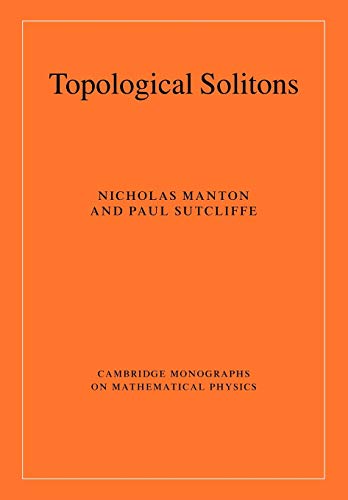
Ebook Info
- Published: 2007
- Number of pages: 508 pages
- Format: PDF
- File Size: 4.34 MB
- Authors: Nicholas Manton
Description
This book introduces the main examples of topological solitons in classical field theories, discusses the forces between solitons, and surveys in detail both static and dynamic multi-soliton solutions. Kinks in one dimension, lumps and vortices in two dimensions, monopoles and Skyrmions in three dimensions, and instantons in four dimensions are all discussed.
User’s Reviews
Editorial Reviews: Review ‘The authors are two of the most prominent in the field and have made many seminal contributions to it.’ Contemporary Physics’The book is self-contained and beautifully written. It should remain for a long period of time as a standard reference for anyone interested in solition theory and its application in physics.’ Zentralblatt MATH’… a unique, up-to-date and authoritative resource for anyone who wants to learn about the latest developments in the field of topological solitons. Moreover, by clearly exhibiting the essential idea of any topic they discuss, the authors have succeeded in writing a book which should teach mathematicians much about physics and physicists much about mathematics. The book is accessible to graduate students in theoretical physics and mathematics and despite the absence of exercises, could be used a s a textbook for an advanced lecture course.’ Nieuw Archief voor Wiskunde Book Description Comprehensive survey of static topological solitons and their dynamical interactions, for graduates and researchers. About the Author Nicholas Manton received his PhD from the University of Cambridge in 1978. Following postdoctoral positions at the Ecole Normale in Paris, M.I.T. and UC Santa Barbara, he returned to Cambridge and is now Professor of Mathematical Physics in the Department of Applied Mathematics and Theoretical Physics, and currently head of the department’s High Energy Physics group. He is a Fellow of St John’s College. He introduced and helped develop the method of modelling topological soliton dynamics by geodesic motion on soliton moduli spaces.Paul Sutcliffe received his PhD from the University of Durham in 1992. Following postdoctoral appointments at Heriot-Watt, Orsay and Cambridge, he moved to the University of Kent, where he is now Reader in Mathematical Physics. For the past five years, he was an EPSRC Advanced Fellow. He has researched widely on topological solitons, especially multi-soliton solutions and soliton dynamics, and has found surprising relations between different kinds of soliton. Read more
Reviews from Amazon users which were colected at the time this book was published on the website:
⭐If you respect people like Einstein, who use real well-defined mathematics to try tocreate a clear understanding of the messy empirical reality we live in… with side possibilities like new nuclear technology.. then you, like me, will view this as a major landmark which belongs on any shelf of “most important sourcesin physics today, for those who are interested in the real frontier.” Maybe the two obvious mainstream audiences for the book are:(1) people interested in the real mathematical story on “solitons,” on stable patterns of foce fields which could explain why particles exist at all and have mass; (2) people interested in the challenge of predicting “mid to low energy nuclear phenomena” — such as what happens when you try to do nuclear fusion by irradiating a pellet. Folks who are only interested in asymptotic energies in accelerators or in deducing the laws of physics from Unaided Pure Reason as in Aristotle might not be interested. But I should confess: I am not so well-qualified to judge how effective the book is in the long sections which explain the basicsof solitons today. Most of that I already learned from reading papers following up on two key books: “the Skyrme Model” by Makhankov,Rybakov and Sanyuk, and Solitons and Instantons by Rajaraman. The former was one of the hardest books I have ever read, but it was an incredible eye-opener as well. Manton’s book appears to cover the same ground much more clearly, as one might expect from someone more experienced both in English and in teaching. Rajaraman is an important source, but not nearly so deep on the issues raised here. Aside from a few quick things in the middle of the book… two main new elements struck me most of all: (1) chapter 11, whichlinks up with electroweak theory, and informed me about Russian work on complete conversion of matter to energy; and (2) the update on the effort to use skyrmion simulations to predict properties of nuclei up to 16 protons, using PDE calculations on supercomputers. In the end, I do not believe that EITHER the skyrmion model OR today’s QCD will turn out to be the ultimate truth. (There is empirical data which people would take more seriously if we did not have such incredible fragmentation in physics today.) But the methods in this book will still be the right way forward, in my view. It’s not just phenomenology.
⭐The beginning is a great review of field theory, from a more mathematical perspective than most texts devoted to the subject. Then a good introduction to topological laws follows. After that, I skipped around, but found what I read really rewarding.
⭐
⭐
⭐
Keywords
Free Download Topological Solitons (Cambridge Monographs on Mathematical Physics) 1st Edition in PDF format
Topological Solitons (Cambridge Monographs on Mathematical Physics) 1st Edition PDF Free Download
Download Topological Solitons (Cambridge Monographs on Mathematical Physics) 1st Edition 2007 PDF Free
Topological Solitons (Cambridge Monographs on Mathematical Physics) 1st Edition 2007 PDF Free Download
Download Topological Solitons (Cambridge Monographs on Mathematical Physics) 1st Edition PDF
Free Download Ebook Topological Solitons (Cambridge Monographs on Mathematical Physics) 1st Edition