Ebook Info
- Published: 2007
- Number of pages: 336 pages
- Format: PDF
- File Size: 5.72 MB
- Authors: Daniel Kennefick
Description
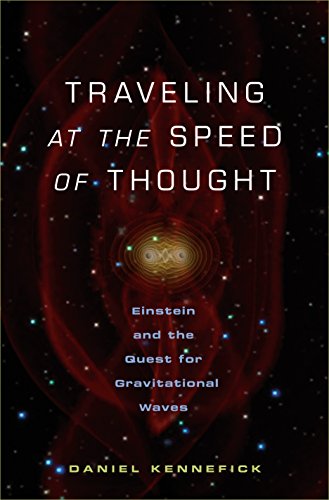
Since Einstein first described them nearly a century ago, gravitational waves have been the subject of more sustained controversy than perhaps any other phenomenon in physics. These as yet undetected fluctuations in the shape of space-time were first predicted by Einstein’s general theory of relativity, but only now, at the dawn of the twenty-first century, are we on the brink of finally observing them. Daniel Kennefick’s landmark book takes readers through the theoretical controversies and thorny debates that raged around the subject of gravitational waves after the publication of Einstein’s theory. The previously untold story of how we arrived at a settled theory of gravitational waves includes a stellar cast from the front ranks of twentieth-century physics, including Richard Feynman, Hermann Bondi, John Wheeler, Kip Thorne, and Einstein himself, who on two occasions avowed that gravitational waves do not exist, changing his mind both times. The book derives its title from a famously skeptical comment made by Arthur Stanley Eddington in 1922–namely, that “gravitational waves propagate at the speed of thought.” Kennefick uses the title metaphorically to contrast the individual brilliance of each of the physicists grappling with gravitational-wave theory against the frustratingly slow progression of the field as a whole. Accessibly written and impeccably researched, this book sheds new light on the trials and conflicts that have led to the extraordinary position in which we find ourselves today–poised to bring the story of gravitational waves full circle by directly confirming their existence for the very first time.
User’s Reviews
Editorial Reviews: Review “The great achievement of Daniel Kennefick’s fascinating Traveling at the Speed of Thought is that he takes…assumed existence of gravitational waves apart. He is not out to show that they do not exist–far from it. Rather, he carefully explains how durable skepticism has been toward the existence of gravitational waves ever since Einstein first predicted them…Kennefick offers a readable account of the theory of gravitational waves, exploring why skepticism was a reasonable stance at various points in the 20th century and why it has ceased to be so in the 21st.”—Michael D. Gordin, Science”This dense account of the history of gravity waves–undetected ripples in space-time–is the kind one might think would appeal only to physicists. But Kennefick uses this narrow subject to elucidate the larger issue of metaphors and analogies in science. A practicing gravitational wave researcher, Kennefick keenly explains how scientists become willing to believe that which they cannot see, or even observe experimentally.” ― SEED Magazine”In Traveling at the Speed of Thought, Daniel Kennefick gives an authoritative, insider’s account of a scientific phenomenon that more of less everyone in the field believes to exist, yet no one has ever seen. This is a scholarly contribution to the history of twentieth-century physics…yet…it provides a rare insight into the tension in physics between the abstract reality that emerges from mathematics, and the warm body of nature that we can see and touch.”—Georgina Ferry, TLS”Kennefick is the right author at the right time. He has strong connections to research in this area as well as being a historian and a very good storyteller…An impressive book, in that Kennefick thoroughly covers the material and still keeps it at a level that should be accessible to all readers.”—E. Kincanon, Choice”This book is worth reading not only because it gives a well-framed picture of the gravitational wave history, but also because it offers many suggestions for reflection on science in general and physics in particular. . . . There is food for thought here.”—Giovanni Pretti, Mathematical Reviews”Traveling at the Speed of Thought will be valuable for historians, sociologists, and philosophers of modern physics and others interested in the development and use of scientific theories. And it will also be of significant interest to practicing physicists and physics students.”—Matthew Stanley, Isis”This book is very insightful. It is definitely a book for physicists. The combination of history and science is at a high level of scholarship. . . . I highly recommend this book to anyone who wants a deeper understanding of the theory and the history that underpins one of the fundamental foundations of modern physics.”—David Blair, Australian Physics”Traveling at the Speed of Thought is an extremely interesting reading, both for scientists and for a larger audience. It is very well documented, and conveys the sense of struggle that is associated with the evolution and strengthening of new paradigms in science.”—Michele Maggiore, European Legacy Review “This book is a very impressive achievement. Kennefick skillfully introduces readers to some of the most abstruse yet fascinating concepts in modern physics stemming from Einstein’s gravitational theory. And he charts the often haphazard, meandering, at times contentious development of these ideas over the course of nearly a century. More than an intellectual history, this book is a kind of detective story. Amid unfolding clues, partial insights, evolving institutions, the play of personalities, and hard thinking, the reader is treated to larger lessons about how theoretical physics works. Until now, we had virtually no serious study of what happened to Einstein’s general relativity after he published his famous equations. Kennefick is among the first to begin to fill in this story.”―David Kaiser, author of Drawing Theories Apart: The Dispersion of Feynman Diagrams in Postwar Physics”In this book, Kennefick describes a seventy-year quest, by three generations of physicists, to discover relativity’s predictions about gravitational waves. Combining his skills as a historian with his mastery of relativity and his powers as a storyteller, he weaves a compelling narrative of intellectual battles and mathematical struggles―and extracts fascinating insights about the roles of mathematics, intuition, analogy, and style, standards of proof, and the sociology of competing schools.”―Kip S. Thorne, California Institute of Technology”This book is a very important contribution both to Einstein studies and to the history of physics in general. It is also very timely given the effort underway to detect gravitational waves. The author is in an absolutely unique position to tell this story. He is extremely well connected to the community of Einstein scholars, to the community of physicists past and present working on gravitational waves, and to the group of people working on the history of the subject.”―Michel Janssen, University of Minnesota From the Inside Flap “This book is a very impressive achievement. Kennefick skillfully introduces readers to some of the most abstruse yet fascinating concepts in modern physics stemming from Einstein’s gravitational theory. And he charts the often haphazard, meandering, at times contentious development of these ideas over the course of nearly a century. More than an intellectual history, this book is a kind of detective story. Amid unfolding clues, partial insights, evolving institutions, the play of personalities, and hard thinking, the reader is treated to larger lessons about how theoretical physics works. Until now, we had virtually no serious study of what happened to Einstein’s general relativity after he published his famous equations. Kennefick is among the first to begin to fill in this story.”–David Kaiser, author of Drawing Theories Apart: The Dispersion of Feynman Diagrams in Postwar Physics”In this book, Kennefick describes a seventy-year quest, by three generations of physicists, to discover relativity’s predictions about gravitational waves. Combining his skills as a historian with his mastery of relativity and his powers as a storyteller, he weaves a compelling narrative of intellectual battles and mathematical struggles–and extracts fascinating insights about the roles of mathematics, intuition, analogy, and style, standards of proof, and the sociology of competing schools.”–Kip S. Thorne, California Institute of Technology”This book is a very important contribution both to Einstein studies and to the history of physics in general. It is also very timely given the effort underway to detect gravitational waves. The author is in an absolutely unique position to tell this story. He is extremely well connected to the community of Einstein scholars, to the community of physicists past and present working on gravitational waves, and to the group of people working on the history of the subject.”–Michel Janssen, University of Minnesota From the Back Cover “This book is a very impressive achievement. Kennefick skillfully introduces readers to some of the most abstruse yet fascinating concepts in modern physics stemming from Einstein’s gravitational theory. And he charts the often haphazard, meandering, at times contentious development of these ideas over the course of nearly a century. More than an intellectual history, this book is a kind of detective story. Amid unfolding clues, partial insights, evolving institutions, the play of personalities, and hard thinking, the reader is treated to larger lessons about how theoretical physics works. Until now, we had virtually no serious study of what happened to Einstein’s general relativity after he published his famous equations. Kennefick is among the first to begin to fill in this story.”–David Kaiser, author of Drawing Theories Apart: The Dispersion of Feynman Diagrams in Postwar Physics”In this book, Kennefick describes a seventy-year quest, by three generations of physicists, to discover relativity’s predictions about gravitational waves. Combining his skills as a historian with his mastery of relativity and his powers as a storyteller, he weaves a compelling narrative of intellectual battles and mathematical struggles–and extracts fascinating insights about the roles of mathematics, intuition, analogy, and style, standards of proof, and the sociology of competing schools.”–Kip S. Thorne, California Institute of Technology”This book is a very important contribution both to Einstein studies and to the history of physics in general. It is also very timely given the effort underway to detect gravitational waves. The author is in an absolutely unique position to tell this story. He is extremely well connected to the community of Einstein scholars, to the community of physicists past and present working on gravitational waves, and to the group of people working on the history of the subject.”–Michel Janssen, University of Minnesota About the Author Daniel Kennefick is Visiting Assistant Professor of Physics at the University of Arkansas. He is an editor of The Collected Papers of Albert Einstein (Princeton). Read more
Reviews from Amazon users which were colected at the time this book was published on the website:
⭐Good book
⭐Excellent
⭐I felt the single review of this book highly underrated it, and since it almost scared me away from purchasing it, I wanted to offset it with a positive one. I would have missed out if I had listened to it! I absorbed this book in just a few days, really enjoying the historical account presented and learning a number of interesting things about gravitational waves along the way.While Kennefick’s work does include references to some technical terms, they are given definitions and in some cases enlightening explanations. I found it pleasant to follow the story in any case by simply not letting myself get bogged down from not having a deep, graduate level, mathematical understanding of general relativity. I am proof that is not required to appreciate this book.One particularly positive aspect is the overall focus on the role of analogies in science. The first chapter was a gem for this reason, but the intriguing theme of differing personal approaches to using analogies is woven throughout the entire book.Overall, I would say that if you enjoy historical biographies of science/math personas where technical discussion slips in here and there, you would have a good chance of liking this work.
⭐Beware, this is not pop science book. In my opinion, “…introduces readers…” and “accessibly written…”, as indicated in the marketing comments, are not accurate representations of the level of this book. The fact that no equations are given in the text should not lead to you think this is easy reading.Instead, this is a scholarly historical analysis, where knowledge of concepts such as “unimodular coordinates”, “metric tensor”, “linearized approximation of general relativity”, just to name a few, are taken for granted as no introduction is given of them. Not even the concept of “gravitational waves” is introduced. Graduate level training of Special and General Relativity is a requirement.I believe this is a great contribution to the historical analysis of this subject, but the target audience needs to be stated correctly.
⭐Interesting.
Keywords
Free Download Traveling at the Speed of Thought: Einstein and the Quest for Gravitational Waves in PDF format
Traveling at the Speed of Thought: Einstein and the Quest for Gravitational Waves PDF Free Download
Download Traveling at the Speed of Thought: Einstein and the Quest for Gravitational Waves 2007 PDF Free
Traveling at the Speed of Thought: Einstein and the Quest for Gravitational Waves 2007 PDF Free Download
Download Traveling at the Speed of Thought: Einstein and the Quest for Gravitational Waves PDF
Free Download Ebook Traveling at the Speed of Thought: Einstein and the Quest for Gravitational Waves