

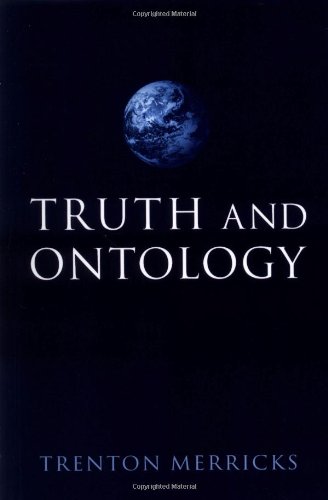
Ebook Info
- Published: 2009
- Number of pages: 202 pages
- Format: PDF
- File Size: 1.76 MB
- Authors: Trenton Merricks
Description
That there are no white ravens is true because there are no white ravens. And so there is a sense in which that truth “depends on the world.” But this sort of dependence is trivial. After all, it does not imply that there is anything that is that truth’s “truthmaker.” Nor does it imply that something exists to which that truth corresponds. Nor does it imply that there are properties whose exemplification grounds that truth. Trenton Merricks explores whether and how truth depends substantively on the world or on things or on being. And he takes a careful look at philosophical debates concerning, among other things, modality, time, and dispositions. He looks at these debates because any account of truth’s substantive dependence on being has implications for them. And these debates likewise have implications for how and whether truth depends on being. Along the way, Merricks makes a number of new points about each of these debates that are of independent interest, of interest apart from the question of truth’s dependence on being. Truth and Ontology concludes that some truths do not depend on being in any substantive way at all. One result of this conclusion is that it is a mistake to oppose a philosophical theory merely because it violates truth’s alleged substantive dependence on being. Another result is that the correspondence theory of truth is false and, more generally, that truth itself is not a relation of any sort between truth-bearers and that which “makes them true.”
User’s Reviews
Editorial Reviews: Review `Review from previous edition Excellent new book…This is an important contemporary debate, and Merrick’s book is a very important move within it.’ Philip Goff, Times Literary Supplement About the Author Trenton Merricks is Professor of Philosophy at the University of Virginia.
Reviews from Amazon users which were colected at the time this book was published on the website:
⭐As a work on truth and its relation to ontology this is a helpful treatment of various theories of truth. Trenton Merricks does a fine job laying out some of the various theories in the dialogue on metaphysics and truth. It is a helpful contribution to the debate. Merricks works through the truthmaker, truth supervenes on being, the correspondence, identity, coherence theories of truth. A great deal of Merricks’s thought is devoted to the truthmaker theory of truth. Primarily, Merricks argues that it has a problem dealing with negative existentials and statements that have no real being in reality. In chapter 4, Merricks considers a theory similar to the truthmaker theory ( called truth supervenes on being (TSB). To demonstrate this further, Merricks handles other issues that are problematic for the truthmaker theorist and truth supervenes on being theory, including: modality, presentism, and subjunctive conditionals. The final chapter contains other potential theories. Merricks considers the correspondence theory of truth, realism about truth, coherence and identity theories and finally truth as primitive. These theories, aleibet alternatives, are put forth as similar to truthmaker and TSB. All but realism about truth and truth as primitive are similar in that they are all theories of truth with a similar motivation as the truthmaker. They construe truth as being a relational property or a relation to being, in general. The problem with this is that these properties are mysterious, but more importantly these theories require an actual existing being to make a proposition or statement true. This certainly seems to be a problem. Merricks is not convinced by these theories, yet still holds to a conviction of realism about truth. That a proposition or statements truthfulness is either true or false–this is keeping with Aristotle. In keeping with this Merricks offers an alternative theory that adheres to the previous insight without the problems of the so called “relational theories” of truth to being. He offers a theory that considers truth to be a primitive monadic property in reality. It is not relational but an actual property that is non-intrinsic and primitive, thus not analysable and sui generis. Neither is it a form of deflationsim that holds there is no property. This book is certainly worth of the attention of those who are interested in general ontology and epistemology. At this point, I am not thoroughly convinced of his proposed theory of truth yet it certainly has challenged my understanding of the correspondence theory of truth. All in all, this is a fine work worthy of reading.
⭐Trenton Merricks is Professor of Philosophy at the University of Virginia, and in this book he provides a critical examination of what (should be) one of the most pressing areas of metaphysics–that of truthmakers, or more properly, the Truthmaker Thesis that states that something (existent) makes a sentence (or proposition) true or false. It is well written, with clear prose, and does not assume mastery of modern analytical metaphysics of the audience (but familiarity with basic debates is assumed). It is repetitive, but I suspect that is a deliberate pedagogical device rather than a stylistic fault.Simply put, T is the truthmaker of sentence S iff “T exists” entails “S is true.” So, if “a is F” there has to be an “a” that has some relation to an “F” that makes the sentence true. But what is this mysterious predicate “entails?” One way is to treat it as necessitation, so T is the truthmaker of sentence S iff “T exists” necessitates “S is true.”However, that won’t work either since the view of truthmakers as necessitators implies that every contingently existing entity is a truthmaker for every necessary truth. That is not the only problem, but enough to show that “entails” is not just ” necessitates.” So Merricks (rightly) adds a second relation–“aboutness.” So, a more convoluted statement of the Truthmaker (big “T”) thesis would be “T is the truthmaker of sentence S iff “T exists” necessitates “S is true” and iff S is about T.”His first job is to detangle this from the familiar and fairly discredited correspondence theory of truth–an effort that forms one of his themes, and is revisited in the end. It is fairly obvious in his presentation that the same problems that plague the correspondence theory remain for Truthmaker such as universal generalizations (For all x, P(x)) and negative existential claims (For no x, P(x)) that seem to go beyond existents for their truth claims. There are other rich examples he does not address, like impossible properties and the truth of their use (sentences like, “The property of not being identical itself is not the same property of being the greatest even prime number greater than two”). This is in part because he assumes a more-or-less conventional theory of universals throughout. Considering the aforementioned problems with Truthmaker, he considers that perhaps another relative of correspondence theory, that truth supervenes on being (TSB), might be on better grounds.He soundly demonstrates that it isn’t clear that TSB offers clear advantages to Truthmaker or vice versa. TSB offers little more ontological economy, as Merrick demonstrates that Truthmaker requires states of affairs whereas TSB just requires the existents to provide the local supervenience base. Nor does TSB provide a more satisfactory solution to the problem of negative existentials or universal generalizations as it makes these claims depend on (at least the) qualities of existents. He argues the best (least bad) solution offered by TSB will depend on `nothing more’ or `totality’ properties that apply to the universe as a whole. But this last solution means “adding something” to the universe for each thing taken away, a problem that remains for both Truthmaker and TSB.Merricks spends considerable effort in outlining the compatibility of Truthmaker and TSB with modality and, curiously, presentism. The first seems straightforward since Lewis’s modal realism was in many ways the attempt to accommodate Truthmaker within modal statements. Presentism at first seems to have been chosen because how incompatible it seems to be with Truthmaker. But, as Merrick shows his hand, we see his argument about the incompatibility of presentism with Truthmaker is framed and argued as a reason to reject eternalism. His claim is “truths entirely about the past lack truthmakers and a TSB-satisfying supervenience base.” Perhaps because this is where his arguments are most novel (but anticipated by his discussion of modality), I found Merrick at his weakest here. Part of it may be the confines of space and the inability to spell out his full position on presentism (he has addressed this elsewhere, like in his article `Good-Bye Growing Block’, in Dean Zimmerman (ed.),
⭐.While sympathetic to his earlier critiques of Truthmaker and TSB, his claims about presentism are much more contentious. I for one do not see that to reject Truthmaker or TSB (or modify them) should make us any more sympathetic to presentism. However, it is this discussion that makes this book most original as most of the problems of Truthmaker and TSB will be familiar to metaphysicians and have been discussed widely in the literature for the last several years. The value of Merrick’s book to the discipline is perhaps not so much as a groundbreaking work of original philosophy but an unambiguous, well-thought out reminder of what cannot be taken for granted and that the questions of truth and ontology are far from settled.
Keywords
Free Download Truth and Ontology in PDF format
Truth and Ontology PDF Free Download
Download Truth and Ontology 2009 PDF Free
Truth and Ontology 2009 PDF Free Download
Download Truth and Ontology PDF
Free Download Ebook Truth and Ontology