

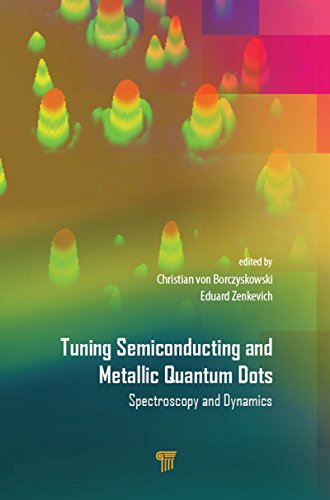
Ebook Info
- Published: 2016
- Number of pages: 406 pages
- Format: PDF
- File Size: 60.35 MB
- Authors: Christian von Borczyskowski
Description
Nanotechnology is one of the growing areas of this century, also opening new horizons for tuning optical properties. This book introduces basic tuning schemes, including those on a single quantum object level, with an emphasis on surface and interface manipulation of semiconducting and metallic quantum dots. There are two opposing demands in current forefront applications of quantum dots as optical labels, namely high luminescence stability (suppression of luminescence intermittency) and controllable intermittency and bleaching on a single-particle level to facilitate super-resolution optical microscopy (for which Eric Betzig, Stefan W. Hell, and William E. Moerner were awarded the 2014 Nobel Prize in Chemistry). The book discusses these contradictory demands with respect to both an understanding of the basic processes and applications. The chapters are a combination of scholarly presentation and comprehensive review and include case studies from the authors’ research, including unpublished results. Special emphasis is on a detailed understanding of spectroscopic and dynamic properties of semiconducting quantum dots. The book is suitable for senior undergraduates and researchers in the fields of optical nanoscience, materials science, and nanotechnology.
User’s Reviews
Editorial Reviews: Review This book considers colloidal semiconductor quantum dots in detail while also addressing metallic quantum dots. With a view to achieving tunability, specific attention is given to interfaces and surfaces. The book has a wide dynamic range, including introductions to the basic properties of quantum dots as well as leading-edge experimental research results. The book is well illustrated and contains many references to the literature. One specific feature of the book is a new model for intermittency in photoluminescence (that is, blinking). The advances made in this respect offer new applications of blinking in sensing and super-resolution microscopy.-K. Alan Shore, Bangor University, U.K. About the Author Christian von Borczyskowski graduated from Freie Universität, Berlin, Germany, in 1973, where he also received his PhD in 1977 and his habilitation degree in 1987. He was a postdoc at Leiden University, the Netherlands. Since 1993, he is a full professor at Technische Universität, Chemnitz, Germany, where he also served as dean of the science department (1994–1997), president of the university (1997–2000), dean of the Accumulation of Single Molecules to Nanostructures graduate college (2003–2007) and the Sensorics and Cognition school (2009–2013), and coordinator of nanoMA (center for nanostructured materials and analytics). He was a visiting professor at the University of Grenoble, France, and the Australian National University, Canberra, Australia. His focus was on optical spectroscopy and molecular physics, including microscopy of single molecules and quantum dots. Dr. von Borczyskowski is one of the pioneers of optical detection of single spins in condensed matter. During the past decade, he has focused on single quantum objects as dynamic probes in soft matter physics, in nanoaggregates, and at nanostructured organic/inorganic interfaces, as well as dynamic optical properties of nanocrystals. He has published more than 250 papers in refereed journals.Eduard Zenkevich graduated from Belarussian State University, Minsk, Belarus, in 1967. In 1973, he received his PhD and in 1990 his Doctor of Sciences degree (Dr. habil.) in physics and mathematics from the Institute of Physics, National Academy of Sciences, Belarus. From 1998 to 2007, he was a full professor of physics at the Institute of Molecular and Atomic Physics, National Academy of Sciences, Belarus, and since 2007, he is a full professor at the Department of Information Technologies and Robotics and scientific head of the Research Laboratory of Applied Physics and Informatics, Belarussian National Technical University, Belarus. The general focus of his research activities is on the study of structure/relaxation dynamics for various nanoscale self-assembled objects: multiporphyrin systems, pigment–protein complexes, and semiconductor quantum dot–functional organic ligand nanocomposites. Since 1993, Dr. Zenkevich is also a visiting professor and lecturer at the Institute of Physics, Technische Universität, Chemnitz, Germany. Since 2010, he is an accredited expert of the Russian Nanotechnologies Corporation RUSNANO. He acts as a referee for various scientific programs and journals and has published more than 200 papers in refereed journals.
Reviews from Amazon users which were colected at the time this book was published on the website:
⭐
Keywords
Free Download Tuning Semiconducting and Metallic Quantum Dots: Spectroscopy and Dynamics 1st Edition in PDF format
Tuning Semiconducting and Metallic Quantum Dots: Spectroscopy and Dynamics 1st Edition PDF Free Download
Download Tuning Semiconducting and Metallic Quantum Dots: Spectroscopy and Dynamics 1st Edition 2016 PDF Free
Tuning Semiconducting and Metallic Quantum Dots: Spectroscopy and Dynamics 1st Edition 2016 PDF Free Download
Download Tuning Semiconducting and Metallic Quantum Dots: Spectroscopy and Dynamics 1st Edition PDF
Free Download Ebook Tuning Semiconducting and Metallic Quantum Dots: Spectroscopy and Dynamics 1st Edition