Ebook Info
- Published: 2013
- Number of pages: 175 pages
- Format: PDF
- File Size: 1.27 MB
- Authors: Ulrich Beck
Description
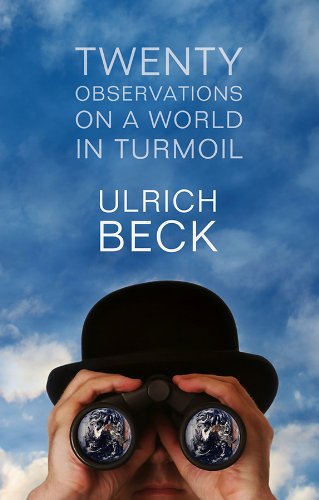
Translated by Ciaran Cronin. The world is a state of turmoil. From the financial crisis to the chaos in the eurozone, from the Arab uprisings to protests in Athens, Barcelona, New York and elsewhere, many of the familiar frameworks are collapsing and we have to find new ways to orient ourselves in a world undergoing rapid change. Of course, it is necessary for political leaders to address local issues and react to people’s specific demands, but without a cosmopolitan outlook, such a reaction is likely to be inadequate. Ulrich Beck’s Twenty-one Observations on a World in Turmoil is a demonstration of cosmopolitan politics in practice. It is more than a mirror: it is a magnifying glass that brings into focus the processes that are transforming our world and highlights the great challenges we face today. ‘Global domestic politics’, the concept introduced and developed by Beck, is much more than a political theory, a philosophical utopia (or dystopia), a governance programme or a mental state: it is the reality of our times. Beck turns the argument that ‘global domestic politics’ is an unrealistic ideology on its head, arguing that it is the proponents of the national who are the idealists. They view reality through the obsolete lenses of the nation-state and thus cannot see the profound global changes that are transforming our reality. Global domestic politics is therefore a perspective, a political reality and a normative idea. And it is the critical theory of our times since it challenges the most profound truths which we hold dear: the truths of the nation.
User’s Reviews
Reviews from Amazon users which were colected at the time this book was published on the website:
⭐The essays in this collection by a popular left-wing German academic are essentially angry anxiety about political developments in the European Union in response to the “Great Recession.” Although really a sub-theme, Ulrich Beck sums up his concerns in terms of a “think globally, act locally” philosophy that while never explicitly defined, is more-or-less outlined in Chapter 15 when describing an idea of John Dewey’s, supposedly that social problems trigger cooperation amoung stakeholders and penalize opposition to commonly-agreed-upon solutions. However Beck asserts that the philosophy, “Welt-Innen Politik,” was formulated by Carl von Weizsaecker in 1963.The idea seems to be that when the same issue affects people in different parts of the world, there’s a common response that creates a sociopolitical reality which somehow trumps the policies of the nation state. Beck doesn’t exactly provide evidence for this, instead referring to various occurances or situations that don’t fall within the legal frameworks established by politics as usual. He acknowledges that many people interpret these developments strictly from the same o’ same o’ political positions, and is plainly concerned that a resurgance of nationalism will undermine the Eurozone. He is particularly critical of the policies of Angela Merkel; his alternative is a vague suggestion of a centralized transnationalist governing board.The essays were written from 2009-2012 (the summation, anyway, must have been written in 2012.) Beck is essentially an idealist of old-school socialism, and the articles are full of characterizations such as “the organized irresponsibility of speculative finance,” “the threats engendered by global risk capitalism,” and “the neoliberal global market regime.”Beck is particularly fearful that national policies are undermining the evolution of Europe into a single political entity, and his bitterest tirades are aimed at them: “All the things which are plunging the world into the abyss… was set in train by… national governments… experts and… democracy” (P 40.) He goes so far as to dismiss local democratic functions: “What is being buried is … the expectation that politics can … shape the present and future of societies” (P 42.) He is convinced that the international capitalist conspiracy is controlling nations: “mobile capital… should cultivate the national because the emphasis on national sovereignty perpetuates competition between states…” (P39.)I find Beck distasteful and a little worrying. His ideas would not have been out of place in the Reichskanzlei of the late ’30s. It seems to me that without really facing the implications of his own ideas, he disconnects populistic urges from the political process, leaving a mass of Volk whose innen-politik is to be interpreted and implemented by an expert political class. That kind of thing rarely ends well.As Beck is apparently a popular contemporary philosopher, the book may represent a good example of popular thinking on the European Left. I hope not, though…
⭐I have hesitated to write a review of Ulrich Beck’s TWENTY OBSERVATIONS ON A WORLD IN TURMOIL (Malden, MA: Polity Press, 2012), because I am not really sure what to say about it. The book is a collection of 20 essays written during 2009 and 2010 and published in various media. The author, Ulrich Beck, was a professor of sociology at the University of Munich until 2009. He has authored numerous publications attempting to make sense out of the world we live in.The essays in TWENTY OBSERVATIONS are interesting. Having studied in Germany during the 1970s (I am only 7 months younger than Professor Beck.), I find his opinions about the role of Germany in today’s Europe very interesting. But I feel that the book will have appeal for only a few American readers. Professor Beck’s understandably many references to different departments of the European Union and German government and society are, I fear, meaningless to most American readers.Another problem is the fact that the book having been published in Germany in 2010 and the USA in 2012, the content and observations are rather dated. Also, like all such books, and television talk shows, it is simply one person’s opinion about issues only marginally interesting to most people, especially in the USA.Admittedly, Professor Beck is one who speaks with some degree of authority on the subjects of the essays. And so I conclude that WORLD IN TURMOIL is a good book for the informed reader with and interest in global issues, and especially those having to do with today’s Europe.
⭐These are essays which were written during the years 2009-2011. Professor Beck touches on several of our concerns including global warming, nuclear power, poverty, immigration, education, religion, and globalization. His concerns seem to be especially on global warming and globalization.These viewpoints are voiced in a rather dry and academic manner. Hey, what else would you expect from a professor? At any rate, these comments are worth listening to. recommended to the thinking reader.
⭐Collections of newspaper columns infrequently translate into good books. Chronological order ensures that the most outdated concepts are discussed first, and rather than beginning with the best writing or most current topic, it may be several chapters before the author hits their stride, or in this case, a studious crawl. Added to these issues are the fact that the original columns were written in German by a sociologist.?uestion marks are used incessantly throughout the text, chapters end on ?uestion marks, topics are introduced with several ?uestions in a row; it is like taking a long drive with a five-year-old, seriously, I don’t know the answer, do you?Okay, so, ‘Twenty Observations’ has a larger theme. The current reality is something Mr. Beck describes as global domestic politics, but political thinking throughout the globe is still enmeshed in the nation-state quagmire of the twentieth century. Fair thesis. Examples? Pretty thin, really. A volcanic ash cloud grounding air traffic, and an alleged global organ market. If you can’t backstop a ghoulish organ market scenario with a bibliography, then don’t bother wasting paper on it.Not a light read or for the faint of heart.
⭐I’m new to Sociology so I don’t know if this book is typical, but I expect not. Ulrich Beck has a good grasp of important world events. He reviews the financial disasters of 2008 and the natural disasters of the Japanese tidal waves etc. He writes from a global perspective but flavoured with a German perspective. You get the strong impression that Germany is bailing out Greece, Italy, Spain and Ireland. Beck doesn’t seem to agree with this and seems to want something more utopian. I think Germany and Angela Merkel are doing a fine job. I think that the connection that the UK has with the European Union is about right too. We are financially independent but still have access to the European Court of Human Rights. That’s the way we like it Theresa May. Although I do see her point re: Abu Qatada.Beck does seem to advocate a World Order, each country considering the benefits to one and other of economic policies etc etc. We live in a shrinking world and old type policies designed to benefit one country at the expense of another country, whether in terms of exploiting its people or natural resources are very likely to come back and bite us on the bum. So G8 and G20 are a good idea but G-everybody might be better still. All in all I think anyone can learn a lot from this book. Two drawbacks are that it is one mans opinion that was originally written in German and translated by another man to English. So there is some loss of understanding there. Secondly it covers an awful lot in 160 pages, so it’s a bit terse. It could do to be double the length with a bit more by way of explanation. That would make it much easier, and hence quicker, to read.
⭐There are some interesting arguments and lessons wrapped up (almost obfuscated!) in this prolix, and, at times tedious and circumlocutory, modest piece of work. What it does, however, make clear and endorse is the parlous state of our world – and the ineptitude and inability of those charged or in a position to provide solutions – and optimism! It doesn’t augur well – and man/womankind is ill-equipped to master these critical challenges. There is quite a bit of peel to be stripped off before being able to identify, the kernels; they are plainly there – but, alas, no definitive answers!
Keywords
Free Download Twenty Observations on a World in Turmoil 1st Edition in PDF format
Twenty Observations on a World in Turmoil 1st Edition PDF Free Download
Download Twenty Observations on a World in Turmoil 1st Edition 2013 PDF Free
Twenty Observations on a World in Turmoil 1st Edition 2013 PDF Free Download
Download Twenty Observations on a World in Turmoil 1st Edition PDF
Free Download Ebook Twenty Observations on a World in Turmoil 1st Edition