

Ebook Info
- Published: 2014
- Number of pages: 328 pages
- Format: PDF
- File Size: 3.69 MB
- Authors: Abū Zayd al-Sīrāfī
Description
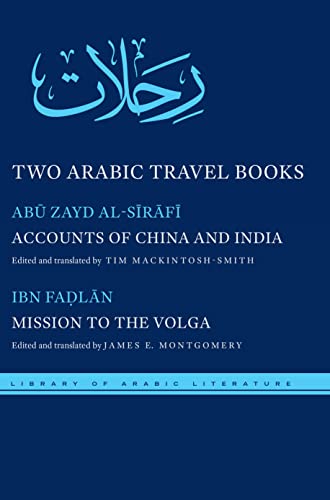
Two Arabic Travel Books combines two exceptional exemplars of Arabic travel writing, penned in the same era but chronicling wildly divergent experiences. Accounts of China and India is a compilation of reports and anecdotes on the lands and peoples of the Indian Ocean, from the Somali headlands to China and Korea. The early centuries of the Abbasid era witnessed a substantial network of maritime trade―the real-life background to the Sindbad tales. In this account, we first travel east to discover a vivid human landscape, including descriptions of Chinese society and government, Hindu religious practices, and natural life from flying fish to Tibetan musk-deer and Sri Lankan gems. The juxtaposed accounts create a jigsaw picture of a world not unlike our own, a world on the road to globalization. In its ports, we find a priceless cargo of information; here are the first foreign descriptions of tea and porcelain, a panorama of unusual social practices, cannibal islands, and Indian holy men―a marvelous, mundane world, contained in the compass of a novella. In Mission to the Volga, we move north on a diplomatic mission from Baghdad to the upper reaches of the Volga River in what is now central Russia. This colorful documentary by Ibn Fadlan relates the trials and tribulations of an embassy of diplomats and missionaries sent by caliph al-Muqtadir to deliver political and religious instruction to the recently-converted King of the Bulghars. During eleven months of grueling travel, Ibn Fadlan records the marvels he witnesses on his journey, including an aurora borealis and the white nights of the North. Crucially, he offers a description of the Viking Rus, including their customs, clothing, tattoos, and a striking account of a ship funeral. Mission to the Volga is also the earliest surviving instance of sustained first-person travel narrative in Arabic―a pioneering text of peerless historical and literary value. Together, the stories in Two Arabic Travel Books illuminate a vibrant world of diversity during the heyday of the Abbasid empire, narrated with as much curiosity and zeal as they were perceived by their observant beholders.A bilingual Arabic-English edition.
User’s Reviews
Editorial Reviews: Review “Both these accounts are full of fascination and wonder. These volumes continue the contribution this excellent series is making towards integrating classics of Arabic into the global canon.” ― Times Literary Supplement”This welcome volume is one of the first in a new series that will be of inestimable value to both scholars and general readers.” ― The Silk Road”Both travel accounts edited and translated here by Mackintosh-Smith and Montgomery are a tribute as well to the foresight, ambition, and excellent quality achieved by the Library of Arabic Literature. This will become a library of cultural richness and enduring value.” ― Speculum”We have been given a precious gift in Two Arabic Travel Books. Mackintosh-Smith and Montgomery bring their years of experience in the field, their towering erudition, and, most importantly, their love of the texts themselves―and of travel―to a wide audience that is most in need of a fresh look at the world shared by the peoples of Eurasia a millennium ago.” ― Journal of the American Oriental Society About the Author Abū Zayd al-Sīrāfī was a seafarer who moved from the Persian port-city of Siraf to Basra in 303/915-916. He wrote the second half of Accounts of China and India, supplementing an earlier section written by an unknown mariner and merchant fifty years earlier.Aḥmad ibn Faḍlān was a member of a diplomatic mission sent by the Abbasid caliph al-Muqtadir in 309-310/921-922 to the king of the Volga Bulghars. His is the only existing record of that mission.Tim Mackintosh-Smith is a noted British travel author, best known for his trilogy on the renowned Moroccan world-traveler Ibn Baṭṭūṭah, which earned him a spot among Newsweek’s top twelve travel writers of the past hundred years. Since 1982, he has lived in Sanaa, Yemen.James E. Montgomery is Sir Thomas Adams’s Professor of Arabic at the University of Cambridge and Fellow of Trinity Hall. His latest publications are Loss Sings, a collaboration with the Scottish artist Alison Watt, and Kalīlah and Dimnah: Fables of Virtue and Vice, a co-translation with Michael Fishbein.
Reviews from Amazon users which were colected at the time this book was published on the website:
⭐For my article on Abu Fadlan, based on this book see:http://www.middleeasteye.net/in-depth/features/vikings-and-abbasids-worlds-apart-interconnected-965352085
⭐Loved it
⭐This book was purchased for me as a gift, as I study Arabic and have a strong interest in Middle Eastern and Asian history. My review will be referring to the hardcover, bilingual edition – as far as I am aware, the paperback publications of the Library of Arabic Literature only include the English translation, and not the accompanying Arabic original.First off, some technical details about the book – appearance, print quality, etc. As to the quality of the translation, I am not *fully* qualified to say, but so far as I can see it appears to be of solid quality, and both the English and Arabic are clearly legible. For those who, like myself, have not reached “Sheikhspeare of Arabic”-level proficiency in the language, it should be noted that the harakat (vowel-markings) are not universally present throughout, and that irregular forms are found in the book, as it is written not in modern FusHa Arabic, but the emerging Arabic of more than 1,000 years ago. That said, it is not devoid of the vowel-markings, by any means – they’re included where beneficial for the clarity, i.e. they’re frequent and there are also numerous footnotes from the author clarifying or commenting on sentences of the text.Armed with the bilingual text, the translator’s commentary, a decent knowledge of Arabic, and a reference grammar and dictionary (personally, I go with Karen Ryding’s grammar and the Hans Wehr, respectively, FWIW), it can be a good source for picking up historical Arabic as opposed to modern or dialectal Arabic.The book itself is quite aesthetically pleasing to look at – where the Loeb Library’s Greek and Latin texts are in green and crimson, the Clay Sanskrit’s in light blue, and the Murty’s in a purplish-red, the LAL’s are published in a deep, dark blue. These all probably seem to be minor points, but I love a well-made book. My only complaint with the physical form is that the book’s jacket seems to be a bit too fond of taking on and showing off finger-prints. It is, however, sturdy and well-bound, and I have no issues with the printing on any of the pages of any of my three volumes from the LAL.On to the actual book itself, it is split between two closely-related “sub-books” from al-Sirafi, and one book of ibn Fadlan unrelated to the former two. The translator provides an introduction to each of these two travel-books, putting them into their historical context and providing insight into the possible history and historiography of the two, in each case relatively murky (e.g., the first book of al-Sirafi’s, begins abruptly, and ibn Fadlan’s book ends just as abruptly).It provides a direct window into a bygone world both incredibly familiar and incredibly unfamiliar, into what the early centuries of the Islamic empires were like for those who made their living off the vast international trade-networks enabled by the meteoric rise and expansion of Islamic empire across much of the known world at the time. One is at times left to wonder the veracity of the accounts, especially during al-Sirafi’s two “sub-books” (NB that al-Sirafi is the older of the two authors being translated here) and their periodically fantastical recounting of details that seem to be either absurd exaggerations or misunderstandings or confusions of actual facts. However, one of the things that I find so entertaining is how difficult it is to determine this as the history being discussed is quite remote in its distance from the modern day – in terms perhaps more familiar to Western audiences, these accounts are contemporaneous with the time of Charlemagne and the later Viking Invasions of Britain, i.e. the “Dark Ages” of Europe.It is also curious, however, how some seemingly minor details can be confirmed by virtue of still being true today – mention is made of what are likely the Andaman and Nicobar Islands in the Bay of Bengal, which from their description here likely sat alongside the major trade-routes from China to Mesopotamia. Accounts of cannibalism among the natives of these islands date back centuries, and their languages are mentioned in Sirafi’s accounts as being unlike any other known (even today, this is largely true, especially in the case of the Sentinel Islanders who remain one of the few peoples in the world totally removed from modernity).Ibn Fadlan’s is the more personalized account of the two, but it is also unfortunately one I have not had time to fully finish. It too has its own mysteries and murky aspects to it, but it is also in many ways far more specific and more trustworthy of the two accounts, albeit also of much more limited scope. Thus, I cannot comment much on ibn Fadlan’s accounts of the Volga River, beyond that what portions I have read were every bit as fascinating as al-Sirafi’s accounts of India and China.Altogether, this is a translation of two (or three, if you count the two “sub-books” of al-Sirafi as separate) striking insights into a murky, bygone age that I feel has reached the point of distance from our present day as to no longer be so readily understandable or relatable, and the production of such texts as these do a great deal to give us insight into our shared global history, by effectively “replacing the bulbs” in the very old but still potentially very bright lights of writers who had zero interest in spinning tall-tales and fables, but were instead intending to produce practical guides that could be made use of by the traders and travelers of the newly-emerging Islamic world and its outskirts.
⭐I found this book very interesting, giving, as it does, many details of the impression sophisticated Muslims in the 9th and 10th centuries had of both more, and less, cultured peoples. It is fascinating on China, but somewhat above my level of historic knowledge of central Asia, and way above my minimal knowledge of Arabic language and writing, so I do not consider that I can provide a satisfactory review of it. . I feel it would be ideal for students of the areas and periods.
⭐Highly recommended.
⭐perfect commentary on the voyages of arab ambassadors in the pursuit and dissemination of knowledge.
⭐A must have for my collection. Translation is very understandable and provides Arabic text as well.
⭐all as specified!
Keywords
Free Download Two Arabic Travel Books: Accounts of China and India and Mission to the Volga (Library of Arabic Literature, 17) in PDF format
Two Arabic Travel Books: Accounts of China and India and Mission to the Volga (Library of Arabic Literature, 17) PDF Free Download
Download Two Arabic Travel Books: Accounts of China and India and Mission to the Volga (Library of Arabic Literature, 17) 2014 PDF Free
Two Arabic Travel Books: Accounts of China and India and Mission to the Volga (Library of Arabic Literature, 17) 2014 PDF Free Download
Download Two Arabic Travel Books: Accounts of China and India and Mission to the Volga (Library of Arabic Literature, 17) PDF
Free Download Ebook Two Arabic Travel Books: Accounts of China and India and Mission to the Volga (Library of Arabic Literature, 17)