

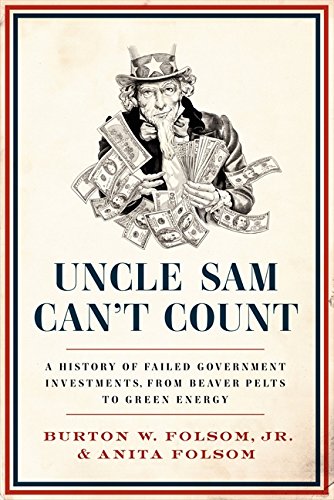
Ebook Info
- Published: 2014
- Number of pages: 256 pages
- Format: PDF
- File Size: 1.64 MB
- Authors: Burton W. Folsom Jr. Jr.
Description
Drawing on examples from the nation’s past and present—the fur trade to railroads, cars and chemicals, aviation to Solyndra—Uncle Sam Can’t Count a sweeping work of conservative economic history that explains why the federal government cannot and should not pick winners and losers in the private sector, including the Obama administration.From the days of George Washington through World War II to today, government subsidies have failed dismally argue Burt and Anita Folsom. Draining the Treasury of cash, they impede economic growth, and hurt the very companies receiving aid.Why does federal aid seem to have a reverse Midas touch? As the Folsoms reveal, federal officials don’t have the same abilities or incentives as entrepreneurs. In addition, federal control always equals political control of some kind. What is best for politicians is not often what works in the marketplace. Politicians want to win votes, and they can do so by giving targeted CEOs benefits while dispersing costs to others.Filled with examples of government failures and free market triumphs, from John Jacob Astor to the Wright Brothers, World War II amphibious landing craft to Detroit, Uncle Sam Can’t Count is a hard-hitting critique of government investment that demonstrates why business should be left exclusively to private entrepreneurs.
User’s Reviews
Editorial Reviews: From the Back Cover In their fascinating history of government misadventure, Burton and Anita Folsom show why the Obama administration’s urge to pick winners and losers in the private sector is doomed to fail.From the days of George Washington through World War II to today, government investments have failed dismally. They not only drain the Treasury of cash but also impede economic growth, and they hurt the very companies they try to support.Why does federal aid seem to have a reverse Midas touch? Simply put, federal officials don’t have the same abilities or incentives as entrepreneurs. In addition, federal control always produces political control of some kind. What is best for politicians is not often what works in the marketplace. Politicians want to win votes, and they can do so by giving targeted CEOs benefits while dispersing costs to others.Uncle Sam Can’t Count is filled with examples of government failures and free market triumphs, including John Jacob Astor, who owned a fur company that defeated a government-funded rival—supported by George Washington himself—by actively cooperating in trade with the Native Americans instead of trying to tell them what they wanted. The Wright brothers, who, with two thousand dollars of their own money, successfully flew the first manned flight, while the government threw money at Samuel Langley, whose two failed attempts at flight both landed in the Potomac River. George Mitchell, who spent seventeen years developing fracking, after the high taxes on oil drilling were repealed, while the government subsidized ethanol.Uncle Sam Can’t Count is a hard-hitting critique of a government completely incapable of either picking winners or learning from its many mistakes, which demonstrates why business should be left to private entrepreneurs. About the Author Burton W. Folsom Jr. is the Charles Kline Professor of History and Management at Hillsdale College, and the author of New Deal or Raw Deal?, The Myth of the Robber Barons, and FDR Goes to War, written with his wife, Anita. He has written for the Wall Street Journal, American Spectator, Policy Review, and Human Events.Anita Folsom has pursued a career in both politics and the teaching of history, including teaching American history at Hillsdale College. She served in the Electoral College in 1988. Since 2006 she has directed Hillsdale College’s Free Market Forum, a national colloquium for college teachers. She is coauthor of FDR Goes to War and has written for the Wall Street Journal, American Spectator, Human Events, and the Detroit News.
Reviews from Amazon users which were colected at the time this book was published on the website:
⭐I have been eagerly awaiting the Folsoms’ latest book. I bought two copies the day it came out: a hardback and the kindle version so I would not have to wait two days to begin reading. I was not disappointed. In fact, I find myself telling stories from the book to my friends on a daily basis. The premise is that the government cannot give enough money (subsidies) to make a business successful. The end is always a lot of wasted money with dismal results at best and no results at worst. The first example in the book is about the fiasco when the government involved itself in fur trading. The government spent huge amounts of money to try to get the Native Americans to trade for items they had no interest in, such as plows and hoes. Astor became the top fur trader, however, because his company supplied to the Native Americans what they wanted. One of my favorite accounts was about the history of the first manned flight. The government invested a lot of money in Samuel Langley, head of the Smithsonian Institute and author of Experiments in Aerodynamics. Langley had successfully flown a small, unmanned airplane in a circular path over the Potomac. It did seem to be one of the government’s safer bets. After all, the Wright brothers never went to college and owned a bicycle repair shop, yet they, with very little money, beat the well-funded Langley to manned flight. I doubt even the most shrewd investors would have taken the bet that the Wrights would beat Langley to the record books. Another lesson here is that it is impossible for the government or anybody else to know who is going to be successful, although history definitely shows you should bet against any corporation or individual that the government bets on. You also will enjoy reading the inside story of Solyndra and the “great successes” of the government picking our energy policy. The book is incredibly well researched and includes 20 pages of citations. Get your kindle version today and buy the hardback edition for your library and friends. It is a very interesting book and easy to read. I predict that when this book is updated in the future the Folsoms will have a new chapter on one of the greatest examples in history of a failed government program: Obamacare.
⭐Conventional history books focus more on superficial details without attempting to understand the underlying causes. It is one thing to explain that there was high inflation and an energy crisis in the 1970s, but quite another to deftly explain the government policies which directly led to it. It is all to common for such events to be depicted as externally caused and inevitable, when in fact they are both heavily influenced by government policy and quite avoidable.Whereas the traditional textbooks have the general theme of “a problem occurred, often due to the failure of free markets to self-regulate, and the government came in and fixed it.” The theme of this book is instead, “government regulations impeded markets, creating and deepening misery.” It is important to not only speak about the intentions of government action, but the results. Most textbooks content themselves to superficially describe a historical problem and then the government policy created with the intent of addressing it. The full causes of the problems in the first place and the effects of the well-intentioned policies are seldom questioned. This book addresses these conventional failings.Burt and Anita Folsom’s insights are sound, as in their other books, but they are sometimes repetitive and patronizing in their tone. This is especially true of the introduction. The tone of his early books, “Myth of the Robber Barons” and “Michigan Entrepreneurs” was more focused and scholarly. This book includes many of the same stories, but with less detail and more judgmental language.This book is well-referenced, but seems to be designed for an audience that is both less intellectual and more partisan than the audience of Folsom’s earlier works on entrepreneurs. I will be trying to use this book in my 8th grade history classroom to help students understand some of the core economic policies of our government, past and present.It would be great to have a second edition that moved back towards the more scholarly style of “Myth of the Robber Barons,” letting the detail-rich biographies speak for themselves.
Keywords
Free Download Uncle Sam Can’t Count: A History of Failed Government Investments, from Beaver Pelts to Green Energy in PDF format
Uncle Sam Can’t Count: A History of Failed Government Investments, from Beaver Pelts to Green Energy PDF Free Download
Download Uncle Sam Can’t Count: A History of Failed Government Investments, from Beaver Pelts to Green Energy 2014 PDF Free
Uncle Sam Can’t Count: A History of Failed Government Investments, from Beaver Pelts to Green Energy 2014 PDF Free Download
Download Uncle Sam Can’t Count: A History of Failed Government Investments, from Beaver Pelts to Green Energy PDF
Free Download Ebook Uncle Sam Can’t Count: A History of Failed Government Investments, from Beaver Pelts to Green Energy