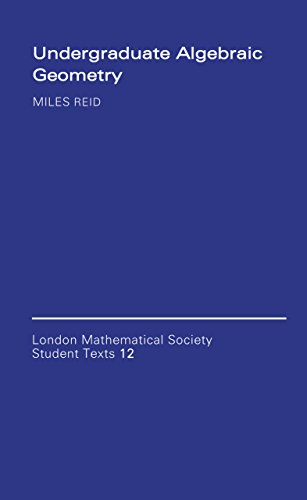
Ebook Info
- Published: 1988
- Number of pages: 140 pages
- Format: PDF
- File Size: 5.73 MB
- Authors: Miles Reid
Description
Algebraic geometry is, essentially, the study of the solution of equations and occupies a central position in pure mathematics. This short and readable introduction to algebraic geometry will be ideal for all undergraduate mathematicians coming to the subject for the first time. With the minimum of prerequisites, Dr Reid introduces the reader to the basic concepts of algebraic geometry including: plane conics, cubics and the group law, affine and projective varieties, and non-singularity and dimension. He is at pains to stress the connections the subject has with commutative algebra as well as its relation to topology, differential geometry, and number theory. The book arises from an undergraduate course given at the University of Warwick and contains numerous examples and exercises illustrating the theory.
User’s Reviews
Reviews from Amazon users which were colected at the time this book was published on the website:
⭐Disclaimer: I picked up this book from my university library unaware of its intended purpose (it’s very short). I had previously taken a course in geometry and while I admit that it did not warrant such an undertaking (my course text being Pressley’s differential geometry), the first section immediately snatched my attention with some familiar topics in number theory, topology and algebra; however, this section was completely irrelevant with respect to the subsequent chapters in the text seeing as the author described it as a cultural introduction that was not logically part of this course. In hindsight, I suppose it was an attempt at conveying what will be expected from this course, which is a lot (and then some).While there are several notable books on algebraic geometry at the graduate level, very few are directed towards undergraduate students. This book easily fills the void with a broad range of topics covering plane conics, cubic curves & group law, Noetherian rings, Hilbert’s basis theorem, Zariski topology and functions on varieties, where it seems the author is constantly vying for your attention as you move from one thought-provoking section to the next. The material is rigorous but the book presents clear, concise definitions that cut through all the fluff that is found in too many undergraduate texts. The topics are organized into three distinct chapters spread over several pages of propositions, facts, examples and some pretty interesting (and no doubt comical) remarks.Nullstellensatz (Hilbert’s zeros theorem) is discussed in great detail and the author establishes the proof by first stating an important result from commutative algebra that you will come back prove to later on in the section. The Nullstellensatz proof is divided into two segments, which allow readers to appreciate the strong geometric content in certain aspects of the proof. In this regard (and to the credit of the author), this book is very forgiving in presenting intrinsically difficult proofs and other meaningful results as part of a short, targeted study of algebraic geometry that allow unstudied readers to arrive at precisely those conclusions that the author had originally intended. However, I would assume that a lot of supplementary material is required to reinforce these notions. While a decent textbook on the subject can only serve to benefit an undergraduate student in actually getting somewhere with this book, I would nevertheless recommend it to any math major.
⭐Sent as gift. A much needed informative book for math major
⭐It is difficult to see who this book is aimed at. Perhaps the extremely gifted undergraduate who can fill in sketchy, incomplete, difficult proofs, but has also taken courses? My professor (a topologist) even had a difficult time presenting the material as-is and solving the exercises, as very few examples were given, hence it was unclear exactly what was required for a satisfactory proof of the questions as stated. Reid, probably in an effort to save space, delegates difficult steps of proofs to the reader by declaring them “obvious,” making the book practically unreadable to the average undergraduate student. The notation is used strangely and the typesetting is awkward.The proof of the 27-lines theorem is interesting and a decent capstone for the introductory subject. However, I did not feel as though I had deepened my knowledge of algebraic geometry as a result, only having learned the bare minimum to approach one useless (albeit entertaining) theorem.If you have to use this book I recommend buying another one to supplement the background knowledge and to figure out how to complete the proofs.
⭐This book is intended to provide us with a short (135 pages), down to earth and fluently motivated introduction to algebraic geometry. And it does a great job. While the author does not clearly state his intentions in advance, I think it would be safe to assume that this is meant to accompany a more standard text on the subject (Hartshorne, Harris, Shafarevich, etc), and that the author’s main goal was to give the quickest possible route to the heart of the subject, making sure the reader stays interested throughout rather than that he is presented with the firmest logical structure. I would like to stress that despite of what I wrote so far, this book does present rigorous proofs and clear definitions.The style is friendly, straightforward and unpretentious. Everything is well motivated, and one occasionally gets to hear the author’s personal perspective or view about a certain topic. I will quote two examples. When discussing the Zariski topology, the author writes “The Zariski topology may cause trouble to some students; since it is only being used as a language, and has almost no content, the difficulty is likely to be psychological rather than technical”. This was very calming for me to read, as I have been previously struggling with the “deep meaning” of the Zariski topology, and no book has had the honesty to tell me that I shouldn’t worry that much about it. As a second example of the author’s style, after a Q.E.D. in page 53 the author explains that “The proof of (b) is a typical algebraist’s proof: it’s logically very neat, but almost completely hides the content: the real point is that …”Chapter 1 begins with the concrete example of conics, intended to motivate the later definitions of the projective plane. Next elliptic curves and their group law is discussed. The chapter ends with a brief survey of the genus of curves.Chapter 2 is more technical; its purpose is to build the algebraic foundations needed for Hilbert’s Nullstellensatz. Among topics covered are Noetherian rings, Hilbert’s Basis Theorem, algebraic sets, the Zariski topology, prime ideals and a nice motivation for the Nullstellensatz. Next coordinate rings, morphisms, varieties and other standard topics are introduced.Chapter 3, titled “Applications”, uses the previous material to discuss some nice geometric topics. I especially enjoyed the section on the 27 lines on a cubic surface.I would highly recommend this book to anyone not very familiar with algebraic geometry; for instance, it could be a good reading to decide if you want to take a more serious study (e.g. a university course) of the subject. If I were to suggest only one text for someone who just wants to know what algebraic geometry is all about, it would definitely be this one.
⭐Urgh. I got this because I was delighted with the author’s other work in this series – a delightfully clear and (surprisingly for a maths textbook) rather witty introduction to the mysteries of Commutative Algebra for those who find themselves struggling for breath on the terse and forbidding slopes of Atiyah and Macdonald.This, though, is a wee bit of a mess. It’s hard to see what it’s actually trying to achieve. It can’t seem to decide whether it wants to teach via example or work directly with the theory, and as a result it’s all over the place. It’s got a few useful exercises, and the author remains a rather warmer presence than for most such books, but if you’re hoping it will give you the same clarity as his other book in the series you will be as disappointed as I was.Add to that the fact that it’s printed so incompetently as to be almost unreadable (seriously, even the latest edition looks like it was done pre-LaTeX) and you’ve got a pretty bad textbook on your hand. This is not a field that admits particularly friendly ‘introductions’, but there are plenty better than this.
⭐I used this book as primary source for my undergraduate thesis, thus feel obliged to scribble down a quick review. First and foremost, do make sure that you use any edition OTHER than the first edition (published in 1988), which contains some pretty serious mistakes, if you own the 2nd edition, you’ll probably notice that this is noted by the author.A text on Algebraic Geometry written specifically for undergraduate level is certainly hard to come by (hence the rather natural choice of based text for a thesis). Yet, as a very mediocre undergrad, I genuinely had a hard time reading this. My main problem is more often than not, expositions are a little obscure and terse, where gaps are expected to be filled in by the reader. At the same time, I struggle to imagine anyone who is familiar with Algebraic Geometry benefiting much from picking up this book.That being said, it can be a cute book provided that you have the right level of mathematical maturity (solid linear algebra and abstract algebra, for the latter: ring fundamentals and Galois theory; basic Topology; a little geometric intuition also goes a long way), as it does discuss some of the most fundamental concepts of basic Algebraic Geometry. Also, Chapter 7 is as accessible and elementary an exposition of a gem of classical Algebraic Geometry: 27 lines on a smooth cubic surface, as one can get. Reid had his argument based on the (much more laconic) original exposition given in Beauville’s “Complex Algebraic Surfaces”; however he elaborated a lot further, the proof as a result is significantly more comprehensible for undergraduate level than the standard argument using blow-ups.A while later after handing in my thesis, I discovered that Reid had another text called “Undergraduate Commutative Algebra”, which apparently is supposed to be read in conjunction / as a stepping stone for this book, so that might be worthy of investigation. In fact, if you’re relatively new to Commutative Algebra and/or its specific tools used in Algebraic Geometry, you would probably be better off starting with that one. (Of course, if you are very confident with your Algebra background, feel free to dive straight into Fulton’s “Algebraic Curves” – deemed to be a classic. Alas, I found it close to unfathomable.)Otherwise, if you choose to stick with this one of Reid’s, another source that I found extremely useful to be read simultaneously is “Ideals, Varieties and Algorithms” by Cox et al. – this is an undergraduate text and does what it says on the tin. It is incredibly accessible, self-contained and provides the quickest pathway to grasping key ideas / basic techniques that every novice in the field absolutely must know, and certain sections complement Reid’s quite nicely. At least speaking from my own experience, you shouldn’t have any problem making sense of Chapter 7 with the Cox book by your side. One may also find Klaus Hulek’s “Elementary Algebraic Geometry” quite useful, as its structure is based on Reid’s anyway, with a stronger emphasis on complex analysis (not an error-free text though, mind you).If you really want something different: Smith et al.’s “An Invitation to Algebraic Geometry” touches upon the basics to more sophisticated areas such as sheaves, but the style of writing is arguably more concise there.Overall, Reid’s Undergraduate Algebraic Geometry is a neat text if you have a pretty good idea what he’s talking about.
Keywords
Free Download Undergraduate Algebraic Geometry (London Mathematical Society Student Texts Book 12) 1st Edition in PDF format
Undergraduate Algebraic Geometry (London Mathematical Society Student Texts Book 12) 1st Edition PDF Free Download
Download Undergraduate Algebraic Geometry (London Mathematical Society Student Texts Book 12) 1st Edition 1988 PDF Free
Undergraduate Algebraic Geometry (London Mathematical Society Student Texts Book 12) 1st Edition 1988 PDF Free Download
Download Undergraduate Algebraic Geometry (London Mathematical Society Student Texts Book 12) 1st Edition PDF
Free Download Ebook Undergraduate Algebraic Geometry (London Mathematical Society Student Texts Book 12) 1st Edition