

Ebook Info
- Published: 2011
- Number of pages: 320 pages
- Format: PDF
- File Size: 2.12 MB
- Authors: John W. Arthur
Description
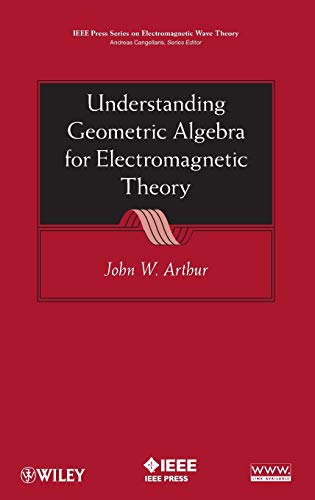
This book aims to disseminate geometric algebra as a straightforward mathematical tool set for working with and understanding classical electromagnetic theory. It’s target readership is anyone who has some knowledge of electromagnetic theory, predominantly ordinary scientists and engineers who use it in the course of their work, or postgraduate students and senior undergraduates who are seeking to broaden their knowledge and increase their understanding of the subject. It is assumed that the reader is not a mathematical specialist and is neither familiar with geometric algebra or its application to electromagnetic theory. The modern approach, geometric algebra, is the mathematical tool set we should all have started out with and once the reader has a grasp of the subject, he or she cannot fail to realize that traditional vector analysis is really awkward and even misleading by comparison. Professors can request a solutions manual by email: pressbooks@ieee.org
User’s Reviews
Editorial Reviews: Review “This book will benefit scientists and engineers who use electromagnetic theory in the course of their work.” (Zentralblatt MATH, 1 May 2013) From the Inside Flap Provides insight into classical electromagnetic theory through geometric algebraThis practical book promotes the understanding of geometric algebra as a straightforward mathematical toolset for both working with and appreciating the fundamentals of electromagnetic theory. Taking a non-axiomatic, less formal tutorial approach, the text introduces new ideas gradually and goes into considerable detail in giving explanations and working out equations.After an introduction to geometric algebra, the book shows how to apply it to some basic concepts. Then, the essential toolset is developed, allowing for the application of geometric algebra more generally—for example, in any dimension of space. After applying the toolset to fundamental electromagnetics in the usual (3+1)D situation where space and time are separate entities, the book prepares the ground for a full 4D treatment in which they are treated equally as spacetime vectors. Through geometric algebra, the reader will discover how to tackle the electromagnetic theory of moving charges in a systematic yet uncomplicated way.In later chapters, the book provides a self-contained primer on the spacetime approach that seeks to avoid the usual conceptual difficulties of special relativity. While this involves some intriguing subtleties, its application is straightforward and readers will see how the toolset unifies previously separate ideas under a single theme: Coulomb’s Law + Spacetime = Σ Classical Electromagnetic Theory. The electromagnetic field of an accelerating charge is worked through in detail to show how the toolset is applied.Most chapters include exercises. There are figures and tables with detailed captions as well as various appendices that offer explanatory information and background material. In particular, a glossary provides an at-a-glance explanation of key terms and symbols.This book will benefit scientists and engineers who use electromagnetic theory in the course of their work, including those who teach the subject; graduate students and senior undergraduates studying electromagnetics; and electromagnetic theorists.Problems and solutions materials are available by sending an email to pressbooks@ieee.org From the Back Cover Provides insight into classical electromagnetic theory through geometric algebraThis practical book promotes the understanding of geometric algebra as a straightforward mathematical toolset for both working with and appreciating the fundamentals of electromagnetic theory. Taking a non-axiomatic, less formal tutorial approach, the text introduces new ideas gradually and goes into considerable detail in giving explanations and working out equations.After an introduction to geometric algebra, the book shows how to apply it to some basic concepts. Then, the essential toolset is developed, allowing for the application of geometric algebra more generally—for example, in any dimension of space. After applying the toolset to fundamental electromagnetics in the usual (3+1)D situation where space and time are separate entities, the book prepares the ground for a full 4D treatment in which they are treated equally as spacetime vectors. Through geometric algebra, the reader will discover how to tackle the electromagnetic theory of moving charges in a systematic yet uncomplicated way.In later chapters, the book provides a self-contained primer on the spacetime approach that seeks to avoid the usual conceptual difficulties of special relativity. While this involves some intriguing subtleties, its application is straightforward and readers will see how the toolset unifies previously separate ideas under a single theme: Coulomb’s Law + Spacetime = Σ Classical Electromagnetic Theory. The electromagnetic field of an accelerating charge is worked through in detail to show how the toolset is applied.Most chapters include exercises. There are figures and tables with detailed captions as well as various appendices that offer explanatory information and background material. In particular, a glossary provides an at-a-glance explanation of key terms and symbols.This book will benefit scientists and engineers who use electromagnetic theory in the course of their work, including those who teach the subject; graduate students and senior undergraduates studying electromagnetics; and electromagnetic theorists.Problems and solutions materials are available by sending an email to pressbooks@ieee.org About the Author JOHN W. ARTHUR earned his PhD from Edinburgh University in 1974 for research into light scattering in crystals. He has been involved in academic research, the microelectronics industry, and corporate R&D. Dr. Arthur has published various research papers in acclaimed journals, including IEEE Antennas and Propagation Magazine. His 2008 paper entitled “The Fundamentals of Electromagnetic Theory Revisited” received the 2010 IEEE Donald G. Fink Prize for Best Tutorial Paper. A senior member of the IEEE, Dr. Arthur was elected a fellow of the Royal Society of Edinburgh and of the United Kingdom’s Royal Academy of Engineering in 2002. He is currently an honorary fellow in the School of Engineering at the University of Edinburgh. Read more
Reviews from Amazon users which were colected at the time this book was published on the website:
⭐I am a geometric algebra enthusiast, and this is my absolute favorite book on that idiom, about any topic. Arthur is a well-known maestro of electrodynamics who became enamored of a more pithy way of presenting it. He proceeded to do so in an extraordinarily elegant way by beginning with space and time distinguished by dimension: space is three dimensional, time is zero dimensional–vector, scalar in other words; which he terms “3,1 algebra”, focusing on the number of scalars in the tuples. (I would call it ” 3,0 spatial arithmetic”, focusing instead on dimension). After the reader has mastered that, about half-way thru the book, author Arthur then reveals that, altho this approach is far superior to the traditional Gibbs-Heaviside algebra, it is nonetheless still somewhat clunky and obscure; so he switches to spacetime 4 algebra. Understanding that is synonymous with understanding special relativity, a task that consumes three chapters. Once you have acquired that, you are finally prepared to REALLY understand all Electrodynamics as a simple inverse-square law in the proper-time frame of a charge; to the point of understanding accelerating charges, usually considered well beyond first-year graduate capability. That chapter was the frosting on the cake for me. There are few math or physics books I still love anymore, but this is one.
⭐Very nice text book. I work in similar area and enjoyed clear and logically consistent presentation. Not very often today.
⭐Very nice book. I really recommend those who want to enhance knowledge in this area. Grab one copy as sooner.
Keywords
Free Download Understanding Geometric Algebra for Electromagnetic Theory 1st Edition in PDF format
Understanding Geometric Algebra for Electromagnetic Theory 1st Edition PDF Free Download
Download Understanding Geometric Algebra for Electromagnetic Theory 1st Edition 2011 PDF Free
Understanding Geometric Algebra for Electromagnetic Theory 1st Edition 2011 PDF Free Download
Download Understanding Geometric Algebra for Electromagnetic Theory 1st Edition PDF
Free Download Ebook Understanding Geometric Algebra for Electromagnetic Theory 1st Edition