

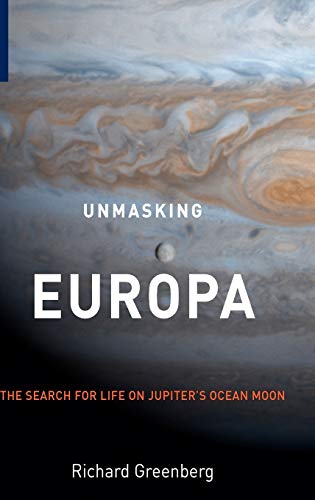
Ebook Info
- Published: 2008
- Number of pages: 287 pages
- Format: PDF
- File Size: 41.73 MB
- Authors: Richard Greenberg
Description
Jupiter’s ice moon Europa is widely regarded as the most likely place to find extraterrestrial life. This book tells the engaging story of Europa, the oceanic moon. It features a large number of stunning images of the ocean moon’s surface, clearly displaying the spectacular crack patterns, extensive rifts and ridges, and refrozen pools of exposed water filled with rafts of displaced ice. Coverage also features firsthand accounts of Galileo’s mission to Jupiter and its moons. The book tells the rough and tumble inside story of a very human enterprise in science that lead to the discovery of a fantastic new world that might well harbor life.
User’s Reviews
Editorial Reviews: Review From the reviews:”Unmasking Europa … brings you face to face with the surface scars of this tiny Jovian moon and tells the story of how our scientific understanding of this enigmatic world has developed. … Through clear descriptions of unfamiliar terms, usefully annotated diagrams, and beautiful colour plates, the story of Europa is made accessible to anyone, even without a prior knowledge of planetary science.” (Emily Baldwin, The Observatory, Vol. 129 (1210), June, 2009)”The icy crust of Jupiter’s moon Europa, cut by dramatic faults and other irregularities, caps a hidden ocean about 100 kilometers deep. Greenberg (planetary sciences, Univ. of Arizona) believes the crust is relatively thin … . his explanations of how tides influenced the Europan crust are generally elegant and interesting. The book includes a few Web sites with images of Europa. Summing Up: Recommended. Lower- and upper-division undergraduates, two-year technical program students, and general readers.” (B. M. Simonson, Choice, Vol. 46 (8), April, 2009)”The book is a very clear and accessible exposition of the Europa observations, and of how movements of the ice crust could have produced them. … the author is gratified that his ‘thin-ice’ model of Europa is now gaining credence, which may well indicate, as he believes, that correct arguments must ultimately win over the scientific community. … this book can be recommended as a good non-technical synopsis of our present understanding of the satellite … .” (Journal of the British Astronomical Association, April, 2009)”It is written by Richard Greenberg … . His arguments that the thick ice interpretation on Europa is flawed sound convincing … . The new book is stripped of much of the mathematical and geologic terminology used in the original in order to reach a wider audience. … the author is spending more time describing the process of discovery of Europa’s secrets.” (Unmanned Spaceflight, October, 2008)”Centauri Dreams readers already know of my admiration for Richard Greenberg’s … Unmasking Europa: The Search for Life on Jupiter’s Ocean Moon(Copernicus). It’s a lively and challenging book, one which Greenberg used to take sharp issue with many of his colleagues, and … when I reviewed the book, the animated back and forth makes for a fascinating look at how planetary science gets done. … Read Unmasking Europa for a close look at the Europan surface as seen through Voyager and Galileo imagery … .” (Centauri Dreams, October, 2009)“This book … recounts the fierce friction between the personalities leading the Galileo mission and publishing their interpretations of what they saw. … the story-telling is first-rate and elegantly explains not just the processes at work on this intriguing little world but also the rivalries and political manoeuvring of Big Science. … Unmasking Europa is a gripping story of the exploration of a new world and the often heated debates within science, and is absolutely stuffed with gorgeous images of strange Europan landscapes.” (Lewis Dartnell, Astrobiological Society of Britain, March, 2009) Review “What lies beneath Europa’s icy crust? Richard Greenberg has been pondering this question for 30-odd years. His new book, Unmasking Europa, describes his view that Europa’s hidden ocean and the life forms it may support are not that far below the surface. A professor in the Lunar and Planetary Laboratory at the University of Arizona, Greenberg was one of the first to formulate how tidal forces could shape the geology on Jovian moons. He got the opportunity to test his ideas as a member of the imaging team on NASA’s Galileo spacecraft, which orbited Jupiter from 1995 to 2003. During several flybys, Galileo took hundreds of snapshots of the moon Europa, showing a surface covered with dark spots and crisscrossing lines. In his new book, Greenberg walks readers through the Europa photo gallery like a curator in an art museum. He interprets the meaning of these wonderful images and recounts how he and his colleagues came to see Europa’s strange features as evidence that the outer crust is a thin layer of ice riding over a deep ocean. This is not the mainstream opinion, however. Most scientists who study Europa believe the ice is much thicker: tens of kilometers as opposed to only a few kilometers. In the course of defending his minority position, Greenberg blames the hierarchical structure of big science projects for creating a politically-motivated “thick ice” cabal that refused to go back on its initial interpretations even when later data seemed to contradict them… With all the evidence in the book for thin ice, why do most planetary scientists continue to support a thick crust interpretation?… Greenberg says that Galileo’s team leaders decided prematurely that Europa had thick ice, and afterwards it became politically advantageous to toe that line. A cautious resistance to paradigm shifts is reasonable when a model has been serving well. But the isolated-ocean model for Europa had become the canonical paradigm for all the wrong reasons…” Review “…The book offers detailed views of the moon’s grooved rafts of ice and scalloped faults. The Tortured landscape arises from Jupiter’s tidal forces, which relentlessly strain the ice–weird physics that Greenberg vividly describes. His team is convinced that water or slush gurgles close to the surface, percolating through faults in ice less than 10 kilometers thick. In contrast, the leaders of Galileo’s imaging teams favor a thicker shell that isolates the ocean. This dispute forms the heart of the book. It’s a fascinating issue that affects plans for future missions to probe for Europan life… Greenberg thinks the thick-ice model is full of holes. In his view, it gained a fervent following not on merit, but because of the political power invested in the team leaders by NASA. This compelling tale deserves an airing. Greenberg makes important points about NASA’s zest for showy news and quick interpretations, and he criticizes the agency for letting archived data languish…” From the Back Cover In Unmasking Europa, Richard Greenberg tells the story of how he and his team of researchers came to believe that the surface of Europa is in fact a crust so thin and active that it can barely hide an ocean of liquid water below. He shows how this ocean is warmed by the friction of tidal movements in this small moon as it revolves while at the same time orbiting immense Jupiter, and how those tides drive all the activity in evidence on the surface. The implications of this interpretation―which includes the idea that there are active intermittent openings from the liquid ocean to the frozen surface―are immense. The warmth, the chemistry, and the connections from ocean to surface provide the conditions necessary for the existence of life, even at this relatively remote locale in our solar system, far beyond what’s normally thought of as its “habitable zone.”Unmasking Europa describes in clear but technically accurate terms―and with extensive illustrations (including more than 100 NASA mission images)―the remarkable history of research on Europa over the last four decades. The book also provides unique insights into how “big science” gets done today, and it is not always a pretty picture. From his perspective as a Professor of Planetary Sciences at the University of Arizona, and a quarter-century-long membership on the Imaging Team for the Galileo space mission, Greenberg describes how personal agendas (including his own) and political maneuvering (in which he received an education by fire) determined a lot about the funding, staffing, and even the direction of research about Europa.While he is satisfied that his team’s work is now, finally, receiving fair consideration and even respect, Greenberg comes away from his decades-long experience feeling that something is fundamentally wrong with the scientific enterprise as a whole because it routinely punishes innovation, risk-taking thought, and a willingness to simply let the evidence lead where it may. In today’s scientific culture, with its careerist pressures and peer-reviewed propriety, Greenberg believes, astute scientists (and sadly many of our youngest and brightest scientists) quickly realize that the most rewarding research strategy is to stay within the mainstream―a tendency that by its very nature is at odds with the ideals of scientific investigation and thought. Read more
Reviews from Amazon users which were colected at the time this book was published on the website:
⭐Review of Unmasking Europa: The Search for Life on Jupiter’s Ocean MoonAuthored by Professor Richard GreenbergThis technical, yet easy to read, book is of the astrophysics genre, within the field of planetary exploration. Its author is a professor of planetary science at the University of Arizona’s Lunar and Planetary Laboratory; and was a leader of a Galileo spacecraft imaging team. Professor Greenberg is an expert on Europan tidal motions and discusses its impact on the habitat likely to exist below Europa’s icy surface. He brings to the table a timely, honest, and personal perspective into the history of the past 40 years of Europa’s research. Also, Greenberg’s 25 years as a professor and his interaction with other Galileo space mission scientists is objective and sobering. As he states, “it is not always a pretty picture”; and this professor pulls no punches!A concise summary of the book’s content and a relevant description of the topics is as follows: The ice crust covering Europa is not a solid tens-of-kilometers thick, as some researchers profess. It could be a tens-of-meters thin… and may, in spots, just cover the vast ocean below which is estimated to be twice the combined volume of all of the Earth’s vast oceans. Friction from tidal motion keeps the subsurface ocean liquid. The convection and transport of liquid water from the Europan ocean floor to the surface manifests itself in the many surface double ridges, mosaic of Chaos, strike slip motion, dilatational bands, and disruption. Professor Greenberg’s clear explanations of these observed features demonstrate how the salty water can melt through to the surface. I found his technical descriptions fascinating! This nice 270-page book contains about 100 clearly described figures, plates, drawings, and a helpful index.Another noteworthy thread throughout this book is that big-time modern science / academia can morph into a draconian and stifling business culture. The author’s use of quotes from Galileo Galilee to introduce some chapters, plus Galileo’s famous small notebook sketch of Jupiter and its Four Jovian moons as an icon for chapter subdividers is a nice touch. I picked up on the irony that the first viewer of Europa, a classic astronomy hero, experienced similar frustrations and threats from his own boss, the church. Professor Greenberg notes that, for young scientists, the ideals and satisfaction of scientific inquiry and logical thought are becoming secondary to a culture that demands we stay within the boundary of mainstream science research for funding sake. I teach several sciences and have noticed this trend; and have passed on this sober warning to my own up-and-coming science students. Greenberg’s frank perspective on both academics and NASA is bold and refreshing.To this end, the audience may further appreciate my comments. I speak the truth: The prospects of discovering simple life on Europa could be as stunning as the Darwinian Revolution. Professor Greenberg’s warnings that a persistent belief of a thick ice covered Europa would erroneously drive future space missions to concentrate on unnecessary elaborate schemes to access its ocean. Where as, if the ice is cracked at the surface with exposure to direct access to the liquid ocean, Greenberg shows that we should confine our efforts to locating and landing sensors near a promising surface crack where frozen sea water oozes out. Difficult missions to access a sealed off ocean 20 kilometers below are the wrong way to approach Europa. The Reader will surely appreciate the author’s understanding. Also, I liked how Professor Greenberg calls for a need to examine / revisit the vast amounts of data already collected. Surely there is valuable data that still needs to be mined.In conclusion, let me restate the thesis: The ice on Europa is thin – not fortress thick. Future space missions should profit from Greenberg’s expertise and understanding. Science researchers can and should profit from a reexamination of the already existing and readily available collected data. The author structures his argument well; and the easy-to-read style of Professor Greenberg is both technical and enjoyable. He has helped me to understand Jupiter’s moon Europa better, and I highly recommend this book to my readers.Edward B. Kaczmarczyk BS, MSScience Chairman.Greenville Charter Technical High School.Greenville, SC.
⭐How can I appreciate a difference of opinions, as a layman, between scientists who seemingly have earned their authority in their particular fields of expertise, where I have none to offer, but a bit of common sense?In the beginning of the book I was surprised by the spiteful undertone in which the author spoke about some of his peers and their research. But as his story, the story of Europa and the story of “big science”, progresses one can start to understand the resentment Greenberg feels, if what he reveils is true. It gives a new dimension to the Galileo mission, not just a quest for discovery, but with it a small battleground for bickering scientists that let personal interests prevail above the search for the actual truth if needed.I’m not talking about ‘the truth’ of Europa, because that is under scientific scrutiny, and in time, even the most controversial characteristic that is under questioning (thick icecrust vs thin icecrust) will become defined and a fact. It is just a question of when and how.What I’m talking about is, that I find it disturbing that scientists are willing to bend their findings to different conclusions in order to stay in place with their “sponsors”, wether the reward is money, firsthand information, promising careermoves in the future or simply the fact that being “wrong” is not an option. It would be a rather marginal conflictzone, if it were not for the billions of dollars that are spend on interplanetary missions. If information, harvested from these missions, is missused or not used at all, but simply stored away or misinterpreted and adopted without proper scientic basis that should be a serious issue in a country that has a soaring national deficit.The growing stack of arguments for thin ice (as a premiss for a direct connection between the ocean and surface) and the seemingly obvious unscientific tactics to undermine or silence these arguments, would drive anyone nuts, that has 30 years of his career invested in the findings of this mission. Although I find his arguments quite compelling, I dare not say if he’s right about his thin icecrust theory. Except for one thing, the arguments for thick ice, seem to lack the elegance of simplicity that Greenberg arguments have to offer. With that in mind and the implications that a thin icecrust can have on the shape, cost and caracter of a future mission to Europa, it is rather a good thing that Greenberg is not holding back and even becomes personal at times. It is almost an outcry for people to take notice. With the attention it draws they will likely to investigate and question the motives of anyone involved (including himself) in this or any future project. With it every aspect of a future mission to Europa (wether it be 2, 3 or even more decades away) is under scrutiny. And hopefully, there will be enough evidence and arguments to keep such a mission as costeffective as can be. In the case of Greenberg’s thin ice theory it would mean not only that a mission could start much earlier, it would cost a view billions dollars less. He suggests that it would be very reasonable to investigate the current data, from the Voyager and Galileo missions, even more. For just a few millions of dollars, good science can be done, save and sound on earth. Without resorting to plan a new mission all too soon. Ironicaly with that, an overinvestment in time and money on the science of Europa, could be prevented, if new insights can be derived from this investigation. We could get more good science results from a future mission, and even sooner, by just going over the information we already have.There are many more puzzles in our solar system, and it would be regretfull, if a lot of science is wasted because the money wasn’t spend efficient and at it, the information misinterpreted.If read in that context, Greenberg has not only delivered an exiting book on a fairly unknown body of our solar system. He also has provoked controversy by confrontation, as a wake up call perhaps, to deliver a message to all who like planetary science. Don’t believe everything you read, question motives, question conclusions and most of all question the institutions who may have many more interests than purely the science of things. That is my aprecciation of things…and wether Europa has a thin icecrust, I still don’t know for sure, but Greenberg did make a strong case for it. Time will tell.
⭐Ich kann dieses Buch nur jedem empfehlen (der Englisch kann).Man lernt sehr viel über die Geologie und Physik des Jupiter-Mond Europa.Europa hat nach Sicht des Autors (und jetzt auch meiner Sicht 🙂 ) nur eine relativ dünne Eisdecke (1km-10km), die immer wieder aufbricht und das flüssige Wasser an die Oberfläche bringt. Das steht im Gegensatz zur Standard-Ansicht, dass die Eisdecke mindestens 20-30 km dick ist und nie ganz durchreißt. Dieser Unterschied hat allerding dramatische Konsequnzen für die Möglichkeit von Leben auf Europa und so ziemlich alles was man geologisch auf der Oberfläche sehen kann.Für ein Buch das wissenschafltich präzise ist, ist es noch erstaunlich leicht verständlich und sehr gut zu lesen (das Englisch ist auch recht klar gehalten, so dass man nur gelegentlich ein Wort nachschauen muss).Vor allem lernt man aber auch etliches über Netzwerke im Wissenschaftbetrieb, die neuen Erkenntnissen mit unglaublicher Beharrlichkeit entgegenstehen (weil sie persönlichen Karrieren entgegenstehen). Man kann die jahrelange Frustration des Autors sehr gut nachempfinden. Dadurch sind die Angriffe in dem Buch ziemlich direkt. Aber das macht es aus meiner Sicht umso interessanter zu lesen. Ich ziehe eine klare Kontroverse dem politisch korrekten Ränkespiel mit komplizierten Anspielungen vor. Aber das ist natürlich Geschmacksache. Man muss immer sehen, dass der wissenschafltiche Vorgänger dieses Buches und das Buch selber, das letzte Mittel des Autors waren, sich Gehör zu verschaffen. Natürlich ist der Autor auch nur ein Mensch und an Selbstvertrauen fehlt es ihm nicht (sonst hätte er das Buch nicht geschrieben). Aber er hat zumindest mal auch einen Blick für die Leistungen seiner Studenten (im Gegensatz zu vielen Professoren, die grundsätzlich nur die Gruppe und damit sich selbst erwähnen). Mein Tip: Er wird recht bekommen. (Ob er recht hat, kann ich noch nicht sagen, da ich die Gegenseite noch nicht gelesen habe, aber von dem was hier gezeigt wurde steht, hat er recht.)Seine Empfehlungen wie die in Planung befindlichen NASA-Missionen geändert werden sollten sind absolut plausibel.(Der kurze Biologie-Teil hat allerdings nicht ganz das Niveau des restlichen Buches. Aber das ist ja auch nicht das zentrale Thema des Buches und nicht das Gebiet des Autors.)Ein Muss für jeden jungen Forscher, der sich überlegt, seinen ganzen beruflichen Werdegang in der Forschung zu verbringen, oder es doch lieber sein zu lassen!One of the best books on Europa. Detailed yet very easy to follow. Personal stories add human element to it.
⭐Une fenêtre ouverte sur la petite histoire de l’exploration spatiale. L’anglais utilisé est facile à lire.On doit signaler la qualité de l’objet: couverture, reliure et papier sont à des km ‘des miles, en l’occurrence) des “pulps” à prix unique que l’on peut trouver en France…L’auteur illustre et défend bien son idée d’une croute “mince” (2 km) de glace au dessus d’un océan, révèle les dessous pas toujours reluisants (luttes d’intérêt, vols d’idées, course à la notoriété…) qui sont aussi le quotidien de la recherche.A great book, value for money.
⭐Well written but not for the beginner
Keywords
Free Download Unmasking Europa: The Search for Life on Jupiter’s Ocean Moon in PDF format
Unmasking Europa: The Search for Life on Jupiter’s Ocean Moon PDF Free Download
Download Unmasking Europa: The Search for Life on Jupiter’s Ocean Moon 2008 PDF Free
Unmasking Europa: The Search for Life on Jupiter’s Ocean Moon 2008 PDF Free Download
Download Unmasking Europa: The Search for Life on Jupiter’s Ocean Moon PDF
Free Download Ebook Unmasking Europa: The Search for Life on Jupiter’s Ocean Moon