

Ebook Info
- Published: 1993
- Number of pages:
- Format: PDF
- File Size: 8.10 MB
- Authors: M.A. Shifman
Description
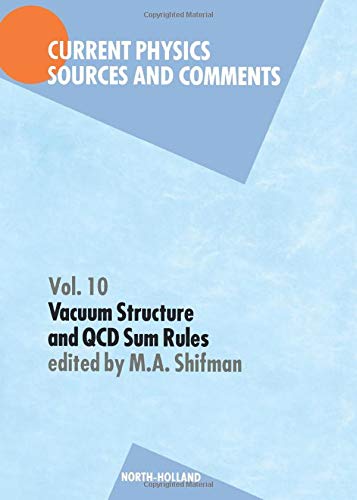
The method of the QCD sum rules was and still is one of the most productive tools in a wide range of problems associated with the hadronic phenomenology. Many heuristic ideas, computational devices, specific formulae which are useful to theorists working not only in hadronic physics, have been accumulated in this method. Some of the results and approaches which have originally been developed in connection with the QCD sum rules can be and are successfully applied in related fields, such as supersymmetric gauge theories, nontraditional schemes of quarks and leptons etc. The amount of literature on these and other more basic problems in hadronic physics has grown enormously in recent years. This volume presents a collection of papers which provide an overview of all basic elements of the sum rule approach and priority has been given to those works which seemed most useful from a pedagogical point of view.
User’s Reviews
Reviews from Amazon users which were colected at the time this book was published on the website:
⭐
⭐
Keywords
Free Download Vacuum Structure and QCD Sum Rules (Current Physics – Sources and Comments) in PDF format
Vacuum Structure and QCD Sum Rules (Current Physics – Sources and Comments) PDF Free Download
Download Vacuum Structure and QCD Sum Rules (Current Physics – Sources and Comments) 1993 PDF Free
Vacuum Structure and QCD Sum Rules (Current Physics – Sources and Comments) 1993 PDF Free Download
Download Vacuum Structure and QCD Sum Rules (Current Physics – Sources and Comments) PDF
Free Download Ebook Vacuum Structure and QCD Sum Rules (Current Physics – Sources and Comments)