

Ebook Info
- Published: 2008
- Number of pages: 736 pages
- Format: PDF
- File Size: 5.46 MB
- Authors: Balakumar Balachandran
Description
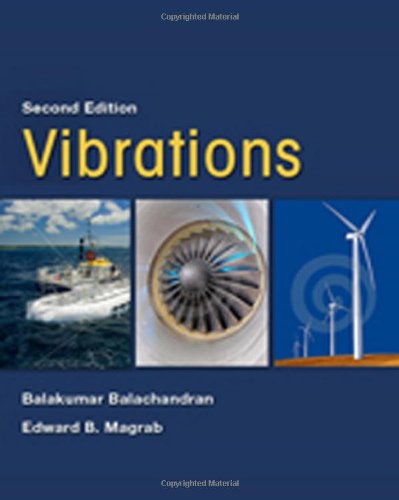
Featuring outstanding coverage of linear and non-linear single degree-of-freedom and multi-degree-of-freedom systems, this book teaches the use of vibration principles in a broad spectrum of applications. In this introduction for undergraduate students, authors Balakumar Balachandran and Edward B. Magrab present vibration principles in a general context and illustrate the use of these principles through carefully chosen examples from different disciplines. Their balanced approach integrates principles of linear and nonlinear vibrations with modeling, analysis, prediction, and measurement so that physical understanding of the vibratory phenomena and their relevance for engineering design can be emphasized. The authors also provide design guidelines that are applicable to a wide range of vibratory systems. MATLAB is thoroughly integrated throughout the text.
User’s Reviews
Editorial Reviews: Review This is a solid text as a first course in Mechanical Vibrations and a good follow on from a first course in Applied Mechanics.The text provides excellent example problems and an excellent collection of end-of chapter problems.The chapter introduction and summaries are excellent for motivating and recapping the material. Overall, I think the text is very sound.This is an excellent text. In my opinion its real strength is that it introduces nonlinear dynamics at an early stage as a natural concept. Too many texts focus just on the linear dynamics, and treat nonlinearity as some anomalous behavior to be considered at the end of the text. Here, the authors give the subject the treatment it deserves and in a non-intimidating manner. About the Author Dr. Balachandran received his B. Tech (Naval Architecture) from the Indian Institute of Technology, Madras, India, M.S. (Aerospace Engineering) from Virginia Tech, Blacksburg, VA and Ph.D. (Engineering Mechanics) from Virginia Tech. Currently, he is a Professor of Mechanical Engineering at the University of Maryland, where has been since 1993. His research interests include nonlinear phenomena, dynamics and vibrations, and control, and his recent efforts have focused on taking advantage of nonlinear phenomena for the benefit of a system. The publications that he has authored/co-authored include over fifty journal publications and several textbooks. He serves on the editorial board of the Journal of Vibration and Control, is a Deputy Editor of the AIAA Journal, and is an Associate Editor of the ASME Journal of Computational and Nonlinear Dynamics. He is a Fellow of ASME, an Associate Fellow of AIAA, and a member of AAM, ASA, Sigma Xi, and SPIE. He served as the Chair of the ASME Applied Mechanics Division Technical Committee on Dynamics and Control of Structures and Systems from 2005 to 2007, and he currently serves as the Chair of the ASME Design Engineering Division Technical Committee on Multi-Body Systems and Nonlinear Dynamics.Dr. Magrab is a Professor of Mechanical Engineering at the University of Maryland, College Park, MD. He has conducted extensive research in the areas of vibrations and acoustics, and recently, his research efforts have focused on the integration of design and manufacturing. He joined the Department of Mechanical Engineering after spending more than twelve years at the National Institute of Standards and Technology (NIST), Gaithersburg, MD, where he held several supervisory positions including Chief of the Sound Section. Prior to going to NIST, he was a Professor of Mechanics at the Catholic University of America, Washington, D. C. He has authored numerous journal publications and six books on subjects including vibrations, noise control, dynamic measurements, integrated design, and MATLAB. Sijthoff and Noordhoff published his graduate level textbook VIBRATIONS OF ELASTIC STRUCTURAL MEMBERS in 1979. Dr. Magrab is a fellow of ASME and a registered Professional Engineer in the State of Maryland.
Reviews from Amazon users which were colected at the time this book was published on the website:
⭐Not very helpful and very confusing, one of the worst textbooks I’ve ever had to buy.
⭐I have been using this books for teaching mechatronic engineers and I find in it quite a lot of very interesting material to be used in control engineering and mechanical analogs of vibrating systems. Of particular interest are all the examples pushing the learning process towards modelling and simulations, from quite the very beginning, creating in the mind of the student a positive actitude in creating a suitable model as a first step for a more complex system analysis. It is not a perfect book but quite handy in many aspects.
⭐The book is a general usage tool book for vibrations studying and as reference. It covers more than just linear but also focus parts of nonlinear-vibrations. Some might thought it is not necessary to mention about the nonlinear part but which make it broad and complete. For the first time reader, somehow it is hard to cover and understand all the contains inside. I read this book couple times, some times for work such as isolator design and some for the example-searching. This book helps, at least in my case. I would recommend the book for vibration-interested or patient reader, because it is not easy to know the whole at once.
⭐
⭐
Keywords
Free Download Vibrations 2nd Edition in PDF format
Vibrations 2nd Edition PDF Free Download
Download Vibrations 2nd Edition 2008 PDF Free
Vibrations 2nd Edition 2008 PDF Free Download
Download Vibrations 2nd Edition PDF
Free Download Ebook Vibrations 2nd Edition