Ebook Info
- Published: 1987
- Number of pages: 200 pages
- Format: PDF
- File Size: 35.94 MB
- Authors: W. Sidney Allen
Description
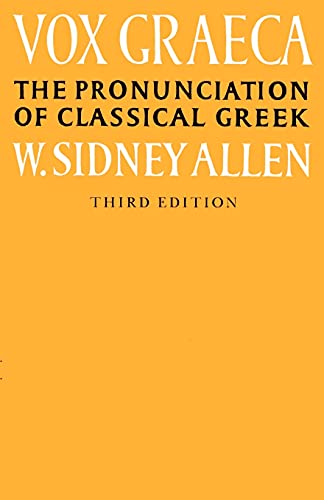
This edition of Professor Allen’s highly successful book is on the pronunciation of Attic Greek in classical times. In this third edition, Allen has revised the section on stress in classical Greek, the chapter on quantity has been recast, and the author has added an appendix on the names and letters of the Greek alphabet, to provide a parallel and historical background to the similar appendix in the second edition of his Vox Latina. The total amount of revision since the first edition has made it necessary to reset the whole book, so in addition to the new material, the supplementary notes of the second edition are now incorporated into the main text making this book much more convenient to use.
User’s Reviews
Editorial Reviews: Review A significant addition to this revised edition is an appendix on the Greek alphabet, designed to provide a parallel and historical background to a similar appendix in the previous edition. — Book Description Book Description A new and enlarged edition of Professor Allen’s successful book on the pronunciation of Attic Greek in classical times.
Reviews from Amazon users which were colected at the time this book was published on the website:
⭐A great book for the reconstructed pronunciation for attic Greek.
⭐VOX GRAECA is W. Sidney Allen’s systematic reconstruction of the facts of Attic Greek pronunciation from a wide variety of ancient sources. It begins with a short explanation of common phonetic terms and then analyses first consonants, then vowels, then the Classical Greek tonal accent system. A series of appendices discusses the pronunciation of Greek in England as it was up to Allen’s day, and this is still remarkably pertinent to contemporary instruction of pronunciation in the United States.It must be repeated that VOX GRAECA is not a defence of the Erasmian pronunciation as some, mostly followers of the Modern Greek pronunciation who have never even read the work, have charged. It defends no pre-existing system. Rather, it is a reconstruction from the ground up like nothing before and proposes a system which (sadly) is not often found in academia. In Appendix B, “Selected Quotations”, Allen lists numerous statements on pronunciation by ancient writers, and one can see the care by which he extracted a convincing and etymologically sound system from these works.While VOX GRAECA is unparalled for its reliability, there are a few negative aspects. The first is that Allen makes a variance from IPA for no good reason, in for example using [y] instead of [j] for the palatal semivowel. And though IPA (with Allen’s idiosyncracies) is used through most of the book, the quick-reference “Summary of Recommended Pronunciations” at the end gives examples with analogies to undependable Received Pronunciation English, French or German sounds (“o as German ‘Gott'”, “omega as English ‘saw'”). Another aspect of the book that limits its usefulness is that Allen’s coverage of changes is limited to only the classical period. He notes that many sounds have changed between Attic or Koine and Modern Greek, but as long as the change was after classical times, he sees no need to tell an exact timeframe for it.VOX GRAECA, whatever its faults, is still the work of reference for Attic Greek pronunciation, and is a must-have for classicists and historical linguists. One hopes that a new, improved edition might be published someday, but in the meantime I highly recommend picking this up.
⭐This book is about greek phonology, not “THE” Greek phonology, as this never existed, but about different phonologic systems that existed between archaic period and Roman (even Byzantine) times, focusing in what we call “classic Greek”, that’s to say, Attic Greek around V century B.C. The reconstruction is based in proofs such as: modern greek pronunciation, Roman transcription in Latin alphabet, Indian inscriptions of Greek names, etc.This is not, as some defenders of modern Greek pronunciation claim, an apology of “Erasmian pronunciation” (a term even incorrect aplied to scholar pronunciation), but a reconstruction of old Greek phonologic system, considering the many variations throughout the mediterranean world, because we know that Greek has changed, and modern pronunciation is anachronic for V century B.C. (but some people dare to defend it maybe for chauvisnit, nationalist rather that scientific motivations).
⭐The previous reviewer’s “not bad for a book” would only serve to humilate him, were he in the company of academics. This isn’t a book designed to teach someone how to recite Greek in school. It’s a book on Ancient Greek phonology. If you are studying Greek, your textbook and instructor will tell you enough to sound it out. This book is for people interested in deeper, historical issues, not restricted to scholars, but not terribly useful for anyone who doesn’t already deal with a fair amount of Ancient Greek. It also happens to be a respected source of information that has seen several editions.
⭐This short book is fascinating reading, though I am neither a classicist nor a philologist. It gives helpful instructions on Attic pronunciation. The detailed information about the evolution of language in the Greek world was helpful to me as it nicely illustrates some of the subtleties of pronunciation. Well worth the money.
⭐If you want to learn about the pronunciation of classical greek this is the book for you.
⭐Not bad for a book, but not the way to learn this. Try “The Pronounciation and Reading of Ancient Greek: A Practical Guide.” by Stephen G. Ditz of City College of New York. His “A Recital of Ancient Greek Poetry” is an excellent sampling. Books and cassettes.
⭐Like the same author’s
⭐Vox Latina: A Guide to the Pronunciation of Classical Latin
⭐this is a work of great scholarship. As in that other work, many of the linguistic prerequisites are explained, but unlike the former it is not quite so thorough in that aspect. After the chapters on pronunciation per se, those on quantity, accent and stress are somewhat less transparent to those like me whose knowledge of ancient Greek is still at a relatively early stage, and are probably only fully penetrable to those already possessing considerable learning and familiarity with poetic forms for example.Although a book on classical Greek, it does give some peripheral consideration of changes in pronunciation before and after the classical period, though is not always definite about precisely when these may have happened. Horrocks’
⭐Greek: A History of the Language and Its Speakers
⭐seemed more certain about the chronology of changes without supplying supporting evidence.After consideration of evidence, the author often gives pronunciation recommendations in emphasised paragraphs. On the question of accent and ancient Greek’s status as a tonal language, he dismisses all attempts by others to recreate the melodic structure and recommends that modern speakers do not attempt to speak it as a tone language, though I wasn’t entirely clear about what kind of stress pattern he is advocating instead.There is an interesting appendix on the historical pronunciation of classical Greek in Western Europe from the 15th century, at first pronounced like the Byzantine Greek of the time, only later as a result of scholarship something like the original pronunciations being recovered, and pronunciation in England which it seems suffered somewhat from the Great Vowel Shift in the English language occurring after study of the language was introduced.In summary, there is much of value in here even to the less experienced student, but everything taken as a whole will only be accessible to those with rather more expertise in the language.
⭐Ce livre est beaucoup plus qu’un simple manuel de prononciation restituée du grec ancien. Il décrit les différents arguments utilisés pour reconstruire la prononciation de chaque phonème. Les différentes incertitudes inhérentes à une telle reconstruction ne sont pas éludées.Même si l’ouvrage est centré sur l’Attique de l’époque classique, l’évolution phonétique jusqu’à la fin de l’antiquité est abondamment décrite, et on trouve aussi quelques indications plus éparses sur les variations dialectales.
⭐
Keywords
Free Download Vox Graeca: The Pronunciation of Classical Greek 3rd Edition in PDF format
Vox Graeca: The Pronunciation of Classical Greek 3rd Edition PDF Free Download
Download Vox Graeca: The Pronunciation of Classical Greek 3rd Edition 1987 PDF Free
Vox Graeca: The Pronunciation of Classical Greek 3rd Edition 1987 PDF Free Download
Download Vox Graeca: The Pronunciation of Classical Greek 3rd Edition PDF
Free Download Ebook Vox Graeca: The Pronunciation of Classical Greek 3rd Edition