

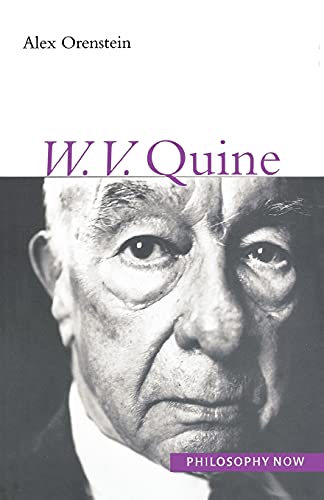
Ebook Info
- Published: 2002
- Number of pages: 224 pages
- Format: PDF
- File Size: 1.30 MB
- Authors: Alex Orenstein
Description
The most influential philosopher in the analytic tradition of his time, Willard Van Orman Quine (1908-2000) changed the way we think about language and its relation to the world. His rejection of the analytic/synthetic distinction, his scepticism about modal logic and essentialism, his celebrated theme of the indeterminacy of translation, and his advocacy of naturalism have challenged key assumptions of the prevailing orthodoxy and helped shape the development of much of recent philosophy. This introduction to Quine’s philosophical ideas provides philosophers, students, and generalists with an authoritative analysis of Quine’s lasting contributions to philosophy. The major themes covered include the adaptation of the language of modern logic to formulate a criterion of ontological commitment; Quine’s own ontological commitments; Duhemian-Holistic empiricism and the attendant rejection of a priori knowledge; the nature and grounds of logical truth; Quine’s criticisms of such notions as meaning, synonymy, analyticity, and necessity; the conjecture of the indeterminacy of translation; modal logic; propositional attitudes; and Quine’s work on naturalized epistemology. Quine’s ideas throughout are contrasted with more traditional views, as well as with contemporaries such as Frege, Russell, Carnap, Davidson, Field, Kripke, and Chomsky, enabling the reader to grasp a clear sense of the place of Quine’s views in twentieth-century philosophy and the important criticisms of them.
User’s Reviews
Editorial Reviews: Review “Orenstein’s thorough knowledge both of Quine and of philosophical logic put him in an ideal position to explain and discuss Quine’s seminal contributions. He does it with clarity and accuracy, and to his illuminating exposition he adds perceptive comment and incisive criticism. This is an outstanding account of Quine’s thought, and will be invaluable to anyone seeking a really good, accessible and insightful introduction to it.”–A. C. Grayling, Birkbeck College, University of London”This is a useful and sympathetic introductory account of the main philosophical views of the late W.V.O. Quine. Its straightforward account of what Quine says and why he says it will be useful to students and others wishing to understand Quine’s views.”–Gilbert Harman, Princeton University”This presentation of Quine’s philosophy is not only a good textbook but also a contribution to Quine scholarship. Written at a level suitable for philosophy majors and beginning graduate students as well as interested laymen, the book is well organized, precise, easy to follow, and includes good examples.”–Dagfinn Føllesdal, Stanford University and Oslo University Review “Orenstein’s thorough knowledge both of Quine and of philosophical logic put him in an ideal position to explain and discuss Quine’s seminal contributions. He does it with clarity and accuracy, and to his illuminating exposition he adds perceptive comment and incisive criticism. This is an outstanding account of Quine’s thought, and will be invaluable to anyone seeking a really good, accessible and insightful introduction to it.”―A. C. Grayling, Birkbeck College, University of London”This presentation of Quine’s philosophy is not only a good textbook but also a contribution to Quine scholarship. Written at a level suitable for philosophy majors and beginning graduate students as well as interested laymen, the book is well organized, precise, easy to follow, and includes good examples.”―Dagfinn Føllesdal, Stanford University and Oslo University”This is a useful and sympathetic introductory account of the main philosophical views of the late W.V.O. Quine. Its straightforward account of what Quine says and why he says it will be useful to students and others wishing to understand Quine’s views.”―Gilbert Harman, Princeton University From the Back Cover “Orenstein’s thorough knowledge both of Quine and of philosophical logic put him in an ideal position to explain and discuss Quine’s seminal contributions. He does it with clarity and accuracy, and to his illuminating exposition he adds perceptive comment and incisive criticism. This is an outstanding account of Quine’s thought, and will be invaluable to anyone seeking a really good, accessible and insightful introduction to it.”–A. C. Grayling, Birkbeck College, University of London”This presentation of Quine’s philosophy is not only a good textbook but also a contribution to Quine scholarship. Written at a level suitable for philosophy majors and beginning graduate students as well as interested laymen, the book is well organized, precise, easy to follow, and includes good examples.”–Dagfinn Føllesdal, Stanford University and Oslo University”This is a useful and sympathetic introductory account of the main philosophical views of the late W.V.O. Quine. Its straightforward account of what Quine says and why he says it will be useful to students and others wishing to understand Quine’s views.”–Gilbert Harman, Princeton University About the Author Alex Orenstein is Professor of Philosophy at Queens College and the Graduate Center, City University of New York. His most recent work is Knowledge, Language, and Logic: Questions for Quine (coedited with P. Kotatko). Read more
Reviews from Amazon users which were colected at the time this book was published on the website:
⭐This book is well-written, but I find many of the commitments to a physicalist worldview quite deplorable. Quine seems to me, from reading this book, to have been even more devoted to skepticism about mind and anything that would depart from the strictly scientific worldview than was Bertrand Russell. Although the logical approach to philosophy is personally highly appealing, reducing language, psychology, and human experience to strictly physical properties of an ostensibly physical world seems, to me, terribly wrong-headed.Orenstein did a fine job of discussing Quine’s work, but it is precisely Quine’s philosophy and efforts to support it that cause a reader such as myself to feel significantly negative toward a book that propounds a worldview that repudiates, mind, will, intention, purpose, and other properties of the psyche. But for readers who are prepared to endorse a materialist stance on the nature of reality, this book is a good place to find support for such an outlook.As is always the case in philosophy, physicalism cannot be proven wrong, but then neither can idealism be demonstrated to miss the mark. Many times, our personal predilections will color our philosophical outlook, and will also lead us to search for evidence that our perspective can be objectively validated. Philosophy is a personal and subjective undertaking, and those who would seek to prove their philosophical perspectives to be objectively valid betray an effort to do in philosophy what cannot be done.
⭐This well written book is a useful introduction to the thought of the important American philosopher WVO Quine. I think the intended audience is advanced undergraduates and graduate students first encountering Quine. This book can be read profitably by laymen interested in philosophy (like me) but some prior background in formal logic and modern analytic philosophy is helpful. Orenstein addresses the major themes of Quine’s work in a series of well organized chapters. Each chapter contains some background information to provide larger context, discussion of Quine’s positions, and criticisms of Quine. Orenstein is a good writer and appears to be very knowledgeable about the major issues. The quality of explanations is excellent, though sometimes quite technical. I think that Orenstein has adopted a partially chronologic approach, as some themes cut across chapters, which can reduce clarity of individual sections. In some sections, Orenstein would have done well to provide better explanations of some terminology such as intensional and extensional, or modal logic.Orenstein develops a number of themes of Quine’s work very well. It appears that in common with a number of other analytic philosophers, Quine was very impressed with the success of the natural sciences and pursued a rigorous, somewhat naturalistic approach to important philosophical questions. Quine’s persistent interest in ontology was not a metaphysical approach but a commitment to a rigorous description of how ontologic commitments are expressed in logic and language. Orenstein describes very well some of the ways in which Quine departed from important aspects of prior traditions, including his attack on the analytic-synthetic distinction and his disposal of the a priori. These are shown to result from his commitment to a holistic view of knowledge. Finally, Quine’s view of epistemology as a branch of psychology is consistent with his broad view of philosophy as continuous with science, mathematics, and logic.This is a useful book with a good bibliography. Probably read most profitably in conjunction with Quine’s work.
⭐This book not only gives an overview of Quine’s work but places it nicely into the context of what was going on in mathematical logic. This neatly tucks Quine’s work into its place and importance in that place. The descriptions of the various problems and their solutions is beautifully clear. I found myself reading a section to my introductory logic class to help explain some of the issues regarding quantification and meaning and how these issues led to much clarification of normally very ambiguous everyday speech.
Keywords
Free Download W. V. Quine (Philosophy Now) 1st Edition in PDF format
W. V. Quine (Philosophy Now) 1st Edition PDF Free Download
Download W. V. Quine (Philosophy Now) 1st Edition 2002 PDF Free
W. V. Quine (Philosophy Now) 1st Edition 2002 PDF Free Download
Download W. V. Quine (Philosophy Now) 1st Edition PDF
Free Download Ebook W. V. Quine (Philosophy Now) 1st Edition