Ebook Info
- Published: 2015
- Number of pages: 70 pages
- Format: PDF
- File Size: 26.49 MB
- Authors: Karl Marx
Description
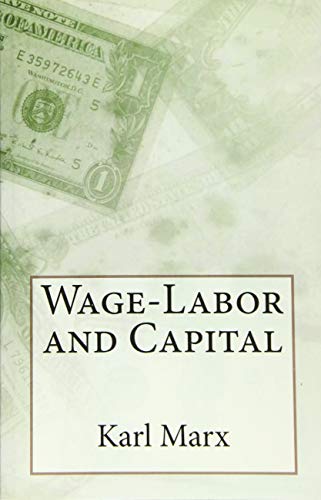
Wage Labour and Capital is an essay on economics by Karl Marx, written in 1847 and first published in articles in the Neue Rheinische Zeitung in April 1849. This book has been widely acclaimed as the precursor to Marx’s important treatise Das Kapital. The ideas that are expressed in the book have a very thorough economic contemplation about them as he put aside some of his materialist conceptions of history for the time being. This book did, however, start to show an increased scientific rationale on his ideas of “alienated labor,” which in Marx’s perspective would eventually lead to the proletarian revolution. Wage-Labor and Capital is considered by Marxists as an “in-depth economic and scientific observation on how capitalist economy works, why it was exploitative, and ultimately why it would eventually implode from within”. Some of the main topics that the book examines are about labour power and labour, and how labour power becomes a commodity. It also presents the Labour Theory of Value that further develops the distinct differences between labour and labour power. The book also examines the commodity and how the economic principles of supply and demand affect the pricing of certain commodities. Beyond that the book explores how capital and capitalism do not service any purpose other than to gain more of it, which Marx presents as an illogical method of living one’s life. Karl Marx (5 May 1818 – 14 March 1883) was a German philosopher, economist, sociologist, journalist, and revolutionary socialist. Marx’s work in economics laid the basis for much of the current understanding of labour and its relation to capital, and subsequent economic thought. He is one of the founders of sociology and social science. He published numerous books during his lifetime, the most notable being The Communist Manifesto (1848) and Das Kapital (1867–1894). Born into a wealthy middle-class family in Trier in the Prussian Rhineland, Marx studied at the Universities of Bonn and Berlin where he became interested in the philosophical ideas of the Young Hegelians. After his studies he wrote for a radical newspaper in Cologne and began to work out the theory of the materialist conception of history. He moved to Paris in 1843, where he began writing for other radical newspapers and met Friedrich Engels, who would become his lifelong friend and collaborator. In 1849 he was exiled and moved to London together with his wife and children, where he continued writing and formulating his theories about social and economic activity. He also campaigned for socialism and became a significant figure in the International Workingmen’s Association. Marx’s theories about society, economics and politics – the collective understanding of which is known as Marxism – hold that human societies progress through class struggle: a conflict between an ownership class that controls production and a dispossessed labouring class that provides the labour for production. States, Marx believed, were run on behalf of the ruling class and in their interest while representing it as the common interest of all; and he predicted that, like previous socioeconomic systems, capitalism produced internal tensions which would lead to its self-destruction and replacement by a new system: socialism. He argued that class antagonisms under capitalism between the bourgeoisie and proletariat would eventuate in the working class’ conquest of political power and eventually establish a classless society, communism, a society governed by a free association of producers. Marx actively fought for its implementation, arguing that the working class should carry out organised revolutionary action to topple capitalism and bring about socio-economic change. Marx has been described as one of the most influential figures in human history. Many intellectuals, labour unions and political parties worldwide have been influenced by Marx’s ideas, with many variations on his groundwork.
User’s Reviews
Reviews from Amazon users which were colected at the time this book was published on the website:
⭐This is a good book for anyone studying Marx to read, but only 4 stars because whoever made this version should have run the spell check function before finalizing.
⭐there’s zero reason not to read this and it’s a good lead in to Capital.
⭐Written 12 years before Capital, here is the heart and soul of Capital. The edition I read has a fantastic introduction (and some minor updates) by Engels. Read it. It is completely accessible, modern and totally relevant to today’s economy.
⭐Very cheap scan, pay some more and get a decent copy
⭐The formatting is terrible – this is a really bad scan of the book. Pay a little more and get a properly edited and formatted version.
⭐Was disappointed at first with how slim it was until I realised the text is quite small and pushed right to the edge of the page (“printed by Amazon”, if that’s why). Arrived quickly and in perfect condition. Satisfied.
Keywords
Free Download Wage-Labor and Capital in PDF format
Wage-Labor and Capital PDF Free Download
Download Wage-Labor and Capital 2015 PDF Free
Wage-Labor and Capital 2015 PDF Free Download
Download Wage-Labor and Capital PDF
Free Download Ebook Wage-Labor and Capital