

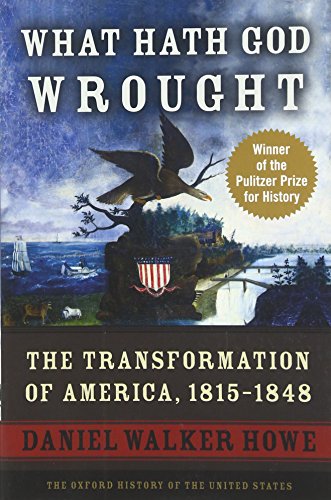
Ebook Info
- Published: 2009
- Number of pages: 928 pages
- Format: PDF
- File Size: 10.80 MB
- Authors: Daniel Walker Howe
Description
The Oxford History of the United States is by far the most respected multi-volume history of our nation. In this Pulitzer prize-winning, critically acclaimed addition to the series, historian Daniel Walker Howe illuminates the period from the battle of New Orleans to the end of the Mexican-American War, an era when the United States expanded to the Pacific and won control over the richest part of the North American continent. A panoramic narrative, What Hath God Wrought portrays revolutionary improvements in transportation and communications that accelerated the extension of the American empire. Railroads, canals, newspapers, and the telegraph dramatically lowered travel times and spurred the spread of information. These innovations prompted the emergence of mass political parties and stimulated America’s economic development from an overwhelmingly rural country to a diversified economy in which commerce and industry took their place alongside agriculture. In his story, the author weaves together political and military events with social, economic, and cultural history. Howe examines the rise of Andrew Jackson and his Democratic party, but contends that John Quincy Adams and other Whigs–advocates of public education and economic integration, defenders of the rights of Indians, women, and African-Americans–were the true prophets of America’s future. In addition, Howe reveals the power of religion to shapemany aspects of American life during this period, including slavery and antislavery, women’s rights and other reform movements, politics, education, and literature. Howe’s story of American expansion culminates in the bitterly controversial but brilliantly executed war waged against Mexico to gain California and Texas for the United States. Winner of the New-York Historical Society American History Book Prize Finalist, 2007 National Book Critics Circle Award for NonfictionThe Oxford History of the United StatesThe Oxford History of the United States is the most respected multi-volume history of our nation. The series includes three Pulitzer Prize winners, a New York Times bestseller, and winners of the Bancroft and Parkman Prizes. The Atlantic Monthly has praised it as “the most distinguished series in American historical scholarship,” a series that “synthesizes a generation’s worth of historical inquiry and knowledge into one literally state-of-the-art book.” Conceived under the general editorship of C. Vann Woodward and Richard Hofstadter, and now under the editorship of David M. Kennedy, this renowned series blends social, political, economic, cultural, diplomatic, and military history into coherent and vividly written narrative.
User’s Reviews
Editorial Reviews: Review “What Daniel Walker Howe hath wrought is a wonderfully mind-opening interpretation of America on the cusp of modernity and might.”–George F. Will, National Review Online”What Hath God Wrought is the dazzling culmination of the author’s lifetime of distinguished scholarship…. The sustained quality of Howe’s prose makes it even harder to put down a volume whose sheer weight makes it hard to pick up…. What Hath God Wrought lays powerful claim to being the best work ever written on this period of the American past.”–Richard Carwardine, The Journal of Southern History”Howe knows his era as well as any historian living, and he generously instructs his readers with detailed expertise and crisp generalizations.”–John Lauritz Larson, The Journal of American History”What Hath God Wrought is a feat worth applauding no matter what omissions will occur to every specialist in any facet of early national America.”–Scott E. Casper, Reviews in American History”Howe is a skillful storyteller who knows how to choose relevant anecdotes and revealing quotations. Both general readers and professional historians can benefit from the book. It can be read with pleasure from cover to cover.”–Thomas Tandy Lewis, Magill’s Literary Annual”One of the best lessons offered by Howe’s book comes in his refusal to view the period of 1815 to 1848 in anything other than its own terms. He never reduces the early part of the book to an analysis of how developments succeeded or failed the hopes of the ‘founders.’ Nor does he ever treat political and social developments as though they launched the United States on a high road to the Civil War…. Precisely because of this clear-eyed vision of the antebellum period, Civil War historians will want to take a fresh look back at howe’s picture of the United States in a constant state of change.”–Sarah J. Purcell, Civil War Book Review”I like to have a heavy tome to calm me down at the end of the day. This is almost as big as a pathology book, but really well written.”–Robin Cook”A comprehensive, richly detailed, and elegantly written account of the republic between the War of 1812 and the American victory in Mexico a generation later…a masterpiece.”–The Atlantic”How’s Pulitzer Prize-winning addition to the mulitvolume Oxford History of the United States is excellent in many ways, not least in the full attention it gives to the religious dynamics of American history in this period…. a very satisfying read.”–The Christian Century”Exemplary addition to the Oxford History of the United States… He is a genuine rarity…extraordinary.”–Washington Post Book World”One of the most outstanding syntheses of U.S. history published this decade.”–Publishers Weekley starred review”What Hath God Wrought is both a capacious narrative of a tumultuous era in American history and a heroic attempt at synthesizing a century and a half of historical writing about Jacksonian democracy, antebellum reform, and American expansion.”–The New Yorker”This extraordinary contribution to the Oxford History of the United States series is a great accomplishment by one of the United States’ most distinguished historians…. It is, in short, everything a work of historical scholarship should be.”–Foreign Affairs”The book is a sweeping and monumental achievement that no student of American history should let go unread. Attentive to historiography yet writing accessible and engaging prose, Howe has produced the perfect introduction or reintroduction to an enormously important period in American national development.”–American Heritage”The best book on Jackson today.”–Gordon Wood, Salt Lake Deseret Morning News “Howe’s book is the most comprehensive and persuasive modern account of America in what we might prefer hereafter to call the Age of Clay. It should be the standard work on the subject for many years to come.”–American Nineteenth Century History”Comprehensive and detailed… an excellent narrative history.”–The California Territorial Quarterly”There is simply too much of value in Howe’s book to be even listed in the longest of reviews. The serious student of American history will want to read this book…This is a book worthy of a master of American history.” –History News Network About the Author Daniel Walker Howe is Rhodes Professor of American History Emeritus, Oxford University and Professor of History Emeritus, University of California, Los Angeles. He is the author of The Political Culture of the American Whigs and Making the American Self: Jonathan Edwards to Abraham Lincoln. He lives in Los Angeles.
Reviews from Amazon users which were colected at the time this book was published on the website:
⭐“Our country! In her intercourse with foreign nations may she always be in the right, but our country, right or wrong.” -Commodore Decatur, 1815 after defeat of the Barbary Corsairs“Beware how you give a fatal sanction in our republic to military insubordination. Greece had her Alexander, Rome her Caesar, England her Cromwell, France her Bonaparte and if we would escape the rock they split we must avoid their errors.” – Henry Clay, 1819 in a Congressional debate after Andrew Jackson attacked Spanish forts in Florida against Executive orders“This question, like a fire bell in the night, awakened and filled me with terror. I considered it at once as the knell of the Union. It is hushed for the moment but this is a reprieve only, not a final sentence…my only consolation is that I will live not to weep over it.“ – Thomas Jefferson, 1820 in support of the compromise extending slavery to Missouri to save the Union“Do they think that I am such a damned fool as to think myself fit for President of the United States? No sir, I know what I am fit for. I can command a body of men in a rough way, but I am not fit to be President.” – Andrew Jackson, 1821“The occasion has been judged proper for asserting, as a principle in which the rights and interests of the United States are involved, that the American continents, by the free and independent condition which they have assumed and maintain, are henceforth not to be considered as the subjects for future colonization by any European powers.” James Monroe 1823************Daniel Walker Howe begins this Pulitzer Prize winning history on New Years Day in 1815 with Andrew Jackson leading US troops to victory over the British, unaware that the war was over and a treaty signed. His theme is that a communications and transportation revolution occurred leading up to the Mexican-American war, most significantly in the telegraph, railroad and steamboat. By 1848 the US had reached the Pacific after the conquest of Texas, New Mexico and California. Along the way Native American populations declined drastically, mostly from imported European and African diseases, but also from the assimilation or removal policies of Jackson and Jefferson before him. The conditions made land abundantly available.Americans – Thomas Jefferson 1801-09The Americans who farmed were plantation owners in the south but individual farming families in the expanding west. The lure of land motivated many who came to escape lives as tenant farmers in Europe, and new customs and thinking evolved. The typical landowner produced crops for personal use as well as for trade, and egalitarian ideas of Locke and Jefferson circulated. Large families were the norm, with the work divided between offspring. Free of social classes, their main adversary was nature: drought, pestilence and disease. For this the predominantly Protestant people turned to faith in God. In the second decade of the 1800’s religious revivals swept the country espousing a stern morality and focus on study of the Bible.British – James Madison 1809-17With the War of 1812 underway the typical tensions between Republican slave owners in the south and Federalist business owners in the north continued. When the British routed the American militia and burned down Washington government buildings Federalists met in Connecticut to debate whether to secede from the Union and make a separate peace. Jackson became celebrated for defeating the British at New Orleans. News of the peace reached the government after news of his triumph and it was assumed he had won the war. Ships at sea were still at war six months after it ended in places as far flung as Java. It was agreed to cease fighting but resolved none of the issues: sea trade, sailor impressment and the boundaries with Canada.Native Americans – James Madison 1809-17With peace came prosperity. Napoleon defeated, trade with Europe resumed. Native Americans could no longer play off the US against the French and British. Tecumseh’s Indian Confederacy was routed in Ontario and Alabama putting an end to the native military power. Howe sees both wars as a program to establish US supremacy, not only over natives but a diverse multicultural society in the southwest. In 1815 the US sent a fleet to the Mediterranean and finished off the Barbary corsair pirates preying on American ships. President James Madison, “the Father of the Constitution”, argued to develop American industry by linking the country together with roads and canals, and setting tariffs on imported goods. Infrastructure was badly needed.Expansions – James Monroe 1817-25Madison ultimately vetoed the development bill and he was succeeded by James Monroe in 1817. The war with Britain concluded, the US turned its attention to the land east of New Orleans, then a Spanish colony known as East Florida. It was a haven for escaped slaves and Native Americans driven off their lands by settlers. In 1818 it was invaded by Jackson and the US Army during the First Seminole war. Under the pretense of an Indian reprisal, Jackson marched along the Gulf Coast and burned villages, captured Spanish forts and occupied the panhandle. Spain’s presence was so weak that it ceded all of Florida in 1821. As Secretary of State, John Quincy Adams negotiated the treaty and became the 6th President in 1825.Foreign Policies – James Monroe 1817-25In 1822 the US recognized independence of Mexico, formerly New Spain, and Gran Columbia (Columbia, Panama, Ecuador and Venezuela). Spain fought hard to retain its colonies but lost during the revolutions. In 1823 Monroe articulated what would become the Monroe Doctrine, that the US opposed ‘foreign’ interference in the Western Hemisphere, mostly written by Adams. Russia got into the game, claiming land from Alaska to Oregon, but was deterred by Monroe and Adams. Teddy Roosevelt later claimed American leadership in Latin America, backed the secession of Panama from Columbia, and began 36 years of banana wars. Eisenhower used the CIA to overthrow Guatemala, Kennedy tried in Cuba and Reagan in Nicaragua.Developments – John Quincy Adams 1825-29The Erie Canal connected the Great Lakes region to New York City in 1825, making it the fastest growing center of US business, able to rival New Orleans with its waterways to the Midwest. Cotton production and slavery migrated from the east coast to Mississippi and Alabama. Importation of slaves was illegal after 1810 but was replaced by US born African-Americans. Between 1820-1840 cotton grew from 40-60% of US exports, rising to nearly 70% of the world supply in 1850. Most cotton was sold to Britain, but by 1815 textile factories were built in Maine and Massachusetts. The Panic of 1819, from a collapse in cotton prices, was the first US depression. The Missouri Controversy over extending slavery threatened a civil war the same year.Divisions – John Quincy Adams 1825-29The Missouri Compromise set the 36th parallel as boundary to future slave states and was a precursor to the north-south conflict that would nearly end the union forty years later. Even Jefferson, against slavery in theory but a slave owner himself, sided with those who wanted to extend it. Missouri while north of the division was allowed slavery as part of the compromise. Religion was yet another point of contention. Although the Bill of Rights separated church and state in 1791 it was on a federal level. Established religion lived on until as late as 1833 in the northeastern states. As religion was disestablished it led to a revival and reform movements which argued for temperance, women suffrage and slavery abolition by traveling preachers.Indian Wars – Andrew Jackson 1829-37Adams out of office in 1829, Jackson, the ‘hero’ of the War of 1812 and Florida conquest, became 7th president. He owed his victory to the three-fifths clause, which gave slave states added electoral votes and representatives in that proportion of the enslaved population. Both a slave owner and trader, Jackson had earlier been a frontiersman and Indian fighter, in addition to a general and politician. He ratified the 1830 Indian Removal Act banishing the natives of the southeast to territories west of the Mississippi. Having run on an anti-corruption campaign he packed federal offices with cronies, purging any who didn’t support him. An authoritarian who brooked no disloyalty, he is reminiscent of a recent president who claimed to admire him.Depression – Martin Van Buren 1837-41, John Tyler 1841-45Secretary of State Martin Van Buren cast doubts in Jackson’s mind about the Vice President’s loyalty to succeed him, and later won Jackson’s endorsement to become 8th President. The Panic of 1837 from land speculation and a cotton price crash led to a bank run and depression until the mid 1840’s ruining his re-election chances. The crisis was exacerbated by Jackson’s refusal to extend the central bank’s charter. Van Buren was succeeded by John Tyler after W. H. Harrison died 31 days into his term from a flu caught at his inauguration. Another Virginia slaver, Tyler still refused to reinstate the national bank. He annexed Texas in 1845 and later sided with the secession, serving in the Confederacy.Mexican War – James K. Polk 1845-49With President Polk in office, Jacksonian Democracy once again became the political philosophy of the day. Texas was now in the Union and Manifest Destiny was back in play. Polk successfully negotiated the border between British Canada and American Oregon Territory, making the US officially reach from sea to shining sea. Polk turned his attention to Mexico where he sent army expeditions to the Rio Grande and Santa Fe, and sent the Navy to the Gulf of Mexico and Los Angeles. Repatriating Santa Anna from exile in Cuba to overthrow the Mexican government, he was promptly double crossed. Frustrated he sent the US army towards Mexico City, negotiating the purchase of California and New Mexico at the point of a gun.While this book helped fill in my personal gaps of American history and layed a foundation for future reading it wasn’t a joy to read. In some ways the issues are familiar and in other ways surprising. They still resonate in the US today: south against north, state rights against federal government. The legacy of Republicans and Federalists is not yet resolved. Half of Americans argue the primacy of state laws, the other that a national government should arbitrate disputes. After 235 years the oldest living democratic constitution still bears the contradictions and dissensions of an earlier age. Thomas Jefferson asserted the Constitution should be rewritten every twenty years or each generation, an idea that was abhorrent to its author James Madison.
⭐American HistoryFor the past few months I’ve been reading American history books focusing on two great series: Penguin and Oxford American History.When I was finished with my first brush at higher learning I had a degree in history with no real understanding of historiography. I understood, because it was one of the contentions of my few looks at philosophy, that at no point in history can we ever have perfect knowledge. And so I knew that my understanding was by no means perfect, that the history I had read would change, that the same was true of science, and, even of art and aesthetics.Art and aesthetics changed very loudly, and many people were sure that this was an indication that art and aesthetics were not true to good learning, that they did not conform to the promise, once you learn something it will remain forever true. They were wrong.One of the things about the new Oxford and Penguin series is that they are written in a way that is conscious of change in our understanding of history, and the writers know that at some point even those new revelations they have served up may be set aside due to newer revelations, but they also recognize somethings that we should be more conscious of.1. If our new understanding is extreme, it’s far more likely to be unseated in the future.2. The rules of historiography favor continuities from recent history and imperfect mixtures of the new and old. They favor a kind of floating question mark which says that most ages are far less certain than their loudest voices make them out to be.3. Complexity is NOT a problem to be overcome by the historian; complexity is the nature of history.These two series are structured on this new understanding of history. A new historiography. Where the old historiography had said that generalizations are written in stone, and the subsequent historiography, which was not very proud of itself, said that generalizations are never valid, the historiography of today says, all history is and must be suspect, but continuities exist, the accumulation of thought and study is complex, but highly valuable, and each attempt to summarize our understanding, if done well and carefully, is a signpost along the path for a new generation to pick up, correct, and move forward.It is in this conception of history that the flagship histories (Penguin and Oxford) of the American years are written. This is my fourth or fifth from the two series. I’m a little over half way through this volume. It focuses, of course, on the generally overlooked years between the War of 1812 and the Civil War. And it is good in the way these two series are always good.
⭐Great, comprehensive look at American society and politics in the Antebellum era. The importance of religion was especially striking. Even atheists and agnostics should recognise the valuable role it played in history, because Howe shows that American Protestantism inspired more progressive movements than anything else in the country. JQ Adams, Charles Finney, Elizabeth Cady Stanton, and others all shine as American luminaries.The Jacksonian Democrats can more easily be painted as villains due to their hardline anti-Native and pro-slavery policies, which Howe documents extensively. But even they enshrined principles that are now taken seen as cornerstones of American culture- acceptance of immigrants, support for democracy abroad, supporting the rugged individual over an elite. Despite being less in favour of internal improvements and infrastructure than the Federalists + Whigs, the Democrats also supported the concept of modernisation.
⭐History is over the United States frequently tend to rush through the period between the War of 1812 and the Civil War. This is perhaps not surprising, but as this excellent book shows, the period 1815 to 1848 it’s fascinating in itself. In addition, it provides a vital background to the conflagration that eventually erupted in 1861.
⭐I really wish I could give this a higher rating but in all good conscience I cannot, and here’s why…This volume of the Oxford History of the United States sits between two of the greatest books of American history ever published – Gordon S Wood’s’ Empire of Liberty’ and James McPherson’s ‘Battlecry of Freedom’ – the former one of the most masterful surveys of the early republic and the second the greatest single volume on the civil war. Howe’s book should be a beautifully constructed bridge between them, instead it is an idiosyncratic, meandering trail which goes way off course and only comes back to the point after exhausting the reader with detour and unnecessary anecdote.I have two main issues with the book: the first is the author’s bizarre attachment to one of the most inconsequential presidents in US history – John Quincey Adams – and his persistent attempts to shoehorn in Quncey’s views or words, or even those of his descendants, when they are not merely unneeded but distracting from the central narrative. The second issue is the author’s style. He follows the frustrating trend among some modern historians of attempting to impose modern value judgements and commentary rather than drawing a contemporary picture of a vanished world. In doing this he distorts the motives and impugns the policy of successive presidents and secretaries of state with whom he disagrees. He also intersperses the central narrative with diversions on cultural and social themes that he uses to pass judgement on individual characters and at times whole people.All this is a great shame because Howe is clearly a good historian, he just falls short of greatness by making the book too much about him and what he thinks about this period in American history rather than letting it and its inhabitants speak for themselves. When I’m reading a history book I don’t want to know what the historian thinks,* I want to be able to immerse myself in another world, to understand their conflicts and disagreements as they themselves understood them, not have them interpreted for me by the author through the prism of his own prejudices and views. It’s all a bit sophomoric.* – Edward Gibbon could get away with this; very few others!
⭐Another excellent book in the Oxford History of the United States series. I really can’t fault it.Sometimes reading epically large history books can become a rather onerous task but this book is beautifully written and does a such good job of moving around the various spheres of society (politics, the military, religion, women’s rights, science etc) that it never becomes boring.The author has also done a good job of giving the book a proper ending which can be tricky when writing about a period of time rather than a particular subject.Highly recommended.
⭐Doing a history degree, I made fantastic use of this book. It was informative yet captivating – I would recommend to those with an interest in American history.
Keywords
Free Download What Hath God Wrought: The Transformation of America, 1815-1848 (Oxford History of the United States) in PDF format
What Hath God Wrought: The Transformation of America, 1815-1848 (Oxford History of the United States) PDF Free Download
Download What Hath God Wrought: The Transformation of America, 1815-1848 (Oxford History of the United States) 2009 PDF Free
What Hath God Wrought: The Transformation of America, 1815-1848 (Oxford History of the United States) 2009 PDF Free Download
Download What Hath God Wrought: The Transformation of America, 1815-1848 (Oxford History of the United States) PDF
Free Download Ebook What Hath God Wrought: The Transformation of America, 1815-1848 (Oxford History of the United States)