

Ebook Info
- Published: 2011
- Number of pages: 336 pages
- Format: PDF
- File Size: 31.13 MB
- Authors: Ed Regis
Description
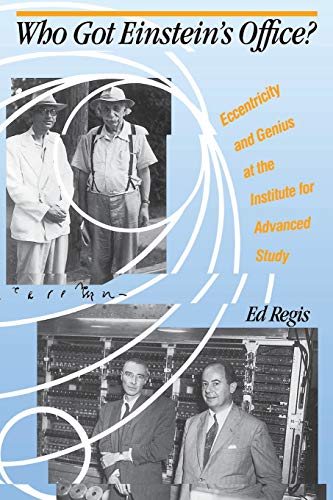
It was home to Einstein in decline, the place where Kurt Göedel starved himself in paranoid delusion, and where J. Robert Oppenheimer rode out his political persecution in the Director’s mansion. It is the Institute for Advanced Study in Princeton, New Jersey; at one time or another, home to fourteen Nobel laureates, most of the great physicists and mathematicians of the modern era, and two of the most exciting developments in twentieth-century science—cellular automata and superstrings.Who Got Einstein’s Office? tells for the first time the story of this secretive institution and of its fascinating personalities.
User’s Reviews
Editorial Reviews: From Publishers Weekly Regis “presents an absorbing, often amusing and scientifically demanding” study of the institute that housed 14 Nobel laureates et al. PW asserted that “this is a bravo biography of a fabulous home, sanctuary and study-hall for geniuses working at the extremes of thought.” Illustrated. Copyright 1988 Reed Business Information, Inc. About the Author Ed Regis, a frequent contributor to Omni magazine, is College Scholar at Western Maryland College. He is at work on a new book about extremely advanced science and technology.
Reviews from Amazon users which were colected at the time this book was published on the website:
⭐Very informative, entertaining, and well-written!
⭐William Leonard Pickard got “Who Got Einstein’s Office and he absolutely loved it he said.
⭐Very satisfactory
⭐Who Got Einstein’s Office: Eccentricity and Genius at the Princeton Institute for Advanced Study is a fascinating account of Albert Einstein’s time at the hallowed institute – and the scientists who were there with him, and a selection of those who followed him.Virtually all of the great figures of twentieth century physics and mathematics were there – for periods between one to two years – to conduct research – in fact, to do whatever they wanted. To the time of writing, the Institute of Advanced Study had employed and housed 14 Nobel Prize winners.The Institute of Advanced Study (IAS) is located in Princeton, New Jersey, USA. It was established as a separate entity to the University of Princeton (not affiliated with it at all) in 1930. When it officially opened in 1933, and Albert Einstein moved in, it became the world centre for physics. With no students, no teachers, no classes, no laboratories, no machines, and no equipment – established for researchers to pursue pure theory – it became known as “an intellectual hotel.”Albert Einstein, a German-born theoretical physicist, was already famous when he moved to Princeton at the age of 54 with his wife Elsa. He had already published his special theory in 1905, his general theory of relativity in 1915, and received the Nobel Prize for Physics in 1921 at 42 years of age. So was Einstein merely appointed as “a figurehead, a living icon, a patron saint” of the AIS? Or did he actually achieve something of note?Basically, light was Einstein’s specialty – light waves, to be specific. And his office caught the afternoon light through large bay windows. Best friends Einstein and Kurt Godel, an Austrian-born mathematician and logician who escaped the Third Reich in January 1940, remained in the town of Princeton until their deaths: Einstein for 22 years until his death in 1955, and Godel for 36 years until his death in 1978. And yes, someone did move into Einstein’s office, room number 115.Regis documents the lives of some famous IAS residents: John Milnor and his work on transcendental numbers; “Good time Johnny” Neumann, the “human adding machine” who planned to build his own computer in 1946; J. Robert Oppenheimer, the “father of the atom bomb” during his directorship of the institute from 1946 to 1966; Freeman Dyson, the particle physicist, astrophysicist, theoretical mathematician and space travel dreamer; Paul Dirac, the reclusive English theoretical physicist; Stephen Wolfram in the 1980s who left in 1986 to run his own institute, the Centre for Complex Systems Research at the University of Illinois; and Ed Witten who prepared for a life time’s work on the subject of superstring theory.Each of the scientists had their own uniquely absorbing tales. For example, John Neumann was granted $100,000 in 1946 to build his own computer. A year later his prototype was “fully automatic, digital, and all purpose” – and it worked. Other mathematicians at the AIS said that “there was never anything that we needed a lot of computing for” and viewed it merely as “the new electronic brain.” It is now on public display at the Smithsonian Institution.The AIS was a man’s world. There is nothing in the Regis book on female scientists at the AIS, with the exception of Margaret Geller who provided a guest lecture on astrophysics in 1984 “fully armed … with slides, view-graphs, even a movie.” When Stephen Wolfram, the cellular automata and complex systems researcher, was asked whether he had a girlfriend, he answered, “Oh yes, if you’re interested in complex systems, there’s nothing more complex than that.”The AIS was, in the end, a place of both success and failure for the Platonist Albert Einstein. “He wanted to get beyond the disorder of quantum mechanics and find a more stable reality beneath the observed phenomena, and here he was partially successful: the EPR (Einstein-Podolsky-Rosen) paradox has a life of its own today. He wanted to unify gravity and electromagnetism, and he certainly failed at that. And he wanted to install a world government upon earth that would ensure world peace, and he failed at that, too.”And so, in the epilogue, Regis questions the AIS, once called the “One True Platonic Heaven,” and its value on current scientific research. The “fall from glory” has been characterized as “a mediocre spiral” in which the current stock of scientists would rather seek money and fame than undertake research, while others would rather work “in a real job” at a university. Regis added that “for a theorist … better to have a beautiful theory than to be twiddling your thumbs down in some salt mine waiting for a light to go on … for the eye of the theorist is ever on the Forms – the mathematical realities – whether they be at the bottom of matter, or at the edge of the universe.”Who Got Einstein’s Office? is a work of literary art; fascinating, interesting, and absorbing. Ed Regis has written a great book! Theoretically speaking!
⭐I recommend Ed Regis’ book for anyone who wants a tune-up on the trajectory of mid-twentieth century science – physics in particular. There may be negatives in telling so much of the personal history of the people but I was left with the feeling that it is great that there was and is such a place as the Institute for Advanced Study. A visit to their website to see what is going on now is also very worthwhile.Mr. Regis uses the scientist and mathematician’s personal stories and science interests to help a reader understand the development of many new ideas in science. I thought the insight into fractals was one of the best stories in the book.The short vignette on Yang and Lee and the disproving of parity as a law of nature was an excellent example and summary of the nature and process of science.Finally, it is a book less about Einstein and his office and more about how relationships and personalities shape science. Try to remember that this book was written well before Wikipedia allowed for us to know the details of a scientist’s life and accomplishments.
⭐Ed Regis’ book is a nice account of the scientists and intellectuals associated with the Institute for Advanced Studies (IAS) at Princeton. Its founder, Abraham Flexner, had in mind the creation of a platonic heaven for great minds who could pursue their own intellectual activities without being bothered by administrative and teaching duties. Among the great names that were permanent members of IAS we can find Albert Einstein, John von Neumann, Kurt Godel, Robert Oppenheimer (as director during 1947-1966) and many others. Also, many famous mathematicians and physicists such as for example Benoit Mandelbrot and Paul Dirac did visit IAS periodically. Although IAS is seen as the ideal place for solitary geniuses (Einstein, Godel) that do not need much interaction with their peers, the great polymath von Neumann did succeed in building the first electronic computer with the participation of talented engineers and technicians (see George Dyson’s book Turing’s Cathedral: The Origins of the Digital Universe and Norman Macrae’s biography of Johnny von Neumann). Richard Feynman, on the other hand, was critical of such heaven because the lack of contact with students deprived its great minds of novel ideas. The IAS scientists, however, can benefit from a very good interaction (and competition?) with those of the nearby Princeton University and joint seminars are often organized by the two communities. More recently the School of Natural Sciences has added System Biology to Astrophysics and Particle Physics. The other three schools are those of Mathematics, Historical Studies, and Social Science. Reading the book was a delight and although written in the late 80s it still conveys you the special atmosphere that permeates the IAS.
⭐I first read this several years ago, but sought out a copy to re-read prior to a visit to Princeton next month. It’s a gossipy, popular account of the Princeton Institute For Advanced Study, a centre for theoretical research which is most famous as the academic home for Albert Einstein in the last twenty years of his life. Other luminaries associated with the institute included the logician Kurt Godel, the mathematician John von Neumann, the physicist J. Robert Oppenheimer and the polymath Freeman Dyson. Plus a group of Nobel laureates whose size is out of all proportion to that of the institute. The author describes how the institute was set up as a haven for scholars in which knowledge could be pursued for its own sake (without worrying about its practical applications or teaching), and gives thumbnail sketches of the achievements and characters of some its most distinguished members, and the way in which they interacted with each other. He also discusses some of their work in abstruse fields such as string theory, fractal geometry, complex systems, philosophy of science and pure mathematics, and presents this in a way which is both intelligible and entertaining.I enjoyed re-reading this book. Some of the same ground is covered by
⭐Turing’s Cathedral
⭐, although that book (written by George, the son of Freeman Dyson) focusses more intently on von Neumann and his development of one of the world’s first electronic computers at the Institute – notwithstanding its focus on less practical topics. The present volume is written in a livelier style, which makes it a pleasant, interesting read in spite of the elevated nature of some of the subjects it’s concerned with.
⭐Fascinating book
Keywords
Free Download Who Got Einstein’s Office? Eccentricity and Genius at the Institute for Advanced Study in PDF format
Who Got Einstein’s Office? Eccentricity and Genius at the Institute for Advanced Study PDF Free Download
Download Who Got Einstein’s Office? Eccentricity and Genius at the Institute for Advanced Study 2011 PDF Free
Who Got Einstein’s Office? Eccentricity and Genius at the Institute for Advanced Study 2011 PDF Free Download
Download Who Got Einstein’s Office? Eccentricity and Genius at the Institute for Advanced Study PDF
Free Download Ebook Who Got Einstein’s Office? Eccentricity and Genius at the Institute for Advanced Study